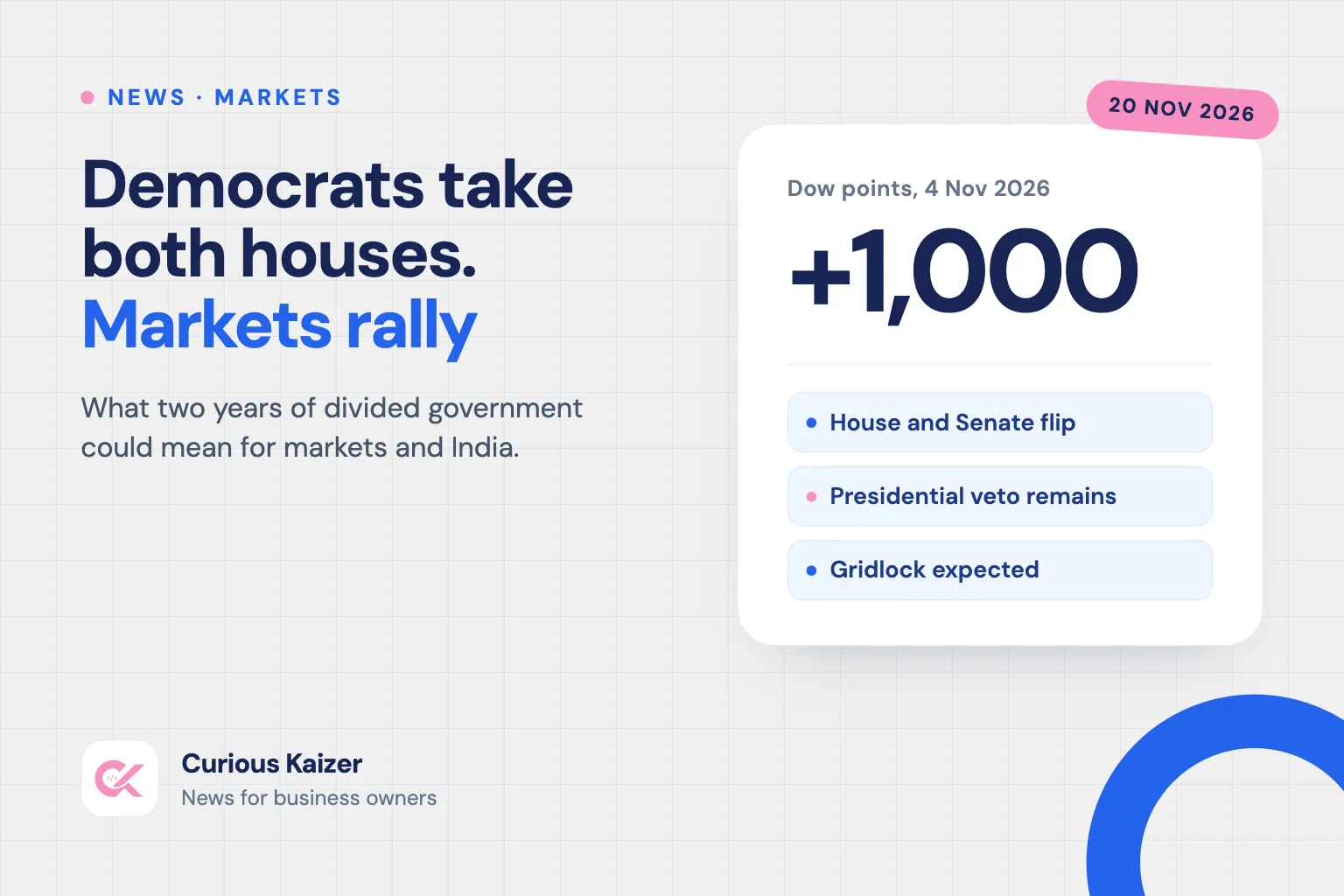
American voters handed Democrats control of both the House of Representatives and the Senate in the midterm elections on 3 November 2026, according to Associated Press race calls. Markets took it calmly, even cheerfully: the Dow Jones Industrial Average rallied more than 1,000 points the next day. With President Trump keeping his veto, most analysts expect two years of gridlock.
Key points
- Democrats won control of the House and the Senate on 3 November 2026, per AP calls.
- The Dow rallied more than 1,000 points on 4 November.
- The President keeps his veto, so divided government and gridlock are widely expected.
- Bills the crypto industry wanted, such as the CLARITY Act, face more uncertainty.
- For India, trade policy is the main thing to watch, since tariffs are largely set by the executive.
The result
Midterm elections fall halfway through a president's four-year term and decide all 435 House seats and about a third of the Senate. In 2026 Democrats gained control of both chambers. From January 2027, they will set the agenda in Congress, run its committees and control what reaches the President's desk.
Why markets rallied
Markets often like divided government because it makes sweeping changes less likely. With one party in the White House and the other in Congress, big tax or spending shifts become harder to pass, which reduces policy surprises. The Dow's 1,000-point rally on 4 November reflected relief that the result was clear. Not every market was happy: bitcoin, which had hoped for crypto-friendly laws, kept sliding.
What may change
- Legislation slows. Expect fewer major laws and more fights over budgets and the debt ceiling.
- Oversight rises. Congressional investigations of the administration usually increase under divided government.
- Executive action continues. Tariffs, sanctions and many regulations can still be changed by the administration without Congress.
- Crypto rules stall. The CLARITY Act, which already failed a Senate vote in September, faces a new and less certain path.
What it means for India
The biggest US decisions for Indian business this year, the tariff cut to 18% in February and the trade framework that followed, came from the executive branch, not Congress. That is unlikely to change. The main risks are indirect: US interest rates, the dollar and global market mood. For Indian exporters to the US, keep an eye on the interim trade agreement and on any tariff changes, which can happen quickly.
Questions readers ask
Who won the 2026 US midterm elections?
Democrats won control of both the House and the Senate on 3 November 2026, according to Associated Press race calls.
How did markets react to the midterms?
The Dow Jones Industrial Average rallied more than 1,000 points on 4 November 2026.
Will the midterms change US tariffs on India?
Not directly. Tariffs are largely set by the executive branch. The India–US trade framework agreed in February 2026 remains the main reference point.
Sources and method
We report what official releases, company filings and established news outlets published up to 20 November 2026, and say so where reports differ. Figures can be revised; check the original source before you act on them.
- Associated Press, 2026 midterm election race calls.
- US market coverage of the 4 November 2026 session.
- Reports on the India–US trade framework, February 2026.
This is news and general information for business owners, not investment, tax or legal advice.
Plan for a tougher market
When money gets dearer, every lead counts. We build websites that bring enquiries and CRMs that make sure none are lost.