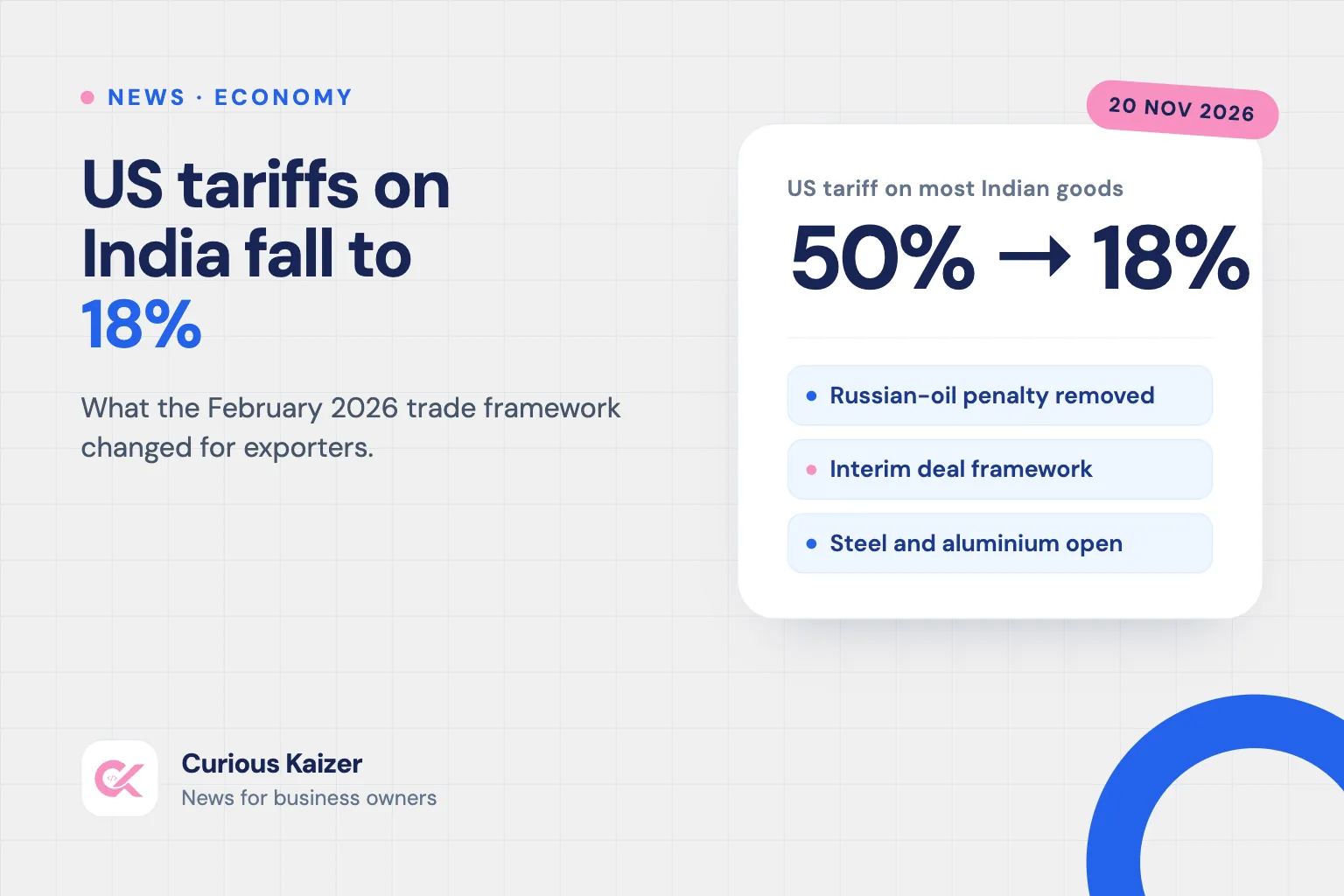
Indian exporters to the United States got relief in February 2026. On 2 February, President Trump cut the reciprocal tariff on Indian goods from 25% to 18% and removed an extra 25% penalty linked to India's purchases of Russian oil, taking the total from 50% to 18%. Days later the two countries released a framework for an interim trade agreement.
Key points
- The US cut its reciprocal tariff on India from 25% to 18% on 2 February 2026.
- It also removed the additional 25% penalty tied to Russian oil, so the total fell from 50% to 18%.
- India agreed to stop buying Russian oil, according to the announcements.
- A joint statement set out a framework for an interim agreement, with India cutting tariffs on US industrial goods and many farm products.
- Steel and aluminium remain unresolved.
What changed
| Component | Before 2 February 2026 | After |
|---|---|---|
| Reciprocal tariff | 25% | 18% |
| Russian-oil penalty | 25% | Removed |
| Total | 50% | 18% |
In return, India agreed to stop buying Russian oil and to lower tariffs on many US industrial goods and a range of farm products, under a framework for an interim agreement released in a joint statement shortly after. Some sectors, notably steel and aluminium, were left for later talks.
What it did for exports
A 50% tariff had made many Indian goods uncompetitive in the US, from textiles and gems to engineering products. At 18%, Indian exporters are closer to rivals in other Asian countries. India's merchandise exports hit a record $49.47 billion in October 2026, though higher prices and many markets played a part, not only the US.
What is still open
- Steel and aluminium tariffs remain a sticking point.
- The full interim agreement still has to be finalised and implemented in detail.
- Policy risk. US tariffs are set largely by the executive and can change quickly, as 2025 showed.
What exporters should do
Recalculate landed costs for US buyers at 18% and update price lists. Check your product's HS code against any sector-specific rules. Use the window to win back US customers lost during the 50% period, and build a direct online presence: an export-ready website with clear specifications, certifications and enquiry forms helps buyers find and trust you. Keep contracts flexible enough to handle another tariff change.
Questions readers ask
What is the US tariff on Indian goods now?
After 2 February 2026, most Indian goods face an 18% US tariff, down from a combined 50%.
Why was there a 50% tariff before?
A 25% reciprocal tariff plus an extra 25% penalty linked to India's purchases of Russian oil.
Is the India–US trade deal final?
A framework for an interim agreement was agreed. Some areas, including steel and aluminium, remain unresolved.
Sources and method
We report what official releases, company filings and established news outlets published up to 20 November 2026, and say so where reports differ. Figures can be revised; check the original source before you act on them.
- White House announcements on tariffs on India, 2 February 2026, as reported.
- India–US joint statement on a framework for an interim trade agreement, February 2026, as reported.
- Ministry of Commerce and Industry, trade data.
This is news and general information for business owners, not investment, tax or legal advice.
Sell to buyers abroad
We build export-ready websites with clear product specs, certifications and enquiry flows that international buyers trust.