What our published work is, and what carries over to an app
Our published case studies are web, commerce and operations systems, not App Store or Play Store apps. We say so upfront because most of the hard parts of an app sit behind the screen: accounts, payments, messaging, permissions and the admin tools your team uses. These are the parts we have built or offer, and where each one comes from.
| What your app needs | Where it comes from | What it means in an app |
|---|---|---|
| OTP login and KYC | Login with OTP, email and KYC is on the Full Software & App tier. Club Re Straddle has member profiles with KYC badges. | Phone sign-in, identity checks and verified account states. |
| Payments with Razorpay | The Total Fitness store takes payments through Razorpay and ships through Shiprocket. | Checkout, prepaid orders and order status for customers. |
| Member accounts and loyalty | Total Fitness has digital memberships and FitPoints loyalty, with 5% back on prepaid orders and memberships. | A member area, points balance and rewards. |
| QR passes and gate scanning | Club Re Straddle, a private club system, has QR passes, gate verification and an admin console. | A pass on the member's phone and a scanner screen for staff. |
| WhatsApp messaging | WatFix CRM uses the WhatsApp Cloud API with 247 ready templates in English, Hinglish and Hindi. | Order updates, reminders and support in the chat app customers already use. |
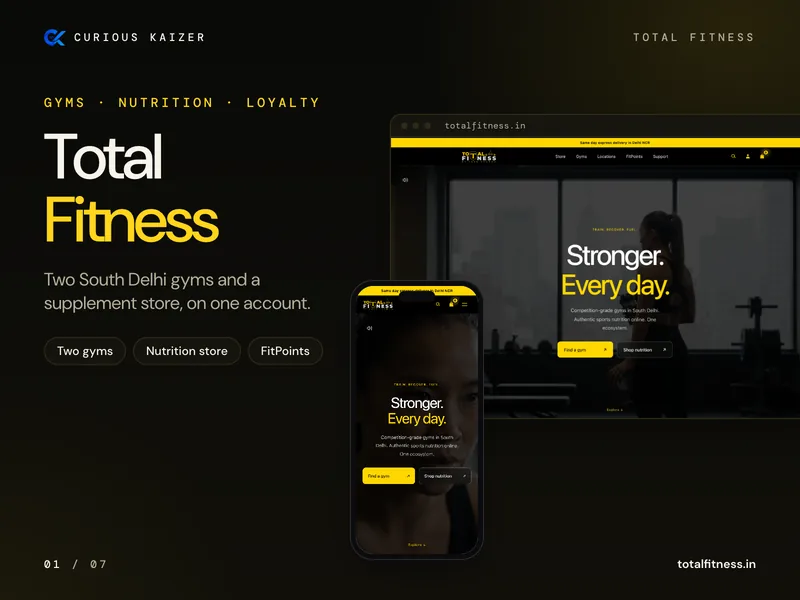
Total Fitness is a responsive website and store, shown here in a browser and on a phone. It is not a store app.
Read how accounts and loyalty fit together in the Total Fitness website case study, and how WhatsApp and lead data connect in the WatFix CRM case study.
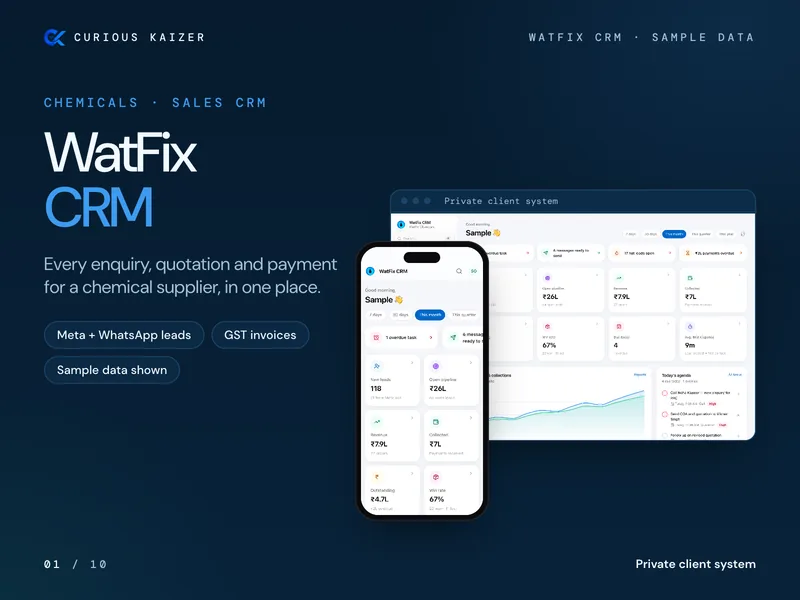
WatFix CRM screens show sample data, not client records. The live system is private.
Types of app we can plan and build
Start from the job the app does. That decides the screens, the backend and which platform makes sense.
- Customer ordering and commerce apps: catalogue, cart, UPI and card payments, delivery tracking and reorders.
- Membership and loyalty apps: member accounts, renewals, points and offers for gyms, clubs and retail brands.
- Booking and service apps: slots, reminders, cancellations and payment for clinics, salons and home services.
- Field and sales team apps: leads, visits, follow-ups and quotations for staff who are rarely at a desk.
- Staff and operations apps: stock checks, dispatch, approvals and QR scanning at a gate or counter.
- Startup MVPs: one core journey, released to test whether people will use it and pay for it.
Native, Flutter or PWA: how to decide
Most buyers do not need to choose a technology first. They need to know what each route costs them in budget, reach and upkeep. This table is the comparison we go through on a scoping call.
| Your question | Native (Swift, Kotlin) | Flutter | PWA |
|---|---|---|---|
| What do I get? | Separate iOS and Android apps | One codebase for iOS and Android apps | A web app people can add to their home screen |
| Is it in the stores? | Yes, both | Yes, both | Opened through a link, so no store review is needed |
| How does the budget compare? | Usually highest if you need both platforms | Usually lower than two native apps | Usually the lowest of the three |
| Which device features can it use? | The widest access, including new OS features first | Most common features, with plugins or native code for the rest | Narrower, and iPhone support differs from Android |
| How do updates reach users? | Through store release and user update | Through store release and user update | On the next visit |
| Choose it when | The app depends on heavy device use or one platform matters most | You want both stores from one team and one budget | You want to test demand, or users already reach you through links and WhatsApp |
React Native is another common cross-platform choice, but it is not in our published stack, so our cross-platform recommendation is Flutter. For Android app development alone, we would use Kotlin or Flutter. For iOS app development alone, Swift or Flutter. If your users mainly sit at a browser, a web application built for phones and desktops may serve you better than any store app.
Planning for Indian users
An app that works on a new phone on office Wi-Fi can still fail in the hands of your customers. We plan for these conditions in the scope, not after launch.
- UPI first: many Indian buyers expect to pay with a UPI app, so payment screens should handle the switch to that app and back. They also need a clear state for pending payments, because a customer may close the app before the result arrives.
- Hindi and mixed language: decide early whether you need full Hindi, Hinglish messages or only English. Text length, fonts and who translates updates all affect the build. HSV Auto Recycling is a bilingual English and Hindi site, and WatFix CRM has templates in all three.
- Low-end Android: limited storage and memory mean download size, image weight and animation need a budget of their own. Test on an inexpensive phone, not only on the team's own devices.
- Patchy networks: screens should load saved data, keep unsent work and retry safely, so that a dropped connection never causes a double payment or a lost form.
- OTP and WhatsApp habits: SMS OTP can arrive late, so plan for resend and fallback. Many customers will also respond faster on WhatsApp than to a push notification.
Backend and admin panel
The app your customers see is only one part of the project. Your team also needs somewhere to manage products, members, orders, refunds and support, and that is often where the operating value sits. Our backend development work covers the API, database, roles and integrations behind the app.
Depending on the project we use Node.js, NestJS, FastAPI or Django, with PostgreSQL, Supabase or Firebase for data. The Full Software & App tier includes a real-time database with daily backups, a custom UI and an admin portal. If the app is one face of a subscription product, read our guide to SaaS product development, because plans, accounts and billing need designing before the screens.
How store submission works
This is the general process on both stores. It usually takes longer than first-time founders expect, so plan for it in your launch date.
- Developer accounts: Apple charges an annual membership fee and Google a one-time registration fee, with current amounts on their sites. Organisation accounts usually need a D-U-N-S number, so start early. We suggest registering them in your business's name so the listings remain yours.
- Listing material: name, description, screenshots, icon, support contact and a privacy policy link.
- Data declarations: both stores ask what user data the app collects and why. Your answers must match how the app really behaves.
- Testing: Apple offers TestFlight and Google offers test tracks. Google's help pages say newer personal accounts need at least 12 testers opted in to a closed test for 14 consecutive days before applying for production access.
- Review: each store checks the app against its policies and may ask for changes. A rejection is normally fixed and resubmitted. No developer can promise approval or a date.
- Payment rules: physical goods and services can generally use a gateway such as Razorpay, while digital content sold inside an iOS app may have to follow Apple's in-app purchase rules. Check this before you fix your pricing model.
Pricing
We do not publish a separate price for mobile apps. The figures below are our published starting points, and a native or cross-platform mobile build is quoted after scoping. For market ranges and what pushes a budget up, read our guide to mobile app development cost in India.
| Option | Published price | Useful for |
|---|---|---|
| Prototype sprint | From $200, stated timeline 48 hours, one revision round | An interactive prototype to test or pitch an idea |
| Full Software & App tier | From $750, stated timeline 2 to 3 weeks | A production web app with OTP login, KYC, billing and an admin portal |
| SaaS or web app | From ₹33,900 ($1,000) | Custom software, including PWAs and responsive web apps |
| Dedicated engineering | From $350 per month | Ongoing work on a product roadmap |
| Native or Flutter mobile build | Quoted after scoping | Android and iOS apps for the stores |
See the full pricing page. Dates and scope are confirmed in the written proposal. Store fees and third-party services such as SMS and payment gateways are separate.
How we work and what you own
- Brief: you share the users, the main journey and any existing records or systems.
- Route: we recommend native, Flutter or a PWA, and say what we would leave out of the first release.
- Written proposal: a fixed price, a written scope and milestones.
- Design and build: screens first, then one working journey through the app, API and database, tested on real phones. See our UI and UX design service if design is a separate need.
- Launch: release through the store process above, or to your domain for a PWA.
- Handover: source code and a private repository handed to you. Support terms are confirmed in writing.
After launch, the code belongs in your repository and the store listings in your accounts, so a later change of developer does not mean starting again.
Questions buyers ask
Have you published an App Store or Play Store app?
No. Our published case studies are web, commerce and operations systems, so we do not have a store listing to show you. We can walk you through the login, payment, loyalty and QR work behind those systems, and how each part would carry over to your app.
How much does a mobile app cost with Curious Kaizer?
We do not publish a separate mobile app price. The published starting points are the Full Software & App tier at $750 and SaaS or web apps from ₹33,900 ($1,000 for international clients). A native or cross-platform mobile build is quoted after scoping, and the price is fixed in the written proposal.
Should I build for Android first or iOS first?
Look at who your users are and what they carry. Many Indian consumer products start on Android because of its reach, while some premium or international audiences lean towards iPhone. If you need both from the start, Flutter is usually the option to price first.
Do you build apps in Flutter, Swift and Kotlin?
Yes, our stack lists Flutter for cross-platform work, Swift for iOS and Kotlin for Android. We recommend one after looking at the device features, budget and audience in your brief.
Do you build in React Native?
React Native is not part of our published stack. If you are not tied to it, we would compare Flutter, native and a PWA for your project. If you already have a React Native codebase and need that framework continued, tell us at the start so we can say plainly whether we are the right team.
Is a PWA enough, or do I need a store app?
A PWA is often enough when people use the product for tasks such as checking records, booking or ordering, and when you want one codebase with instant updates. Choose a store app when you need deep device features, dependable background behaviour or a presence in the stores.
Can you add UPI payments and OTP login?
Yes. Login with OTP, email and KYC is on our Full Software & App tier, and Razorpay is in our stack and live on the Total Fitness store. Razorpay's UPI flows and an SMS provider for OTP are confirmed during scoping, and the running fees sit with those providers.
Do you work only with businesses in Delhi?
No. We are based in Delhi and work with businesses across Delhi NCR and the rest of India, and deliver remotely to clients in the UAE, the US and the UK. Calls, reviews and handover all work remotely, so your location does not change the process.
Talk to us about your app
Send the main task your users need to complete, who they are and the phones they use. We will tell you which route fits and what the first release should include.
- Phone: +91 85951 21436
- WhatsApp: +91 85951 21436
- Email: jaigoel2206@gmail.com
- Project brief: contact form