SaaS products we have built: StaySphere PMS and CuriousCRM Pro
Two examples from our portfolio show the product work behind this page. Neither is presented as a business with customers or revenue, because we do not publish customer counts or revenue for either one.
StaySphere PMS
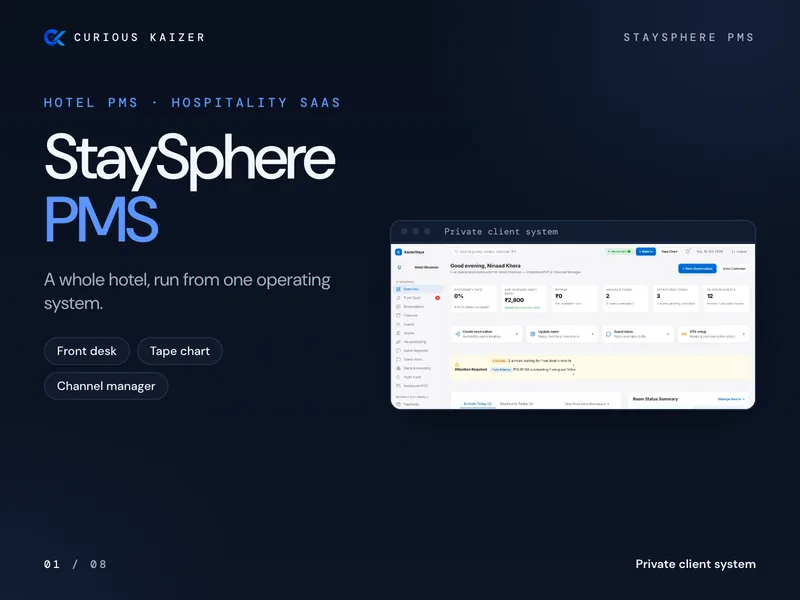
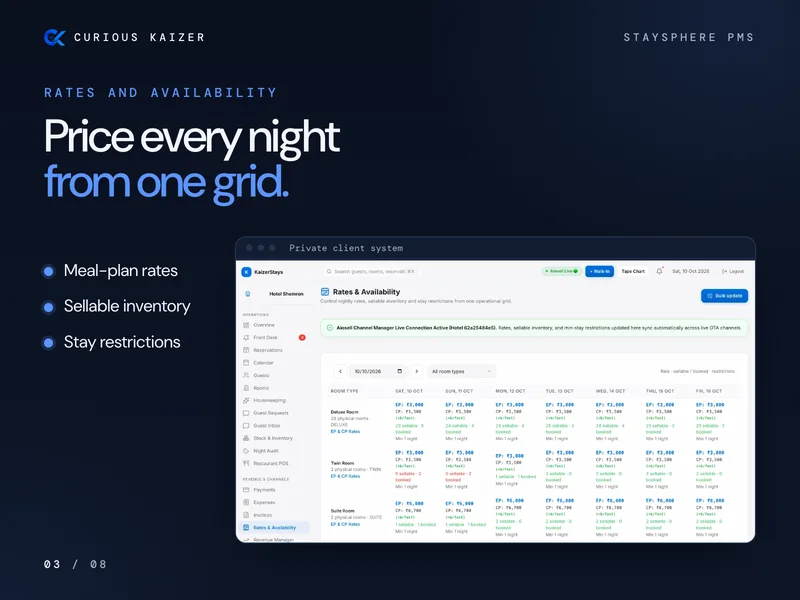
StaySphere PMS is a hotel management workspace with a room status grid, front desk check-ins, guest folios and channel rates. It is built with React, TypeScript, Node.js and PostgreSQL. It is a private client system, so we do not link it or describe its data. What it shows is the core of a SaaS build: a PostgreSQL database, a Node.js API and a data-heavy React interface.
CuriousCRM Pro
CuriousCRM Pro is our in-house CRM product, written in Vanilla JS, with contact management, a kanban pipeline and email integration on monthly plans. It is a useful reference for dashboard and pipeline screens before you scope your own.
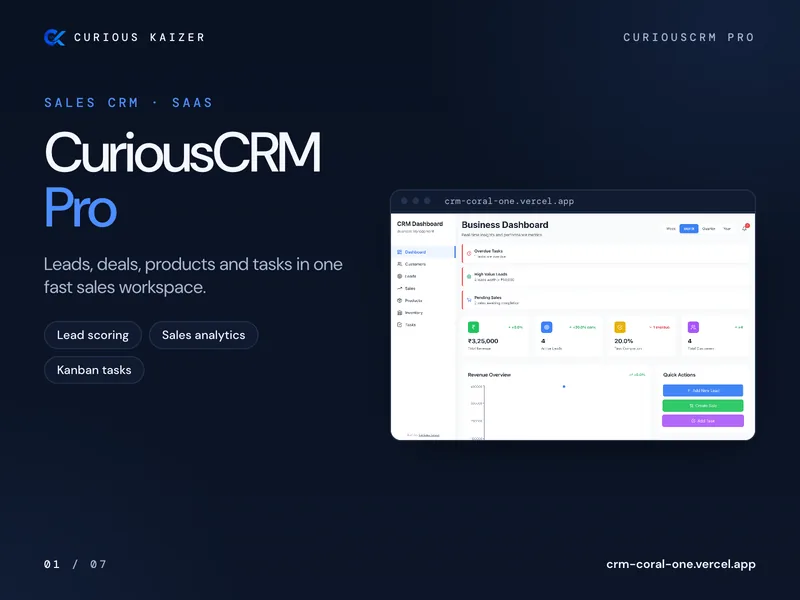
Screens are shown for the interface only. Nothing on them should be read as a customer count or a revenue figure.
What a SaaS MVP should include
A scoping call with an MVP development company in India goes further when you arrive with one type of customer, one job they will pay for and one price to test. We split the first release from the second using the list below. If your product is closer to an internal tool than something sold to many organisations, our web application development page is the better fit.
| Area | In the first release | Can wait |
|---|---|---|
| Login | Email login, invitations, and OTP verification where your users expect it | Single sign-on for large customers |
| Organisations | One organisation per sign-up, with an owner | One person in several organisations, and an organisation switcher |
| The core job | The one workflow customers pay for, from start to a visible result | Configurable fields, custom reports, bulk tools |
| Plans and billing | One or two plans, checkout, subscription status, receipts and failed-payment notices | Coupons, add-ons, usage-based pricing |
| Roles | Owner, admin and member | A custom role builder |
| Admin console | Organisation list, plan status, suspend and reinstate, logged support access | Revenue dashboards and cohort reports |
| Data control | Export and deletion of an organisation's data on request | Self-serve portability tools |
The test for each row is whether an early customer would notice it missing. If not, it waits. If a packaged tool or a no-code app already covers your first customers, start there.
A responsive web app or PWA is part of our published offer, so an MVP does not need an app store release on day one. For Android and iOS apps, see our mobile app development company page.
Multi-tenancy: keeping one customer's data away from another's
In a SaaS product many organisations share one application, so the central security question is whether a user from one organisation can ever read another's records. Choose the tenancy model before the first table exists, because changing it later means migrating live data.
| Model | How it works | Suits | Watch for |
|---|---|---|---|
| Shared database, tenant ID on every row | All organisations sit in one PostgreSQL schema, and every row carries a tenant ID. | Most MVPs, and products with many small organisations. | Every query must filter by tenant. Enforce it in server code and, where it fits, with PostgreSQL row-level security as a second line of defence. |
| Schema per tenant | One database, with a separate schema for each organisation. | A smaller number of organisations that want stronger separation. | Each release runs migrations once per schema, so deploys slow down as tenants grow. |
| Database per tenant | A separate database for each organisation. | A few large customers with contractual separation needs. | Higher hosting and operations cost, and reports across tenants need extra work. |
For most first releases a shared database with a tenant ID on every table is the sensible start. Whatever the model, enforce the boundary on the server for every query, export, file download and background job, because hiding records in the screen is not enough. Settle during scoping whether one person can belong to several organisations, how invitations, suspension and ownership transfer work, and who on your team can open a customer's account and with what record.
Subscription billing with Razorpay and Stripe
A payment provider takes the money, but your application decides who gets access to what, and for how long. We work with Razorpay, which is also part of the Total Fitness store build, and with Stripe. Fees, eligibility and recurring-payment rules change, so check each provider's current terms for your business.
| Question | Razorpay | Stripe |
|---|---|---|
| Where it usually fits | Collecting rupees from customers in India, with UPI, cards and netbanking. | Collecting card payments in foreign currencies from overseas customers. |
| Recurring charges | Subscription tools, subject to RBI rules for recurring payments on Indian cards and UPI. | Stripe Billing for plans, invoices and renewals. |
| What to check first | That your business and bank account are accepted, and which payment methods are enabled. | That your business is eligible for an account, and which currencies you may charge in. |
The billing events your product has to handle
- A trial starts and ends.
- The first payment succeeds or fails.
- A renewal fails, with a retry period and a clear message before access is restricted.
- A customer upgrades, downgrades or changes seats part-way through a period.
- A subscription is cancelled now or at period end, and later reactivated.
- A payment is refunded or disputed.
Webhook events can arrive twice, late or out of order, so each one is processed idempotently and reconciled against the provider's own records. Tie features to entitlements, a single table of what each plan allows, and not to plan names scattered through the code. Card numbers are typed into the provider's checkout fields, so your servers never store them.
If you charge overseas customers in dollars or pounds, you may need a second provider account. Decide in scoping whether launch needs one provider or both, since two providers means two sets of webhooks to test and two sets of payouts to reconcile. Invoices for Indian customers usually need GST details. Our WatFix CRM issues GST invoices with CGST and SGST from the same record as the quotation, so the logic is familiar, but your accountant should confirm what yours must show.
Roles, permissions and the admin console
Permissions are enforced on the server, not only hidden in the screen. These are the roles a SaaS MVP usually needs, and you may need fewer.
| Role | Can do | Notes |
|---|---|---|
| Platform admin (your team) | See every organisation, suspend or reinstate it, change a plan, open support access. | Kept out of the customer-facing app. Every use is logged. |
| Organisation owner | Manage billing, invite and remove users, delete the organisation. | Every organisation needs an owner, and a defined ownership transfer. |
| Organisation admin | Manage users and settings, without billing. | Optional. Merge it into owner until the two roles really differ. |
| Member | Use the core workflow within what the plan allows. | The default role for invited users. |
The admin console lets you run the product without opening the database. A first version has organisation search, plan and payment status, suspend and reinstate, a webhook log with replay, usage against plan limits and a record of support access. Reports and approval screens beyond it fall under custom software development.
What to test before you scale
Scaling an unproven foundation multiplies its faults. Acceptance on our builds includes tenant isolation, billing event replay, invitation expiry and restore checks. Run the full list below before a launch campaign, a large customer or an investor demo.
| Test | How to run it | Passing looks like |
|---|---|---|
| Tenant isolation | Create two organisations with overlapping record numbers. Change IDs in requests to read, edit, export and download files across them. | Every attempt is refused, including exports and background jobs. |
| Roles and invitations | Change a user's role, then repeat an action with their old session. Open an expired invitation link and a used one. | The new permission applies at once, removed users lose access and both links are refused. |
| Billing replay | Send the same webhook twice, then out of order. Fail a renewal, cancel, resume and refund. | Access and invoices match the provider's records after every step. |
| Backup restore | Restore a backup into a clean environment with sample data. | The app runs, and you know how long the restore takes. |
| Deletion and export | Delete one test organisation and export another. | Deleted data is gone from the database, files and search, or its retention is documented. |
| Usage limits | Call the endpoints that use paid external APIs in a loop. | Rate limits trigger before the bill does. |
| Slow screens | Load realistic row counts for your largest organisation and open the heaviest lists. | The slowest query is found and indexed before a customer meets it. |
| Monitoring | Break something on purpose in staging. | An alert reaches a person with enough detail to act, and logs hold no customer content. |
Before a wider launch, invite a small agreed pilot group, measure whether they finish the core task and where they fail, and collect product feedback with their consent.
SaaS development price in India
These are published starting points from our pricing page. A SaaS quote depends on the roles, billing providers, integrations and admin tools in scope.
| What you buy | Published price | Fits when |
|---|---|---|
| SaaS or web app, custom software | from $1,600 | You want a product scoped around your workflow and users. |
| AI automation | from $600 | Your product adds AI steps such as routing or summaries. |
| Managed cloud hosting | from ₹2,500 per month, with ₹5,000 and ₹8,000 plans | You want us to run the hosting after launch. |
| Mobile app | No separate published price, quoted after scoping | You need Android or iOS apps on top of the web product. |
Dates and scope are confirmed in the written proposal. Razorpay, Stripe, email and SMS providers charge their own fees, separate from our build price, so add them to your running costs.
How the build runs, and what you own
SaaS projects are fixed price with a written scope, and milestones are confirmed in the proposal. The work follows these stages:
- Scope and architecture, including the tenancy model, roles and billing plan.
- UX and UI design.
- Frontend build.
- Backend and database.
- Auth, billing and integrations such as Razorpay and Stripe.
- QA, launch and handover.
After launch you have source code handover and private repository handover. Support terms are confirmed in writing, so you know what is covered before you sign. The site that explains your product, with its pricing and sign-up pages, is separate work: see website design for startups, which can run alongside the build.
Questions about SaaS development in India
How much does SaaS development cost in India?
Our published starting price for a SaaS or web app is from $1,600. Tenancy, billing providers, roles and admin tools are scope items, so the final fixed price is set in a written proposal after scoping. Razorpay, Stripe and email provider fees are separate from the build price.
How long does it take to build a SaaS MVP?
Dates and scope are confirmed in the written proposal after scoping. A product with several roles, two billing providers or many integrations needs more time than a single-purpose app.
What should a SaaS MVP include?
The one workflow customers pay for, login, an organisation account with an owner, one or two paid plans, basic roles, a small admin console and emails for invitations and receipts. Coupons, usage-based pricing and custom roles can wait.
Do I need multi-tenancy from the start?
If you sell to organisations that each have their own users and data, yes. Put a tenant ID on every record from the first table, because adding it later means migrating live data. If you sell to individuals, you may not need organisation accounts yet.
Should I use Razorpay or Stripe for subscriptions?
Razorpay usually fits customers paying in rupees in India, and Stripe usually fits card payments in foreign currencies. Eligibility, fees and recurring-payment rules depend on your business, so check each provider's current terms. Decide during scoping whether launch needs one or both, because it changes the webhook and reconciliation work.
Which SaaS products have you built, and do they have paying customers?
Our portfolio lists StaySphere PMS, a hotel management workspace that is a private client system, and CuriousCRM Pro, our in-house CRM product with monthly plans. We do not publish customer counts or revenue for either, and this page does not claim them. They show the product and engineering work we can walk you through on a call.
Do we own the SaaS source code?
Source code handover and private repository handover are published terms on our pricing page. Support terms after launch are confirmed in writing.
Can you also build the mobile app for our SaaS product?
A responsive web app or PWA is part of our published offer, so an MVP can start there. Native or cross-platform mobile builds are quoted after scoping and have no separate published price.
Talk to us about your SaaS MVP
Send the customer you are building for, the job they pay for, the plans you expect to charge and any tools you need to connect. We work remotely from Delhi with clients across India, and in the UAE, US and UK.
- Phone: +91 85951 21436
- WhatsApp: +91 85951 21436
- Email: jaigoel2206@gmail.com