Where we stand before you read on
Flutter is in our published stack, with Swift for iOS and Kotlin for Android. React Native is not. We are a Flutter team comparing Flutter with a framework we do not sell, so weigh our lean towards Flutter with that in mind.
Our published case studies are web, commerce and operations systems, not App Store or Play Store apps, so we have no store listing to show you. This guide rests on the official documentation of both frameworks and on named public surveys, linked where we use them and listed under Sources. Where we give an opinion, we say so. For our own app work, see mobile app development in Delhi.
Flutter or React Native: a decision table
Find the row closest to your situation. The last column is our reasoning, not a measurement, so check it against the sections that follow.
| Your situation | Lean towards | Why |
|---|---|---|
| You need Android and iOS from one budget and want a custom, brand-led look | Flutter | One codebase draws the same interface on both phones, so the design is built once. |
| Your team or your hires already work in React and TypeScript | React Native | Their skills carry over, and public surveys show a much larger pool of people who know JavaScript. |
| You run a React web app and want to share logic with a mobile app | React Native | Both sides use one language, so some code and habits can be shared. How much depends on how the web app was built. |
| You want a mobile app and a web app, and may want desktop later | Flutter, with a caveat | Flutter lists web and desktop support, but its web support suits app-like screens, not content pages that must rank in search. |
| You need new platform features on release day, depend on heavy device use, or only one platform matters | Native (Swift or Kotlin) | Native code reaches the platform directly, with no framework or plugin in between. |
| People mostly check records, book or order, and arrive through a link or WhatsApp | A PWA | No store review, updates reach users on their next visit, and it is one web codebase. |
| An app already exists in one framework and works | Stay with it | A rewrite costs money and risks new bugs. Change only for a reason you can name. |
| You are still testing whether anyone wants the idea | A prototype first | Test the screens and flow first. The framework can follow the answer. |
No row says always. If two rows fit you, the cheaper test is a small prototype built before you commit.
The two frameworks side by side
These facts come from each framework's official site and repository, read on 2 November 2026.
| Topic | Flutter | React Native |
|---|---|---|
| Backed by | Google supports and uses it. | Meta released it in 2015 and has maintained it since. |
| Language | Dart | JavaScript or TypeScript, with React |
| How screens are drawn | Flutter draws its own widgets on the screen. | React components map to the platform's native controls. |
| Official platforms | Android, iOS, web, Windows, macOS and Linux, per its supported platforms page. | Android and iOS in the core. Other platforms come from partner and community projects, per its platforms page. |
| Licence | BSD-3-Clause, per its GitHub repository. | MIT, per its GitHub repository. |
The third row explains most of what follows. Flutter paints the screen itself, while React Native asks the phone to show its own controls.
Performance
Both are fast enough for most business apps. We have not run a head-to-head benchmark, so we do not quote one. What the documentation does show is how each is built.
Flutter compiles Dart to native machine code, according to Flutter's site. Its Impeller renderer is the default on iOS and on Android API 29 and above, and it prepares its shaders when the engine is built instead of while the app runs, according to the Impeller documentation. React Native's New Architecture has been the default since version 0.76. Its JavaScript Interface lets JavaScript hold a reference to a C++ object and call its methods directly, without the serialisation cost of the older asynchronous bridge, according to the architecture documentation.
In our view, an app is usually slow because of its own code, oversized images or a slow API, not because of the framework. Ask any agency, us included, to run a prototype on a budget Android phone of the kind your customers carry.
Hiring pool in India
We have no sourced count of Flutter or React Native developers in India, so we will not invent one. Public surveys are global, not India only, but they show the shape of the two pools.
- In the Stack Overflow Developer Survey 2024, 9.4% of all respondents listed Flutter and 8.4% listed React Native. Among professional developers the figures were 9.4% and 9%.
- In the 2025 survey, 66% of all respondents listed JavaScript and 43.6% listed TypeScript, against 5.9% for Dart.
Read together, the two frameworks have communities of similar size, while React Native draws on a much larger pool of people who already know its language. That is not the same as a larger pool of finished mobile developers. A React web developer still has to learn navigation, native modules and store release. Flutter's own guide for React Native developers calls Dart an easy language to learn, which is Google's claim and not a measurement.
Whichever you choose, ask a candidate or an agency for apps they have released and a sample of their code. The person matters more than the logo.
Cost
Both frameworks are free to use, so the framework itself rarely decides your budget. What moves a mobile quote is the number of screens, the backend and admin panel behind them, integrations such as payments and OTP login, and how many device features you need.
Cross-platform saves money where Android and iOS share a design and logic, because one team builds one codebase. It does not remove testing on both platforms, store accounts and listings, or extra work for a feature that needs native code. Compare two quotes only when they list the same screens, the same platforms and the same backend.
Our own starting prices are in the table further down. Our mobile app development cost guide for India goes through what moves a mobile quote.
User interface and look
Flutter draws every control itself, as its guide for React Native developers explains, so a button looks the same on a budget Android phone and on an iPhone unless you design otherwise. That suits a strong brand look and unusual layouts. React Native's site says its components render to the platform's own native UI, so screens take on the look and behaviour of each platform, which suits an app that should feel familiar on each phone. Either framework can produce either result. What differs is the starting point and the work each needs.
Because Flutter draws its own controls, matching a new system look is work for the framework or for your team. With React Native the controls come from the phone. Ask any agency how it handles a new Android or iOS release.
Web and desktop reach
Flutter's supported platforms page lists Android, iOS, Windows, macOS, Linux and the Chrome, Firefox, Safari and Edge browsers. Its web documentation adds a limit: web support suits app-like screens, while text-rich static content such as blog articles fits the document-centric web better. A Flutter web app therefore suits a dashboard behind a login, not pages that must rank in search.
React Native's core targets Android and iOS. Its platforms page credits Windows, macOS, visionOS and OpenHarmony to partner projects, and TV platforms, the web through React Native Web and a Skia-based renderer to community projects. Expo describes one JavaScript or TypeScript project for Android, iOS and web. Each extra platform has its own maintainers, so check it is current before you rely on it.
For most Indian businesses the simpler question is whether you also need a website or a web app. That is a separate build, and our web application development page covers it.
Access to native phone features
Camera, location, notifications and payments are the usual needs. Both frameworks can reach any feature the phone exposes. The question is whether a maintained package already does it or someone has to write native code.
Flutter calls Kotlin or Swift code through platform channels, can generate type-safe bridging code with the Pigeon package, and shares plugins on pub.dev. React Native uses Turbo Native Modules: you write a typed specification in TypeScript or Flow, Codegen produces the native interfaces, and you implement them in Kotlin or Java for Android and Objective-C++ for iOS.
Before you choose, list every device feature and third-party SDK in your brief, then check that each has a maintained package for your framework. Some payment, KYC and device vendors publish native Android and iOS SDKs first, so look for a documented Flutter or React Native package. Budget native code for any feature that lacks one.
When to go native instead
Native means Swift for iOS and Kotlin for Android, built as two separate apps. It is worth the extra cost when:
- one platform matters most to your users or your revenue;
- the app depends on heavy device use, such as Bluetooth accessories, constant background behaviour, camera processing or augmented reality;
- you need new Android or iOS features on release day.
Native costs more because you build and maintain two apps. For Android alone we would use Kotlin or Flutter, and for iOS alone, Swift or Flutter.
When a PWA is enough
MDN describes a progressive web app as an app built with web technologies that gives a user experience like a platform-specific app. It can be installed on the device, can work offline, can show notifications, and runs on multiple platforms from a single codebase.
A PWA is often enough when people use the product to check records, book or order, when customers arrive through a link or WhatsApp, and when you want updates to reach everyone on their next visit. Choose a store app when you need deep device features, dependable background behaviour or a presence in the app stores.
Support for each PWA feature differs by browser and operating system. Test every feature you need on the Android and iPhone versions your users carry, using MDN's compatibility tables. PWAs and responsive web apps are part of our published offer, with SaaS or web apps from ₹33,900.
What our work shows, and what it does not
Total Fitness covers two gym branches in New Delhi. Its store runs on headless Shopify with 57 supplements, digital memberships and FitPoints loyalty, which gives 5% back on prepaid orders and memberships. Payments go through Razorpay, shipping through Shiprocket, and the site is hosted on Vercel.
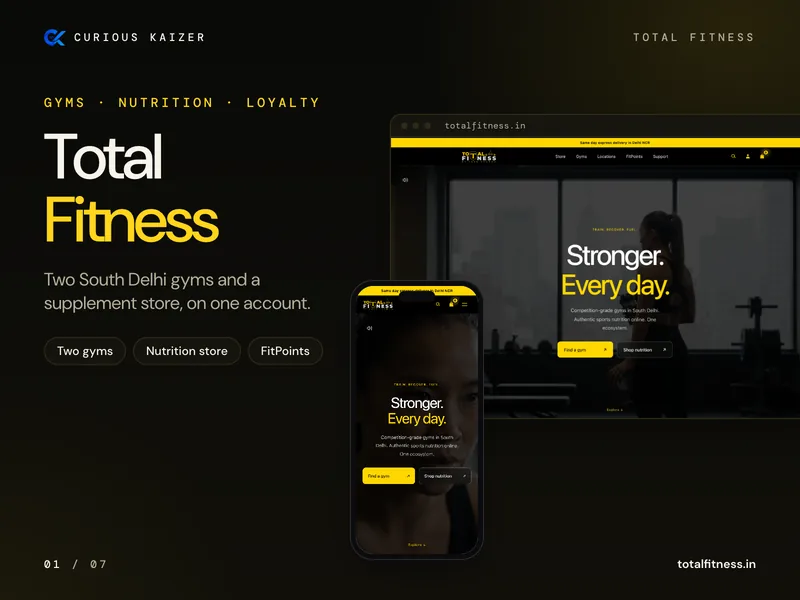
This is a responsive website and store, not a store app. We show it because an app for a business like this would sit on the same accounts, payments and orders. The framework decides how the screens are built. It does not decide whether those parts work. More work is on our portfolio.
What our published prices cover
We have no separate published mobile price. These are the starting points on our pricing page that apply to an app project.
| What you buy | Published price | Fits when |
|---|---|---|
| Prototype sprint | from $200, stated timeline 48 hours, one revision round | You want to test an idea's screens and flow before a full build. |
| Full Software & App tier | from $750, stated timeline 2 to 3 weeks | You want a defined production build, with OTP login, KYC and billing available in this tier. |
| SaaS or web app, custom software | from ₹33,900 ($1,000 for international clients) | A PWA or a responsive web app is enough for the job. |
| Flutter, Swift or Kotlin mobile build | Quoted after scoping | You need an app in the stores. |
Dates and scope are confirmed in the written proposal.
How we run the choice, and what you own
Our projects are fixed price, with a written scope and milestones confirmed in the proposal. For an app we would work in this order:
- Start from your users, the phones they carry and the features you cannot do without.
- Recommend Flutter, native or a PWA, explain why, and say what we would leave out of the first release.
- Write the scope and the fixed price.
- Build the screens, the backend and the admin panel, and connect payments, login and messaging as scoped.
- Test, release and hand over.
If React Native suits you better, or you already have a React Native app, tell us at the start so we can say plainly whether we are the right team. After launch you have source code handover and private repository handover, as listed on our pricing page. Support terms are confirmed in writing.
Flutter vs React Native questions
Is Flutter or React Native better in 2026?
Neither is better for every project. Flutter suits a custom look on Android and iOS from one codebase. React Native suits teams already working in React and TypeScript. We build in Flutter and not in React Native, so check our lean against the decision table.
Is Flutter faster than React Native?
We have not run a head-to-head benchmark and do not quote one. Flutter compiles Dart to native machine code and draws with its Impeller renderer, while React Native's New Architecture, the default since version 0.76, replaces its old asynchronous bridge. For most business apps, your own code, your images and the speed of your API matter more.
Which has more developers in India, Flutter or React Native?
We have no sourced India headcount, so we do not quote one. In the global Stack Overflow Developer Survey 2024, 9.4% of respondents listed Flutter and 8.4% listed React Native. In 2025, 66% listed JavaScript, which React Native uses, against 5.9% for Dart.
Is Flutter or React Native cheaper to build with?
Both are free to use, so cost comes from scope: screens, backend, integrations and device features. We have no separate published mobile price. Our Full Software & App tier starts from $750 and a SaaS or web app from ₹33,900, and a mobile build is quoted after scoping.
Do you build in React Native?
No. React Native is not part of our published stack, which lists Flutter, Swift and Kotlin for mobile. If you already have a React Native app or need that framework, tell us at the start so we can say plainly whether we are the right team.
Can one Flutter or React Native app also run on the web?
Both can, with limits. Flutter's documentation says its web support suits app-like screens, and that blog-style content fits the document-centric web better. React Native reaches the web through Expo or community projects such as React Native Web. A marketing site that must rank in search is better built as a normal website.
Is a PWA enough, or do I need a store app?
A PWA is often enough when people use the product to check records, book or order, and arrive through a link. Choose a store app for deep device features, dependable background behaviour or a presence in the app stores. Test each PWA feature on the Android and iPhone versions your users carry, because support differs.
Sources
We read these pages on 2 November 2026. Versions, platform lists and survey figures change, so check the source before you rely on a number.
- Flutter home page
- Flutter supported platforms
- Flutter Impeller rendering engine
- Flutter on the web
- Flutter platform channels
- Flutter for React Native developers
- React Native home page
- React Native architecture overview
- React Native out-of-tree platforms
- React Native Turbo Native Modules
- Expo documentation
- Flutter repository and licence on GitHub
- React Native repository and licence on GitHub
- Stack Overflow Developer Survey 2024, technology
- Stack Overflow Developer Survey 2025, technology
- MDN, progressive web apps
Talk to us about your app
Send your users, the phones they carry and the features you cannot do without. We work remotely from Delhi with clients across India, and in the UAE, US and UK.
- Phone: +91 85951 21436
- WhatsApp: +91 85951 21436
- Email: jaigoel2206@gmail.com