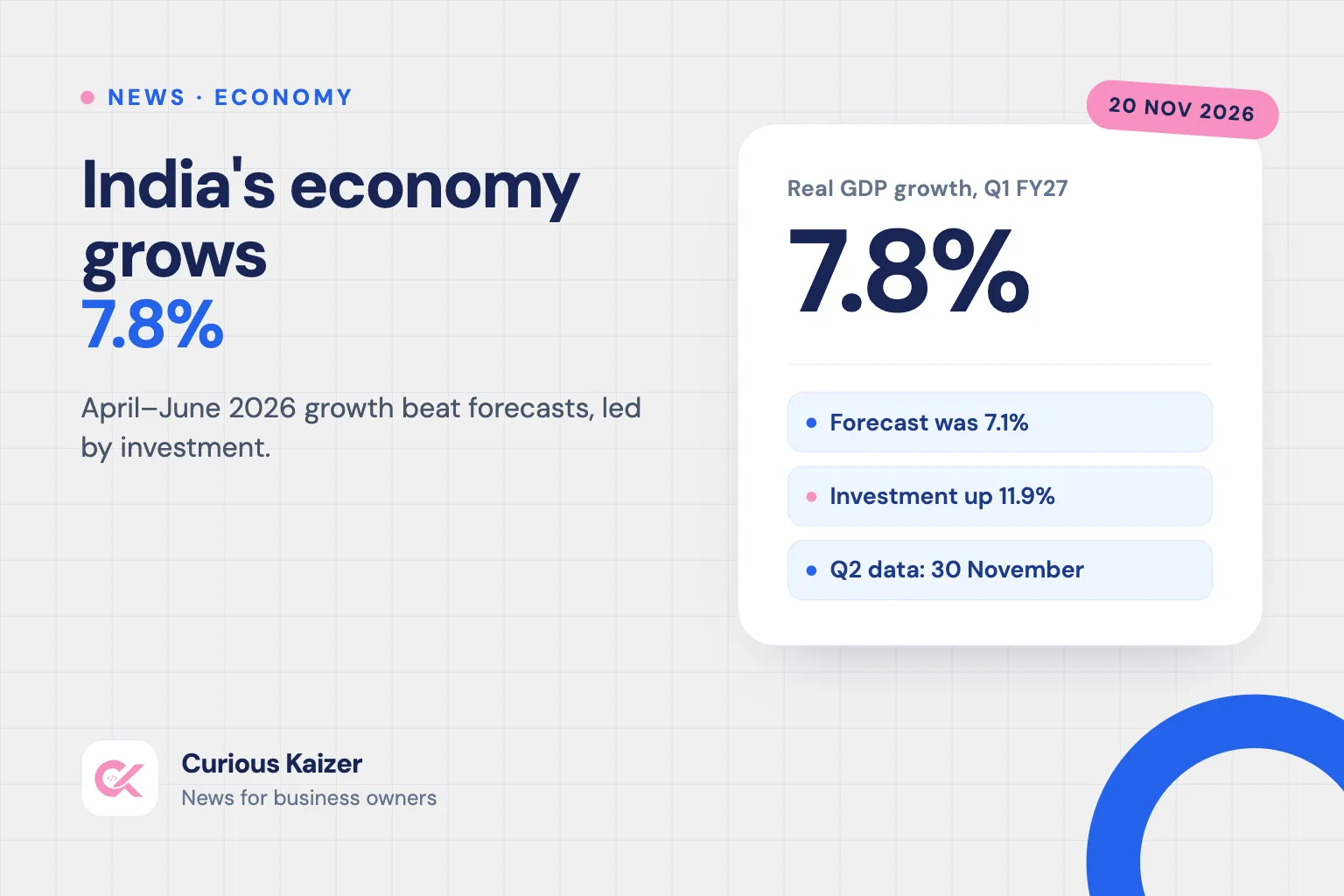
India's economy grew faster than expected in the first quarter of the 2026–27 financial year. Real GDP rose 7.8% from a year earlier in April to June 2026, according to official estimates, against 7.1% in a Reuters poll of economists and the RBI's own 7.0% projection. Investment was the standout. The next figure, for July to September, is due on 30 November.
Key points
- Real GDP grew 7.8% in April–June 2026, against a Reuters poll forecast of 7.1% and an RBI projection of 7.0%.
- Growth in the previous quarter was 8.6%.
- Nominal GDP rose about 10.3% to roughly ₹88.27 lakh crore for the quarter.
- Gross value added grew 8.2%, and investment (gross fixed capital formation) grew about 11.9%. Mining contracted.
- Data for July–September 2026 will be released on 30 November, just before the RBI meets.
The numbers
| Measure | Growth or level |
|---|---|
| Real GDP growth | 7.8% |
| Previous quarter (January–March 2026) | 8.6% |
| Gross value added | 8.2% |
| Investment (gross fixed capital formation) | About 11.9% |
| Nominal GDP | Up about 10.3%, to roughly ₹88.27 lakh crore |
What drove it
Investment led the way, with gross fixed capital formation up about 11.9%, reflecting government infrastructure spending and private projects. Services and manufacturing held up well. Mining was the weak spot, contracting in the quarter. The strength came despite the oil shock that began in late February, though most economists expect its effects, through higher costs and interest rates, to show more in later quarters.
Reasons for caution
Strong growth and high inflation together are what pushed the RBI to raise rates in October. A fast-growing economy can absorb a rate increase, and the RBI's view is that inflation is now the bigger risk. Nominal growth of about 10.3% also matters for businesses, because it is closer to the growth in rupee revenues most firms actually see.
What it means for business
Demand is still there. Growth near 8% means more customers, more projects and more competition for attention. The firms that win in a fast-growing but costlier economy are the ones that convert demand efficiently: fast websites, quick replies to enquiries and tight follow-up. Watch the 30 November release for signs of slowdown before planning big expansions.
Questions readers ask
What was India's GDP growth in Q1 FY27?
Real GDP grew 7.8% year on year in April–June 2026, according to official estimates.
Was the GDP growth better than expected?
Yes. A Reuters poll had forecast 7.1%, and the RBI had projected 7.0%.
When is the next GDP release?
Estimates for July–September 2026 (Q2 FY27) are due on 30 November 2026.
Sources and method
We report what official releases, company filings and established news outlets published up to 20 November 2026, and say so where reports differ. Figures can be revised; check the original source before you act on them.
- Ministry of Statistics and Programme Implementation, GDP estimates for Q1 2026–27.
- Reuters poll of economists and coverage of the GDP release by Indian business media.
This is news and general information for business owners, not investment, tax or legal advice.
Plan for a tougher market
When money gets dearer, every lead counts. We build websites that bring enquiries and CRMs that make sure none are lost.