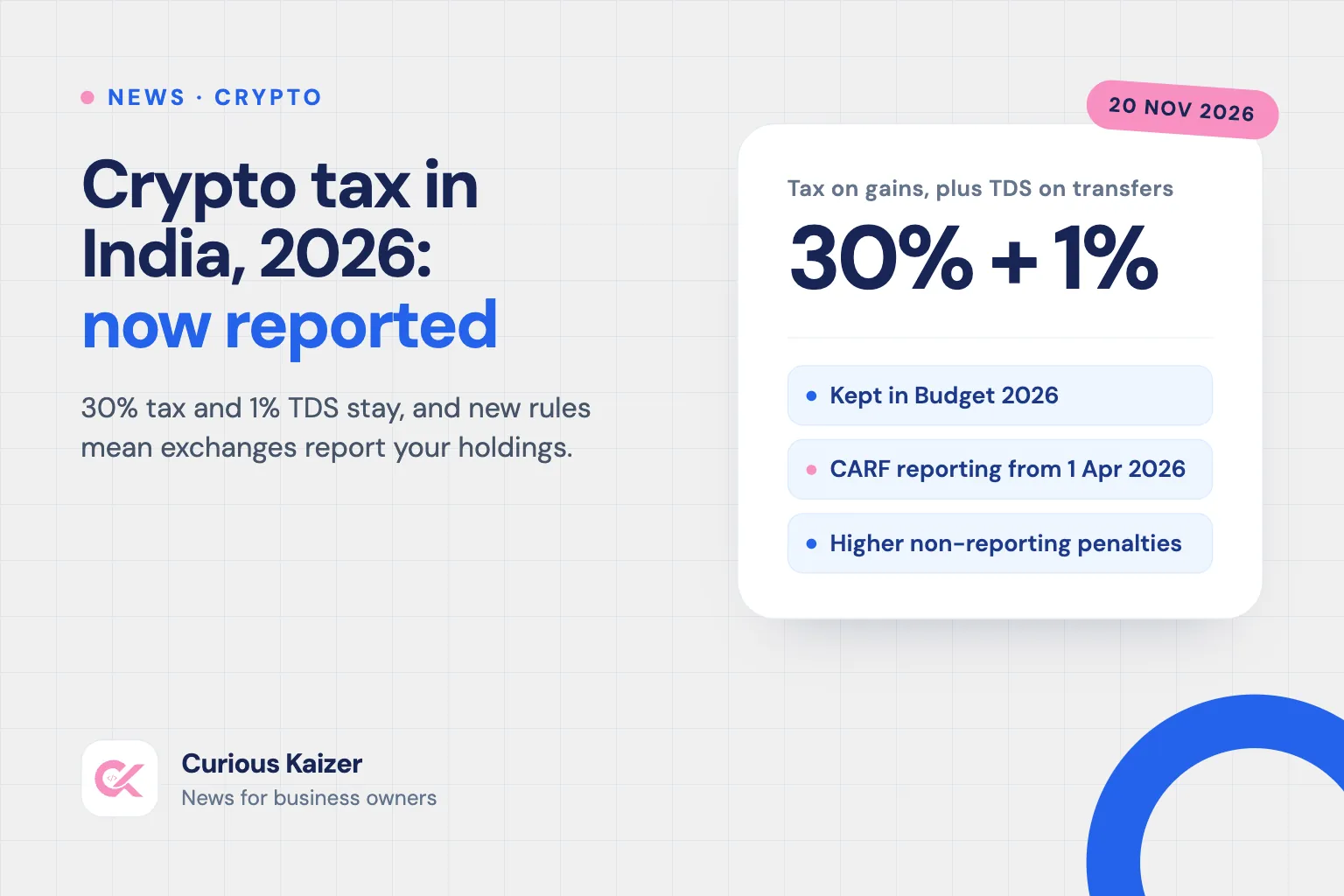
India's crypto tax rules did not get easier in 2026. The Union Budget kept the flat 30% tax on gains from virtual digital assets and the 1% TDS on transfers, and added higher penalties for failing to report them. New rules adopted in March also bring crypto into an international reporting system, so exchanges will share account information with the tax department.
Key points
- Gains from virtual digital assets (VDAs), including crypto, are taxed at a flat 30%, plus surcharge and cess. Losses cannot be set off against other income.
- A 1% TDS applies on transfers of VDAs above set limits.
- Budget 2026 kept both and raised penalties for not reporting VDA transactions.
- On 5 March 2026 the CBDT amended reporting rules to implement the Crypto-Asset Reporting Framework (CARF). Domestic reporting applies from 1 April 2026.
- KoinX estimates that about 72.7% of Indian crypto trading volume in FY25, around ₹51,252 crore, happened on offshore platforms.
The tax rules in brief
| Rule | What it means |
|---|---|
| 30% flat tax on gains | Applies regardless of your income slab or how long you held the asset |
| No deductions except cost | Only the purchase cost can be deducted; fees and other expenses cannot |
| No loss set-off | Losses on one VDA cannot reduce gains on another or other income, and cannot be carried forward |
| 1% TDS | Deducted on transfers above threshold limits, usually by the exchange |
| Reporting | VDA income must be reported in the relevant schedule of your return, with higher penalties for non-reporting |
What CARF changes
The Crypto-Asset Reporting Framework is an international standard developed by the OECD for tax authorities to exchange information about crypto holdings, similar to how banks already report foreign accounts. India's Central Board of Direct Taxes amended its reporting rules on 5 March 2026 to adopt it, and domestic reporting applies from 1 April 2026. In practice, crypto service providers will report user and transaction information, which the tax department can match against returns.
The offshore question
High taxes pushed many Indian traders to foreign exchanges. KoinX estimated that about 72.7% of Indian crypto volume in FY25 went offshore. As more countries join CARF, foreign platforms will also report to their own authorities, who share data with India. Trading offshore does not remove the obligation to report and pay tax in India.
For businesses
If your business accepts crypto, pays in it or holds it, treat it as a VDA for tax purposes, keep records of every transaction with rupee values on the date, and make sure TDS is handled. With the move to the Income-tax Act 2025 and the new "tax year" concept, check how your accountant is mapping these rules. This is general information, not tax advice; speak to a chartered accountant about your situation.
Questions readers ask
What is the crypto tax rate in India in 2026?
Gains from virtual digital assets are taxed at a flat 30%, plus applicable surcharge and cess, and 1% TDS applies on transfers above threshold limits.
Can I offset crypto losses in India?
No. Losses from virtual digital assets cannot be set off against other income or carried forward.
What is CARF?
The Crypto-Asset Reporting Framework, an OECD standard for sharing crypto account information between tax authorities. India adopted it through rule amendments on 5 March 2026, with domestic reporting from 1 April 2026.
Sources and method
We report what official releases, company filings and established news outlets published up to 20 November 2026, and say so where reports differ. Figures can be revised; check the original source before you act on them.
- Income Tax Department, provisions on virtual digital assets.
- Union Budget 2026–27 documents, 1 February 2026.
- CBDT notification amending reporting rules for CARF, 5 March 2026, as reported.
- KoinX estimates of offshore trading volume, as reported.
This is news and general information for business owners, not investment, tax or legal advice.
Building in Web3 or fintech?
We build secure dashboards, onboarding flows and internal tools for finance and crypto businesses, with audits and access controls built in.