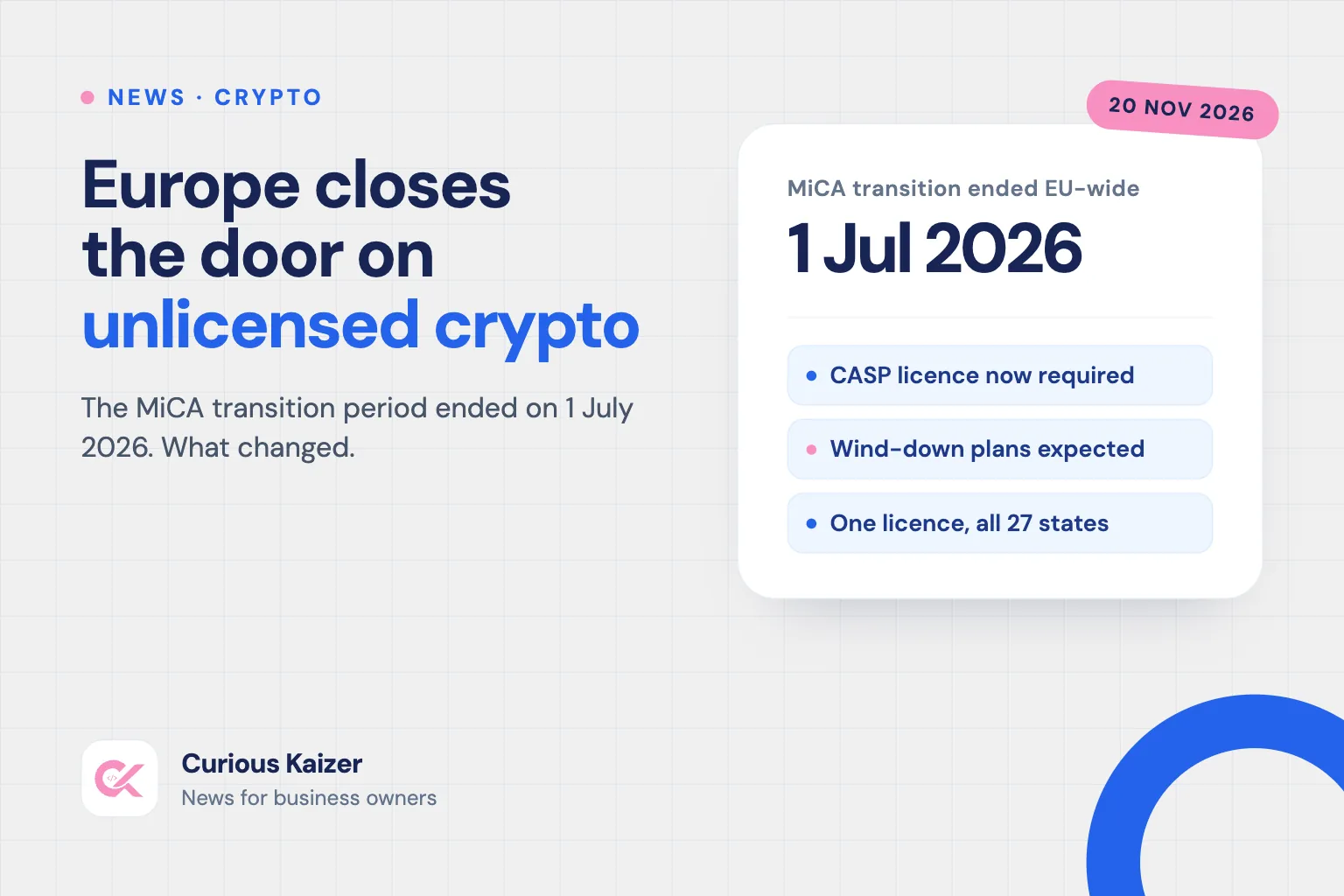
Since 1 July 2026, any company offering crypto services to people in the European Union needs a licence under MiCA, the EU's Markets in Crypto-Assets Regulation. The transitional period that let existing firms keep operating under national rules has ended in every member state. Firms without a licence were expected to wind down their EU business.
Key points
- MiCA's transitional period for crypto-asset service providers (CASPs) ended across the EU on 1 July 2026.
- Only MiCA-authorised CASPs may now serve EU customers.
- ESMA, the EU securities regulator, expected unlicensed firms to have orderly wind-down plans.
- Some countries ended the transition earlier, such as the Netherlands in July 2025 and Italy in December 2025.
- A MiCA licence from one member state can be "passported" to serve customers in all 27.
What MiCA is
The Markets in Crypto-Assets Regulation is the EU's single rulebook for crypto. Its rules for stablecoins applied from mid-2024 and its rules for service providers, such as exchanges, brokers and custodians, from the end of 2024. To avoid a cliff edge, member states could let existing firms keep operating under their old national registrations for up to 18 months. That window has now closed everywhere.
What changed on 1 July
- A licence is required. To offer crypto services to EU residents, a firm must be authorised as a CASP by a national regulator under MiCA.
- Passporting. A licence from one country lets a firm serve customers across the EU after notifying regulators, rather than registering in each country.
- Wind-downs. Firms that did not get licensed in time had to stop serving EU customers and return assets in an orderly way.
- Last-minute approvals. Several firms received licences right up to 1 July.
How it compares with India and the US
| Market | Approach in 2026 |
|---|---|
| European Union | Single licensing regime under MiCA, fully in force since 1 July 2026 |
| United States | Stablecoin law (GENIUS Act) with rules being written; market structure bill (CLARITY Act) stalled |
| India | No dedicated licensing law; 30% tax, 1% TDS, FIU registration for anti-money-laundering, CARF reporting |
Why it matters for businesses
If you sell to customers in Europe and accept or handle crypto, you must use MiCA-licensed providers. If you are building a crypto or fintech product with European users, licensing is now a launch requirement, not an afterthought. Clear rules also make banks and payment firms more willing to work with crypto businesses, which is the point.
Questions readers ask
When did the MiCA transition period end?
The transitional period for crypto-asset service providers ended across the EU on 1 July 2026.
Can an unlicensed exchange still serve EU customers?
No. Since 1 July 2026 only MiCA-authorised crypto-asset service providers may serve EU customers.
Does MiCA apply in India?
No. MiCA is EU law. It matters to Indian businesses only if they serve customers in the EU.
Sources and method
We report what official releases, company filings and established news outlets published up to 20 November 2026, and say so where reports differ. Figures can be revised; check the original source before you act on them.
- European Securities and Markets Authority, statements on the end of MiCA transitional measures.
- Regulation (EU) 2023/1114 on markets in crypto-assets (MiCA).
- Reports on national transition dates in the Netherlands and Italy, and on licences granted by 1 July 2026.
This is news and general information for business owners, not investment, tax or legal advice.
Building in Web3 or fintech?
We build secure dashboards, onboarding flows and internal tools for finance and crypto businesses, with audits and access controls built in.