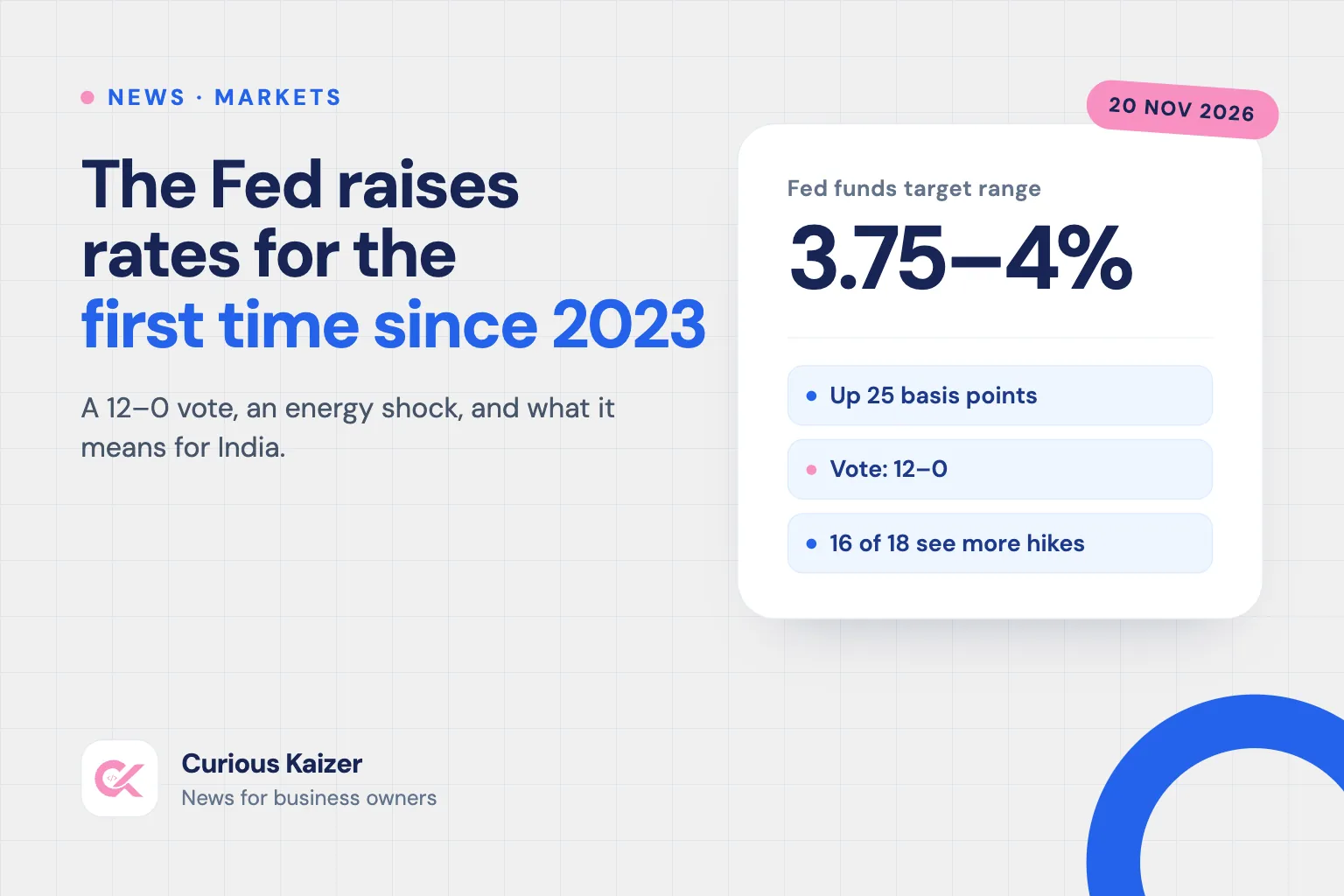
On 16 September 2026, the US Federal Reserve raised its benchmark interest rate by a quarter point to a range of 3.75% to 4.00%. It was the Fed's first increase since July 2023, approved unanimously under Chair Kevin Warsh, and it was driven by the jump in energy prices that followed the war involving Iran.
Key points
- The Fed raised the federal funds target range by 25 basis points to 3.75%–4.00% on 16 September 2026.
- The vote was 12–0. In July, three officials had already dissented in favour of a hike.
- It was the first increase since July 2023, under Chair Kevin Warsh.
- The median projection put rates at about 4.1% by the end of 2026, and 16 of 18 officials saw at least one more hike.
- For India, higher US rates tend to pull money out of emerging markets and pressure the rupee.
What the Fed decided
The Federal Open Market Committee lifted its target range for the federal funds rate, the overnight rate at which US banks lend to each other, from 3.50%–3.75% to 3.75%–4.00%. All twelve voting members agreed. The Fed pointed to rising inflation driven by energy prices since the conflict involving Iran began in February, which sent oil sharply higher.
Its projections suggested more to come: the median official expected rates to end 2026 at about 4.1%, and 16 of the 18 officials who submit projections saw at least one more increase.
Why an American decision matters in India
- Capital flows. Higher US rates make dollar assets more attractive, which can pull foreign investment out of Indian shares and bonds.
- The rupee. Outflows and a stronger dollar push the rupee down. It has already hit record lows near 96 this year.
- RBI policy. A weak rupee makes imports, especially oil, more expensive and adds to inflation. That was one reason the RBI raised its own rate in October.
- Borrowing abroad. Companies with dollar loans pay more as US rates and the dollar rise.
What happened next
At its next meeting on 28 October the Fed held rates steady, with two officials voting for another increase, and said it would hold fewer meetings from 2027. We cover that in our post on the October decision.
What to do about it
Most Indian small businesses feel the Fed indirectly, through the rupee and through the RBI. If you import, or pay for dollar-priced software, budget for a weaker rupee. If you export services, consider pricing in dollars. And if you plan to borrow, expect Indian rates to stay higher for longer than seemed likely a year ago.
Questions readers ask
What is the US Fed interest rate now?
After the 16 September 2026 increase, the federal funds target range is 3.75%–4.00%. It was held there on 28 October 2026.
Why did the Fed raise rates in 2026?
Mainly because energy prices rose sharply after the conflict involving Iran began in February 2026, pushing up inflation.
How does a Fed hike affect India?
It can draw foreign money out of India, weaken the rupee and raise import costs, which adds pressure on the RBI to keep rates higher.
Sources and method
We report what official releases, company filings and established news outlets published up to 20 November 2026, and say so where reports differ. Figures can be revised; check the original source before you act on them.
- Federal Reserve, FOMC statement and Summary of Economic Projections, 16 September 2026.
- Coverage of the September 2026 FOMC decision by US and Indian business media.
This is news and general information for business owners, not investment, tax or legal advice.
Plan for a tougher market
When money gets dearer, every lead counts. We build websites that bring enquiries and CRMs that make sure none are lost.