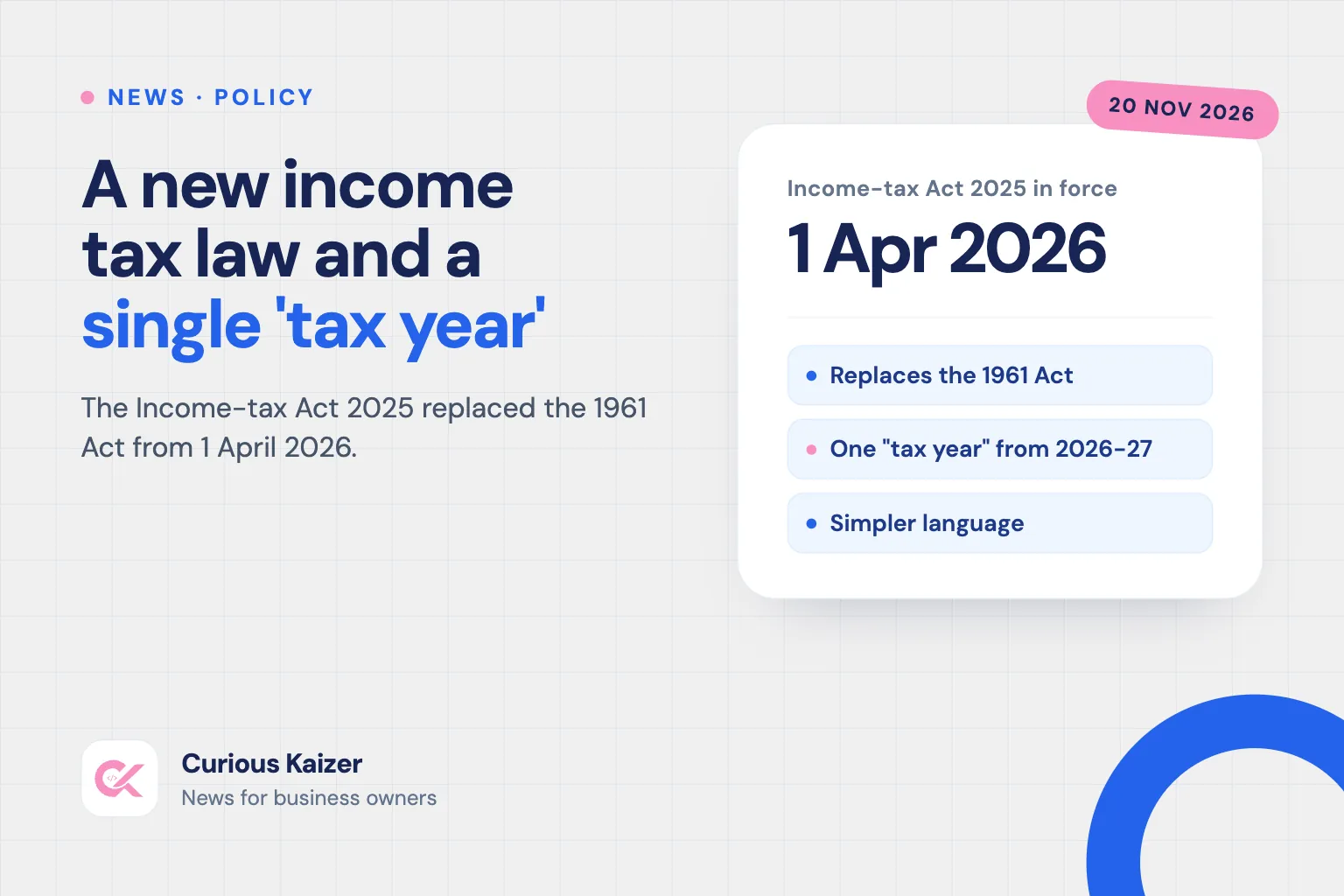
India has a new income tax law. The Income-tax Act, 2025 came into force on 1 April 2026, replacing the Income-tax Act, 1961, which had been amended so many times it was hard to read. The new law is designed to be revenue-neutral: it rewrites and simplifies rather than raising or cutting taxes. The change most people will notice is the end of the 'assessment year'.
Key points
- The Income-tax Act, 2025 took effect on 1 April 2026, replacing the 1961 Act. New Income-tax Rules, 2026 were notified alongside.
- A single "tax year" replaces the old pair of "previous year" and "assessment year", starting with tax year 2026–27.
- The rewrite is broadly revenue-neutral, with simpler language, fewer sections and tables in place of long provisos.
- Tax rates and slabs are set by each year's Budget, not by the rewrite itself.
- Update invoices, contracts, payroll and accounting templates that refer to old section numbers.
Why a new law
The 1961 Act had grown through decades of amendments, provisos and explanations, many of them cross-referring to each other. The new Act reorganises the same ideas in plainer language, with tables and formulas where the old law used long paragraphs. The government's stated aim was to make the law easier to understand and reduce disputes, without changing the overall tax burden.
The new "tax year"
Under the old law, income earned in the "previous year" was assessed in the following "assessment year". Income earned from April 2025 to March 2026, for example, belonged to assessment year 2026–27. Many taxpayers found that confusing. The new Act uses a single "tax year", the financial year in which income is earned. Income earned from April 2026 to March 2027 is simply tax year 2026–27.
| Income earned | Old term (1961 Act) | New term (2025 Act) |
|---|---|---|
| April 2025 to March 2026 | Previous year 2025–26, assessment year 2026–27 | Filed under the old Act |
| April 2026 to March 2027 | — | Tax year 2026–27 |
What businesses should update
- Section references. TDS sections, deductions and exemptions have new numbers. Update invoices, payroll software and vendor forms that cite old sections.
- Contracts. Clauses that refer to "assessment year" or specific 1961 Act sections may need wording updates.
- Accounting software. Check your software vendor has updated forms, TDS codes and reports.
- Returns for the last year under the old law. Income for 2025–26 is still filed under the 1961 Act, so you will deal with both for a while.
Budget 2026 also made changes to return deadlines, revised returns, STT and TCS. Confirm the details that apply to you with a chartered accountant; this article is general information, not tax advice.
Questions readers ask
When did the Income-tax Act 2025 come into force?
On 1 April 2026, replacing the Income-tax Act, 1961.
What is a tax year?
Under the new Act, the tax year is the financial year in which income is earned. It replaces the old "previous year" and "assessment year" pair, starting with tax year 2026–27.
Did tax rates change with the new Act?
The rewrite was designed to be revenue-neutral. Rates and slabs are set by each year's Finance Act.
Sources and method
We report what official releases, company filings and established news outlets published up to 20 November 2026, and say so where reports differ. Figures can be revised; check the original source before you act on them.
- Income Tax Department, Income-tax Act, 2025 and Income-tax Rules, 2026.
- Union Budget 2026–27 documents.
- Coverage of the new Act by Indian business and tax media.
This is news and general information for business owners, not investment, tax or legal advice.
Systems that keep up with tax changes
We build invoicing, payroll and accounting tools where section codes and rules live in settings, not hard-coded.