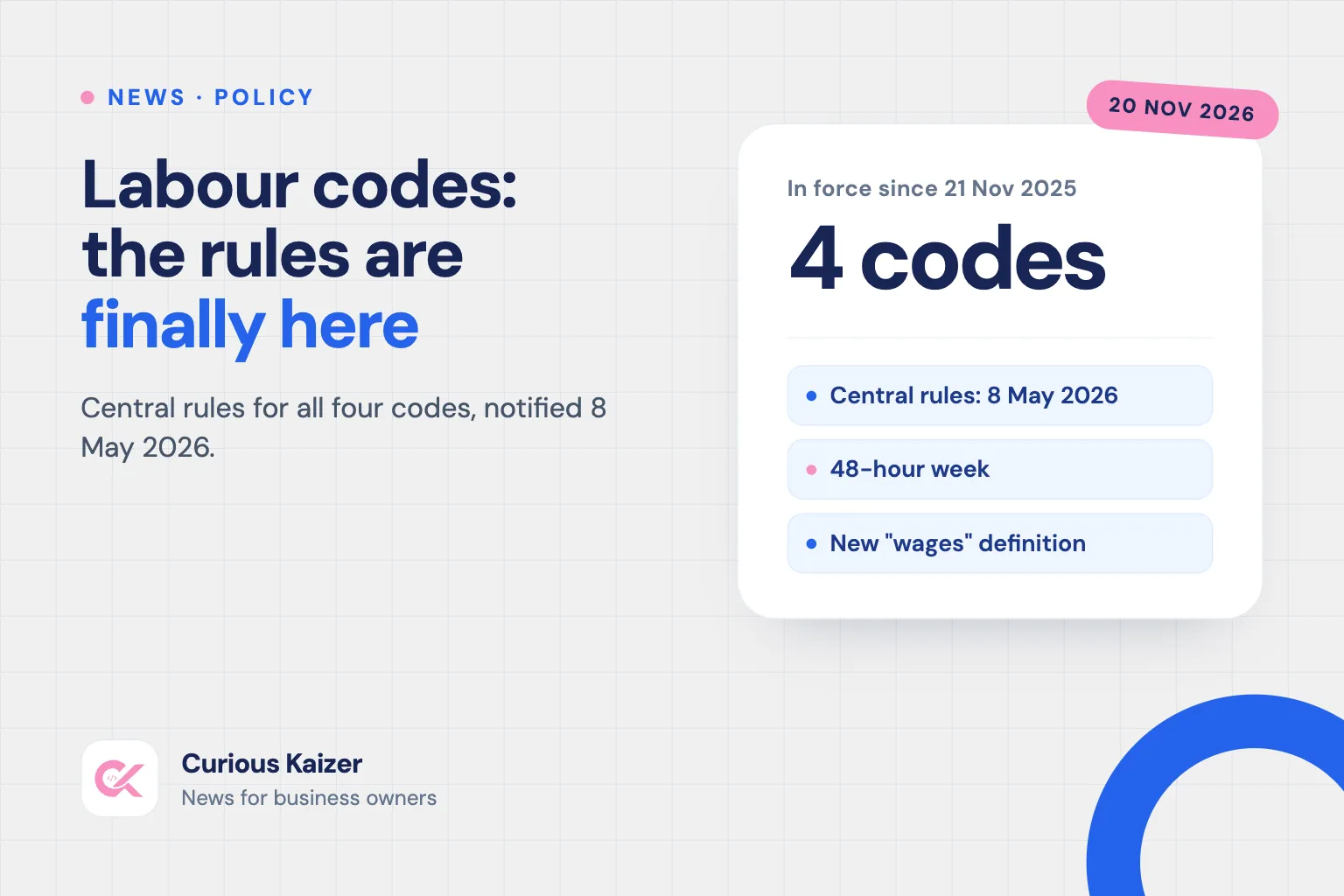
India's four labour codes, which replaced 29 older labour laws, came into effect on 21 November 2025. On 8 May 2026, the central government notified rules for all four codes. They apply where the Centre is the appropriate government; states are making their own rules at different speeds. For employers, the changes reach payroll, working hours and record-keeping.
Key points
- The four codes, on wages, industrial relations, social security and occupational safety, took effect on 21 November 2025.
- Central rules for all four, including the Code on Wages (Central) Rules, 2026, were notified on 8 May 2026.
- The rules keep an 8-hour day and 48-hour week, with overtime paid as set out in the codes.
- A new uniform definition of "wages" affects how gratuity, provident fund and other benefits are calculated.
- Registers can be kept electronically. State rules are uneven, so check where your staff work.
The four codes
| Code | Covers |
|---|---|
| Code on Wages, 2019 | Minimum wages, payment of wages, bonus, equal pay |
| Industrial Relations Code, 2020 | Trade unions, standing orders, disputes, layoffs |
| Code on Social Security, 2020 | Provident fund, ESI, gratuity, maternity, gig and platform workers |
| Occupational Safety, Health and Working Conditions Code, 2020 | Working hours, safety, welfare, registrations |
The definition of wages
The biggest practical change for many employers is the uniform definition of "wages". Broadly, allowances above a set share of total pay are added back into wages for calculating benefits. Companies that kept basic pay low and allowances high to reduce provident fund and gratuity costs may need to restructure salaries. That can change take-home pay and employer costs, so plan it with your payroll provider or accountant.
Working hours and overtime
The central rules keep the 8-hour day and 48-hour week, with overtime for work beyond those limits as provided in the codes. Some flexibility exists for how hours are spread across the week, subject to the weekly limit and state rules.
The state picture
Labour is a shared subject, so each state writes its own rules for establishments under its jurisdiction. Progress is uneven: some states have final rules, others such as Karnataka have final rules pending, and West Bengal has published drafts. If you have staff in several states, you may follow different rules in each for a while.
What employers should do
- Review salary structures against the new wages definition.
- Update appointment letters, standing orders and leave policies.
- Move registers and records to a proper HR system, since electronic registers are allowed.
- Track which state rules apply to each location.
This is a general summary, not legal advice. Labour law details depend on your sector, size and state.
Questions readers ask
When did the labour codes come into effect?
The four labour codes took effect on 21 November 2025. Central rules for all four were notified on 8 May 2026.
Do the labour codes change working hours?
The central rules keep an 8-hour day and a 48-hour week, with overtime beyond those limits as provided in the codes.
Why does the new definition of wages matter?
It affects how provident fund, gratuity and other benefits are calculated, which can change salary structures and employer costs.
Sources and method
We report what official releases, company filings and established news outlets published up to 20 November 2026, and say so where reports differ. Figures can be revised; check the original source before you act on them.
- Ministry of Labour and Employment, labour codes and central rules notified 8 May 2026.
- Law firm commentary on the labour codes and state rules, 2025–2026.
This is news and general information for business owners, not investment, tax or legal advice.
HR records that are audit-ready
We build HR and payroll tools with electronic registers, leave tracking and attendance, set up for your states.