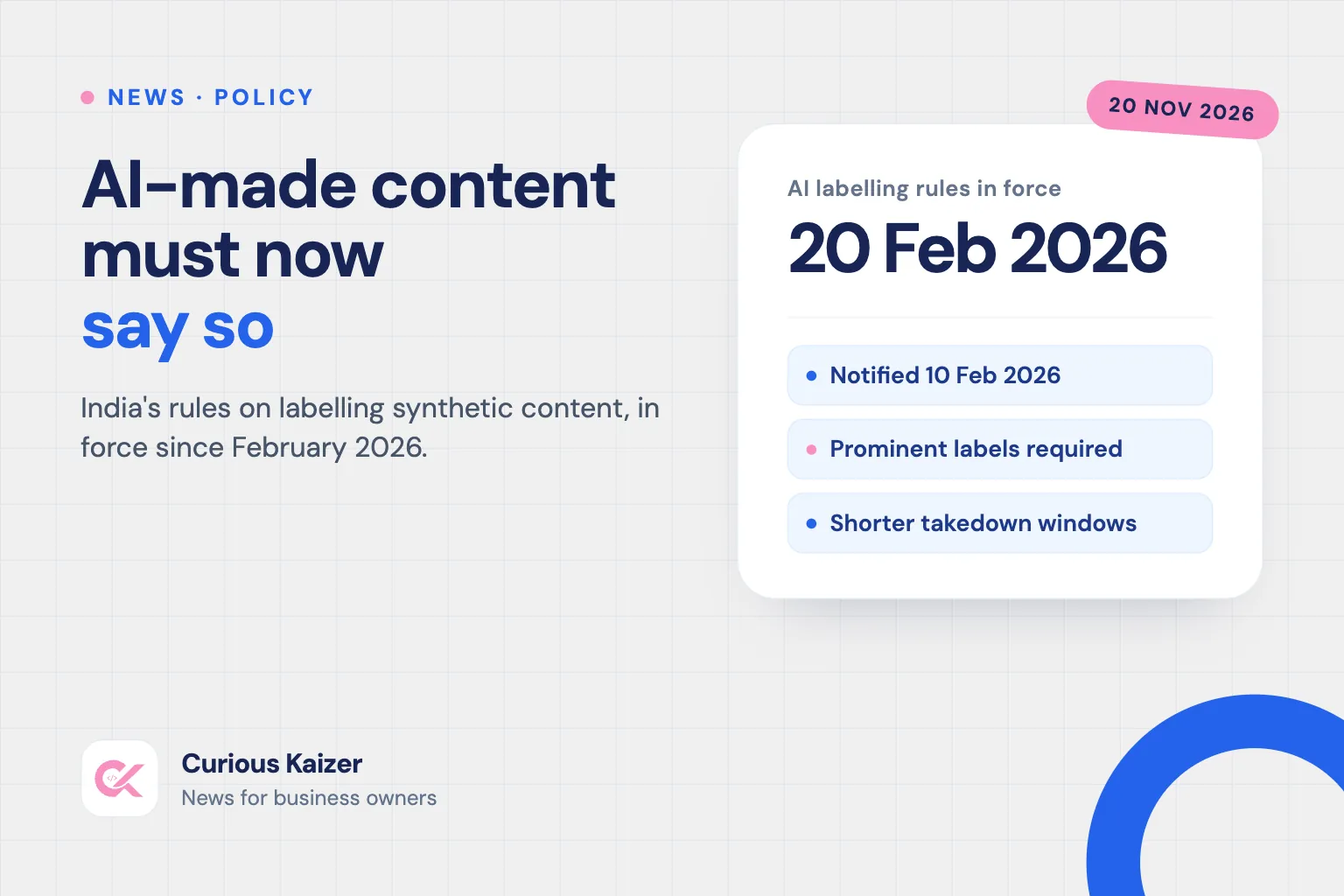
Since 20 February 2026, online platforms in India have had to label AI-generated content clearly. The Information Technology amendment rules, notified on 10 February 2026, define 'synthetically generated information' for the first time and set out what platforms must do about it, including shorter deadlines for taking down unlawful content.
Key points
- The IT amendment rules were notified on 10 February 2026 and took effect on 20 February 2026.
- They define "synthetically generated information": content created or altered by AI or similar tools so that it appears real.
- Platforms must ensure such content is prominently labelled.
- Takedown windows for unlawful content are shorter.
- There are good-faith exemptions, for example for routine editing that does not mislead.
What the rules require
The rules amend India's IT intermediary rules, which set duties for platforms such as social networks, video sites and messaging services. They focus on content that is generated or altered by AI in a way that could be mistaken for real, such as deepfake videos, cloned voices or realistic synthetic images. Platforms that allow such content must make sure it carries a visible label, and must act faster when told to remove unlawful content.
What is not covered
The rules include good-faith exemptions. Ordinary editing, such as colour correction, cropping or noise removal, that does not change what the content shows in a misleading way is not meant to be treated as synthetic.
What it means for brands
- Label AI visuals and voices. If an ad uses an AI-generated person, voice or realistic scene, disclose it. Platforms may add labels themselves, but it is better to be upfront.
- Do not fake endorsements. Using AI to make a real person appear to endorse your product is a fast route to takedowns and legal trouble.
- Keep source files. If your content is challenged, being able to show how it was made helps.
- Check your agency. Ask creative partners which tools they use and how they label AI content.
How we handle it
We use AI tools in some design and writing work, and we tell clients when we do. For client sites, we avoid realistic AI people and fake testimonials altogether. Real photos, real reviews and clear labels build more trust than any synthetic shortcut.
Questions readers ask
Does India require labels on AI-generated content?
Yes. IT amendment rules in force since 20 February 2026 require platforms to ensure synthetically generated information is prominently labelled.
What counts as synthetically generated information?
Content created or altered using AI or similar tools so that it appears real or authentic, such as deepfake videos, cloned voices or realistic synthetic images.
Do I need to label photos I edited?
Routine editing that does not mislead, such as cropping or colour correction, is generally covered by good-faith exemptions. Realistic AI-generated or altered content should be labelled.
Sources and method
We report what official releases, company filings and established news outlets published up to 20 November 2026, and say so where reports differ. Figures can be revised; check the original source before you act on them.
- Ministry of Electronics and Information Technology, Information Technology (Intermediary Guidelines and Digital Media Ethics Code) Amendment Rules, 2026, notified 10 February 2026.
- Coverage of the rules by Indian legal and technology media, February 2026.
This is news and general information for business owners, not investment, tax or legal advice.
Content that earns trust
We build websites with real photography, verified reviews and clear disclosures, so your brand never needs a fake.