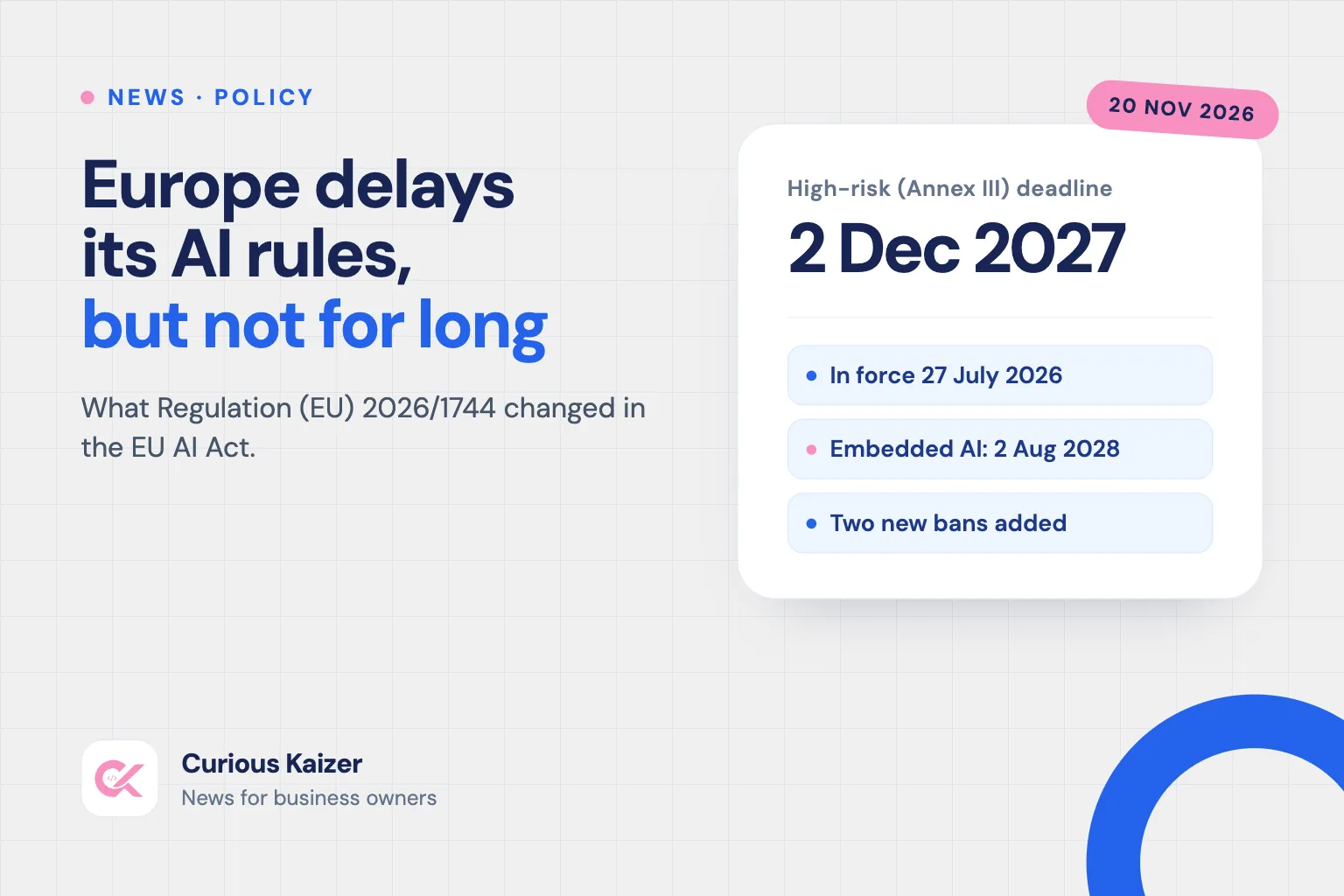
The European Union has given businesses more time to comply with the toughest parts of its AI Act. An amending regulation, known as the AI omnibus, was published as Regulation (EU) 2026/1744 and entered into force on 27 July 2026. It moves deadlines for high-risk AI systems to December 2027 and August 2028, eases some duties for smaller companies, and adds two new banned practices.
Key points
- The omnibus was adopted by the European Parliament on 16 June and the Council on 29 June, signed on 8 July and published on 24 July 2026 as Regulation (EU) 2026/1744.
- It entered into force on 27 July 2026.
- Rules for stand-alone high-risk AI (Annex III uses, such as hiring and credit scoring) now apply from 2 December 2027.
- Rules for high-risk AI built into regulated products apply from 2 August 2028.
- It adds relief for small mid-caps, more powers for the AI Office, and two new prohibited practices on AI-generated non-consensual intimate imagery and child sexual abuse material.
The new timeline
| Date | What applies |
|---|---|
| 2 February 2025 | Original bans on unacceptable-risk AI and AI literacy duties |
| 2 August 2025 | Rules for general-purpose AI models |
| 27 July 2026 | Omnibus (Regulation 2026/1744) enters into force |
| 2 December 2027 | High-risk AI systems listed in Annex III |
| 2 August 2028 | High-risk AI embedded in regulated products |
Why the delay
The technical standards and guidance businesses need to comply with the high-risk rules were not ready in time. Rather than force companies to comply with rules nobody could yet interpret, the EU moved the deadlines and tied them to realistic dates. The omnibus is separate from a wider "digital omnibus" that proposes changes to GDPR, NIS2 and the Data Act, which is following its own path.
What else changed
- Smaller firms. Some simplified obligations, previously for SMEs, now extend to small mid-cap companies.
- The AI Office. The EU's AI Office gets stronger powers, especially over AI built on general-purpose models.
- New bans. Using AI to generate realistic non-consensual intimate imagery or child sexual abuse material is added to the list of prohibited practices.
Why it matters to Indian businesses
The AI Act applies to anyone placing AI systems on the EU market or whose AI output is used in the EU, wherever they are based. Indian software firms building HR screening, credit scoring, education or medical tools for European clients will fall into the high-risk category. The delay gives time to build documentation, risk management and human oversight into products. Use it rather than waiting for the last month.
Questions readers ask
When do the EU AI Act high-risk rules apply now?
After the 2026 omnibus, rules for stand-alone high-risk AI (Annex III) apply from 2 December 2027, and for high-risk AI in regulated products from 2 August 2028.
What is Regulation (EU) 2026/1744?
The amending regulation, often called the AI omnibus, that changed the EU AI Act. It entered into force on 27 July 2026.
Does the EU AI Act apply to Indian companies?
Yes, if they place AI systems on the EU market or their AI output is used in the EU.
Sources and method
We report what official releases, company filings and established news outlets published up to 20 November 2026, and say so where reports differ. Figures can be revised; check the original source before you act on them.
- EUR-Lex, Regulation (EU) 2026/1744 amending Regulation (EU) 2024/1689, Official Journal, 24 July 2026.
- European Parliament and Council press releases, June 2026.
- European Commission AI Office guidance on the AI Act timeline.
This is news and general information for business owners, not investment, tax or legal advice.
Building AI for clients abroad?
We build AI features with logs, human review and documentation designed in, so compliance is not an afterthought.