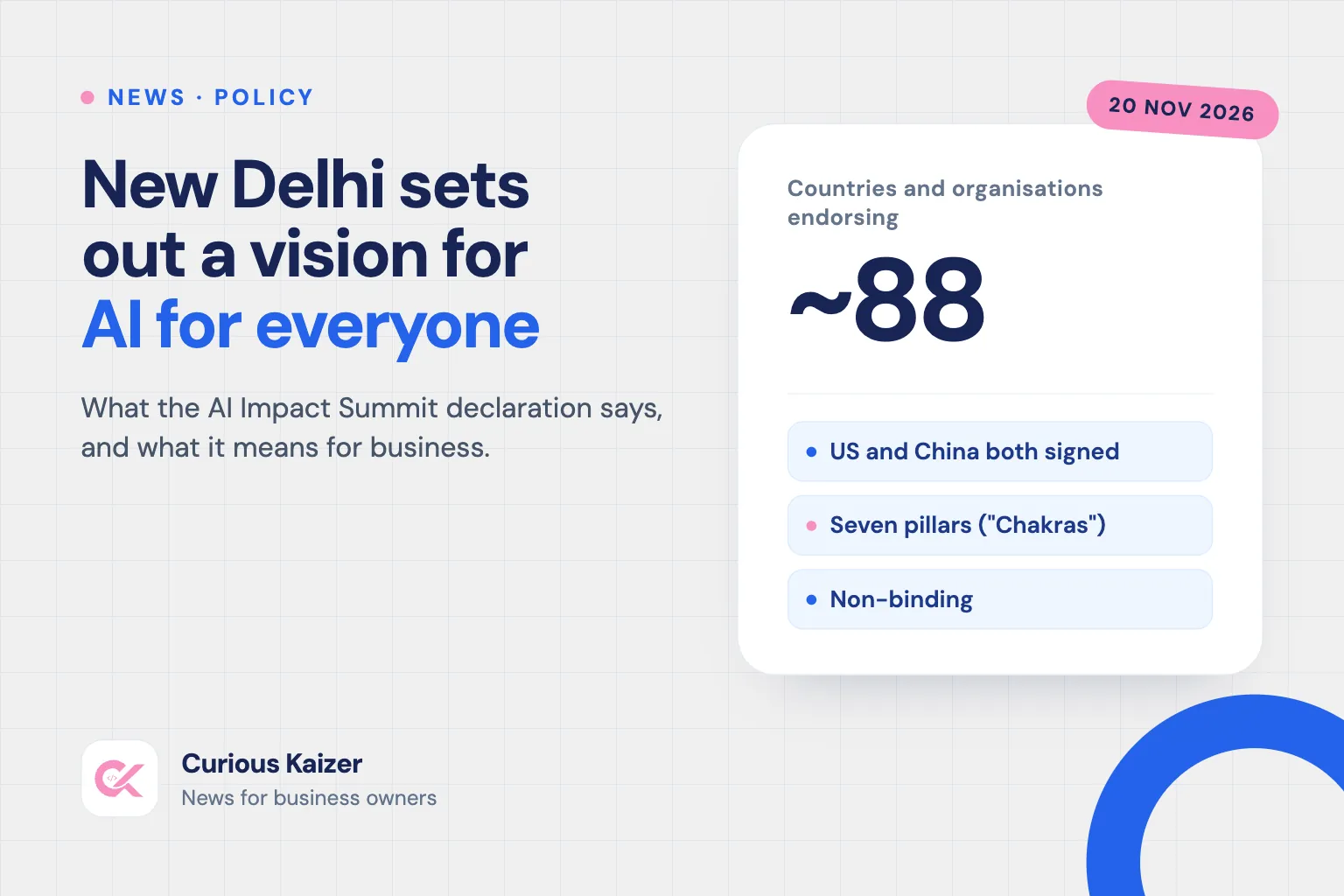
In February 2026, India hosted the AI Impact Summit in New Delhi, the latest in a series of global AI summits that began at Bletchley Park in 2023. It ended with the New Delhi Declaration on AI Impact, a non-binding statement endorsed by about 88 countries and international organisations, including both the United States and China.
Key points
- The summit was held in New Delhi in February 2026, with the main days around 19–20 February and an expo running to 21 February.
- The New Delhi Declaration on AI Impact was endorsed by about 88 countries and organisations, including the US and China.
- It is organised around seven pillars, called "Chakras", under the theme "Sarvajan Hitaya, Sarvajan Sukhaya" (welfare and happiness for all).
- Frontier AI companies signed the voluntary New Delhi Frontier AI Impact Commitments.
- India said it expects more than $200 billion of AI-related investment over two years.
What the declaration says
Earlier summits in the UK, South Korea and France focused heavily on AI safety and risk. The New Delhi summit shifted the emphasis to impact: how AI can benefit people in developing as well as rich countries. The declaration is built around seven pillars, which India called "Chakras", setting out shared goals for spreading AI's benefits widely and safely. It is non-binding, meaning it sets shared goals rather than legal duties.
Who signed
About 88 countries and international organisations endorsed the declaration. Getting both the United States and China to sign the same AI statement is unusual and was seen as a diplomatic success for India. Separately, leading AI companies signed voluntary commitments on how they develop and deploy frontier models.
What India gets out of it
- Investment. India said it expects more than $200 billion in AI-related investment over two years, including data centres such as Google's planned AI hub in Visakhapatnam.
- Positioning. India presents itself as a bridge between AI superpowers and the Global South, with its public digital infrastructure, such as UPI and Aadhaar, as a model.
- Rules at home. India has so far preferred targeted rules, such as labelling AI-generated content, over a single sweeping AI law.
What it means for business
For Indian businesses, the practical effect is momentum: more data centres, more AI services priced for India, and more government programmes to support adoption. The summit does not create new obligations. The rules that matter day to day are specific ones, like the AI content labelling rules and the DPDP privacy law. The opportunity is to use AI where it clearly saves time, in customer support, document handling and sales follow-up, while keeping people in charge of decisions.
Questions readers ask
What is the New Delhi Declaration on AI Impact?
A non-binding statement agreed at the AI Impact Summit in New Delhi in February 2026, endorsed by about 88 countries and international organisations, setting out shared goals for beneficial AI.
Did the US and China sign the New Delhi Declaration?
Yes. Both endorsed it, which was widely noted as unusual.
Does the declaration create new laws?
No. It is non-binding. AI rules in India come from specific regulations, such as the IT rules on labelling synthetic content.
Sources and method
We report what official releases, company filings and established news outlets published up to 20 November 2026, and say so where reports differ. Figures can be revised; check the original source before you act on them.
- Ministry of Electronics and Information Technology and IndiaAI Mission announcements on the AI Impact Summit, February 2026.
- Coverage of the New Delhi Declaration by Indian and international media, February 2026.
This is news and general information for business owners, not investment, tax or legal advice.
Put AI to work, sensibly
We build AI assistants for support, sales follow-up and document handling, with people kept in charge.