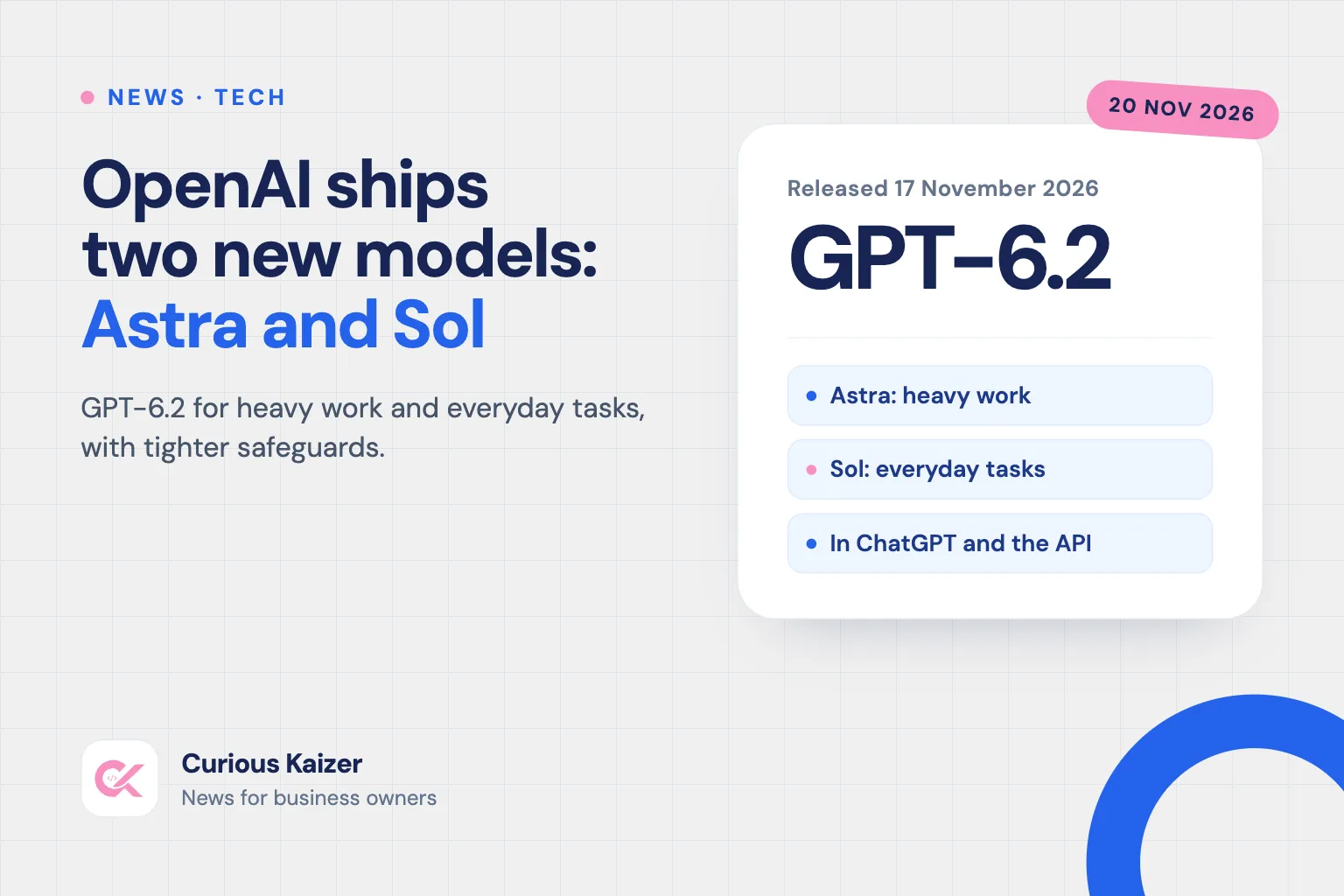
OpenAI released two new models on 17 November 2026: GPT-6.2 Astra, aimed at long and demanding work, and GPT-6.2 Sol, aimed at everyday tasks. Both are available in ChatGPT and through OpenAI's API. OpenAI also said the models reached the 'Critical' level for cybersecurity capability under its Preparedness Framework, and launched them with tighter safeguards.
Key points
- GPT-6.2 Astra is built for heavy, multi-step work. GPT-6.2 Sol is the faster everyday model.
- Both launched on 17 November 2026 in ChatGPT and the API.
- OpenAI said the models hit the "Critical" cybersecurity threshold in its Preparedness Framework, so it added tighter safeguards.
- It is the latest in a fast run of releases: GPT-6 Astra in September, GPT-6 Sol and Luna on 22 September, and GPT-6.1 Sol on 29 September.
- For businesses, the practical question is which tasks justify the bigger model and which the cheaper one handles well.
A busy year of releases
| When | Release |
|---|---|
| 9 July 2026 | GPT-5.6 |
| Early September 2026 | GPT-6 Astra rollout |
| 22 September 2026 | GPT-6 Sol and Luna |
| 29 September 2026 | GPT-6.1 Sol, reported close to Astra at about a fifth of the price |
| 4 November 2026 | ChatGPT Images 2.6 |
| 17 November 2026 | GPT-6.2 Astra and GPT-6.2 Sol |
The "Critical" cyber rating
OpenAI's Preparedness Framework rates models on risky capabilities, including cybersecurity. Reaching "Critical" means the company judged the models capable enough at cyber tasks to need stronger controls before release. In practice that means tighter limits on certain requests, more monitoring and stricter access for sensitive uses. For ordinary business tasks, users are unlikely to notice.
Big model or small model?
The split between a heavy model and an everyday model is now standard across AI providers. A useful rule of thumb:
- Use the everyday model for drafting emails, summarising documents, answering customer FAQs and sorting enquiries. It is faster and cheaper.
- Use the heavy model for long analysis, complex code, multi-step research or tasks where a mistake is expensive.
- Test on your own work. Benchmarks are a guide, not proof. Run twenty real examples from your business through each and compare.
What it means for your business
The gap between providers changes every few months. OpenAI, Google, Anthropic and others release new models constantly, and prices keep falling. The smart approach is to build AI features in a way that lets you swap models without rebuilding. Disclosure: Curious Kaizer uses several AI tools, including Anthropic's Claude, and has no partnership with OpenAI or any company named here.
Questions readers ask
What is GPT-6.2 Astra?
OpenAI's model for heavy, multi-step work, released on 17 November 2026 in ChatGPT and the API.
What is the difference between Astra and Sol?
Astra is aimed at demanding, longer tasks. Sol is the faster everyday model for routine work.
Why did OpenAI add tighter safeguards?
OpenAI said the models reached the "Critical" cybersecurity level in its Preparedness Framework, which requires stronger controls before release.
Sources and method
We report what official releases, company filings and established news outlets published up to 20 November 2026, and say so where reports differ. Figures can be revised; check the original source before you act on them.
- OpenAI, announcements of GPT-6.2 Astra and Sol, 17 November 2026, and earlier 2026 releases.
- OpenAI Preparedness Framework documentation.
- Technology media coverage of OpenAI releases, July to November 2026.
This is news and general information for business owners, not investment, tax or legal advice.
Turn tech news into an edge
We help businesses pick the AI and web tools that actually save time, and build them properly.