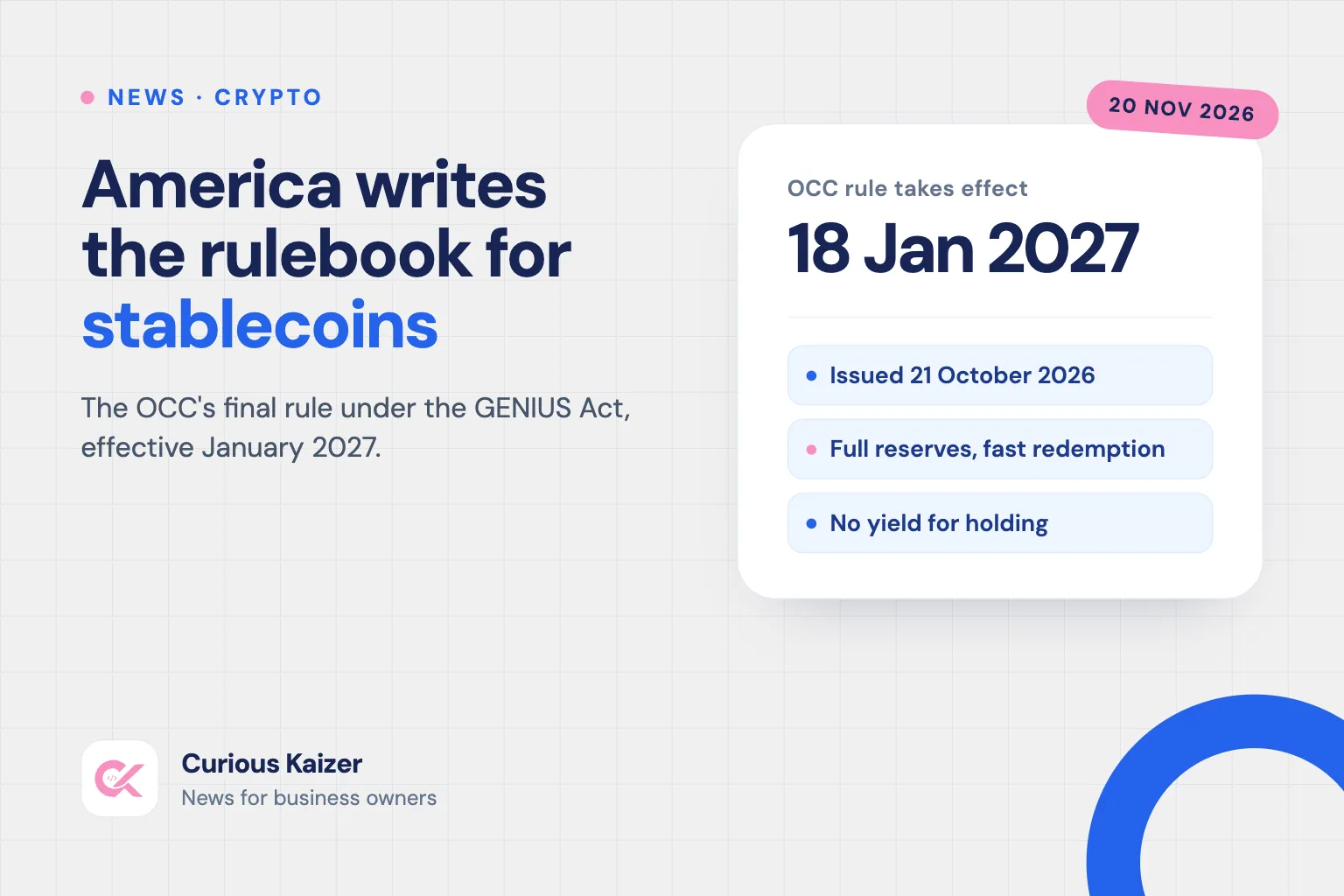
On 21 October 2026, the US Office of the Comptroller of the Currency issued its final rule for payment stablecoin issuers it supervises under the GENIUS Act, the 2025 law that created the first federal framework for stablecoins. The rule takes effect on 18 January 2027 and sets out how issuers must hold reserves, redeem coins and manage risk.
Key points
- The OCC published its final rule on 21 October 2026. It takes effect on 18 January 2027.
- It covers reserves, redemption, risk management, custody and capital for stablecoin issuers under OCC supervision, in a new part 15 of title 12 of the Code of Federal Regulations.
- Issuers may not pay yield or interest to people simply for holding a stablecoin.
- Anti-money-laundering and sanctions rules from Treasury, FinCEN and OFAC were proposed in April and are still pending.
- Regulators missed the July deadline in the law for final rules, which is why the rule came out in October.
What the GENIUS Act is
A stablecoin is a crypto token designed to hold a steady value, usually one US dollar, backed by reserves such as cash and short-term Treasury bills. The GENIUS Act, signed into US law in 2025, says who may issue payment stablecoins and how. It hands detailed rule-writing to federal regulators, including the OCC, which supervises national banks and federally licensed trust companies.
What the OCC rule requires
| Area | In short |
|---|---|
| Reserves | Stablecoins must be fully backed by high-quality, liquid reserves held separately |
| Redemption | Holders must be able to redeem at face value, with clear and timely procedures |
| Risk management | Issuers need governance, liquidity, operational and cyber risk programmes |
| Custody | Rules for holding reserves and customer assets safely |
| Capital | Issuers must hold capital suited to their risks |
| No yield | Issuers cannot pay interest or yield just for holding the stablecoin |
What is still pending
The OCC rule is only one piece. Anti-money-laundering and sanctions rules, proposed by the Treasury Department, FinCEN and OFAC in April 2026, have not been finalised. Other regulators, including the Federal Reserve and state authorities, have their own parts to write. The law originally expected final rules by July 2026, and regulators missed that deadline.
Why it matters outside the US
Dollar stablecoins are widely used for cross-border payments, trading and, in some countries, saving. Clear US rules make it easier for banks and payment companies to use them, and the ban on yield is meant to stop stablecoins competing directly with bank deposits. For Indian businesses, stablecoins remain a grey area under Indian law, taxed as virtual digital assets. Do not build a product around them without legal advice.
Questions readers ask
When does the OCC stablecoin rule take effect?
The final rule was issued on 21 October 2026 and takes effect on 18 January 2027.
Can stablecoin holders earn interest under the GENIUS Act?
Under the OCC rule, issuers may not pay yield or interest to holders simply for holding the stablecoin.
Are all GENIUS Act rules final?
No. Anti-money-laundering and sanctions rules proposed by Treasury, FinCEN and OFAC in April 2026 were still pending in November.
Sources and method
We report what official releases, company filings and established news outlets published up to 20 November 2026, and say so where reports differ. Figures can be revised; check the original source before you act on them.
- Office of the Comptroller of the Currency, final rule implementing the GENIUS Act, 21 October 2026.
- Law firm and trade press coverage of the OCC final rule, October 2026.
- Reports on Treasury, FinCEN and OFAC proposed rules, April 2026.
This is news and general information for business owners, not investment, tax or legal advice.
Building in Web3 or fintech?
We build secure dashboards, onboarding flows and internal tools for finance and crypto businesses, with audits and access controls built in.