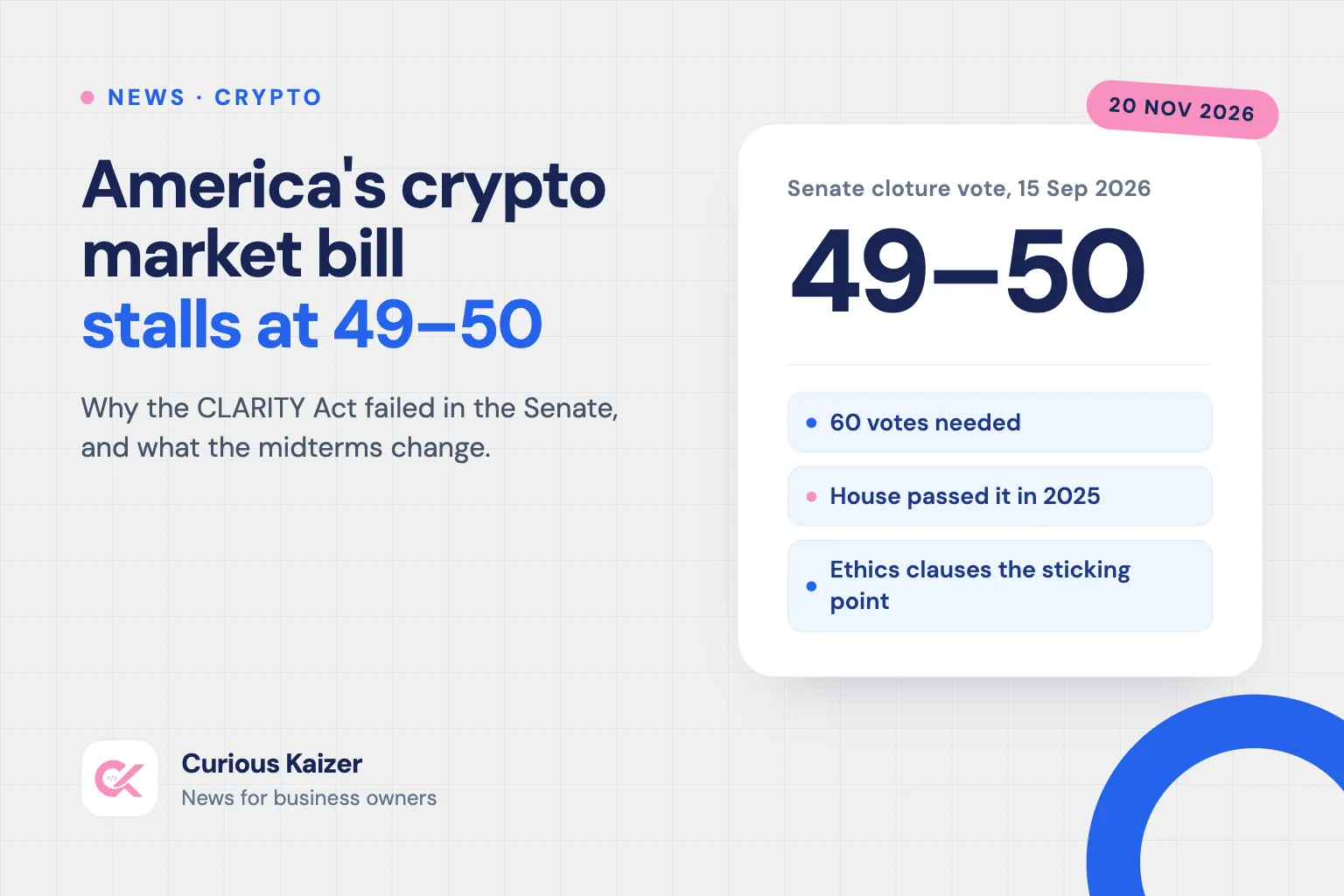
The bill meant to settle how crypto is regulated in the United States has stalled. On 15 September 2026, a Senate vote to move the CLARITY Act forward failed 49 to 50, well short of the 60 votes needed. With Democrats winning control of Congress in November, its chances in this session look slim.
Key points
- The House passed the CLARITY Act in July 2025, by 294 votes to 134.
- The Senate Banking Committee cleared its version on 14 May 2026, 15 to 9, after the Agriculture Committee released a version in January.
- On 15 September 2026, a cloture vote to end debate failed 49–50. Cloture needs 60 votes.
- Ethics provisions on officials' ties to crypto businesses were the main obstacle.
- Law firm Orrick said the bill's chances in this Congress had diminished. The Democratic midterm win adds uncertainty for the next.
What the CLARITY Act does
US crypto firms have long complained that it is unclear which regulator oversees what. The Securities and Exchange Commission treats many tokens as securities; the Commodity Futures Trading Commission oversees commodities such as bitcoin. The CLARITY Act sets out when a digital asset is a security and when it is a commodity, gives the CFTC more power over spot crypto markets, and creates registration rules for exchanges, brokers and dealers.
How it got here
| When | Step |
|---|---|
| July 2025 | Passed the House, 294–134 |
| January 2026 | Senate Agriculture Committee version released |
| 14 May 2026 | Senate Banking Committee cleared its version, 15–9 |
| 15 September 2026 | Senate cloture vote failed, 49–50 |
| 3 November 2026 | Democrats won control of the House and Senate in the midterms |
Why it failed
The main dispute was not about crypto rules themselves but about ethics. Several senators wanted provisions limiting senior officials, including members of the executive branch, from profiting from crypto ventures while in office. Supporters of the bill could not find enough votes from both parties to agree on that language, and the cloture motion failed.
What happens next
The current Congress runs until January 2027, leaving little time. The new Congress, controlled by Democrats, could write a different bill. Meanwhile stablecoins already have their own law, the GENIUS Act, and regulators are writing its rules. For crypto businesses, that means continued uncertainty over everything except stablecoins.
For Indian readers the takeaway is simpler: global crypto rules are still in flux, India has its own tax and reporting regime, and nothing in the US debate changes Indian law.
Questions readers ask
What is the CLARITY Act?
A US bill to define when digital assets are securities or commodities and to set rules for crypto exchanges, brokers and dealers, with a bigger role for the CFTC.
Why did the CLARITY Act fail in the Senate?
A cloture vote on 15 September 2026 failed 49–50, short of the 60 needed, mainly over ethics provisions about officials' ties to crypto businesses.
Is the CLARITY Act dead?
Not formally, but its chances in the current Congress are reported to be slim, and a new Democratic-controlled Congress starts in January 2027.
Sources and method
We report what official releases, company filings and established news outlets published up to 20 November 2026, and say so where reports differ. Figures can be revised; check the original source before you act on them.
- Congress.gov, legislative record of the CLARITY Act.
- Orrick and other law firm analysis of the Senate vote, September 2026.
- Reports on the Senate Banking Committee vote of 14 May 2026 and the 15 September 2026 cloture vote.
This is news and general information for business owners, not investment, tax or legal advice.
Building in Web3 or fintech?
We build secure dashboards, onboarding flows and internal tools for finance and crypto businesses, with audits and access controls built in.