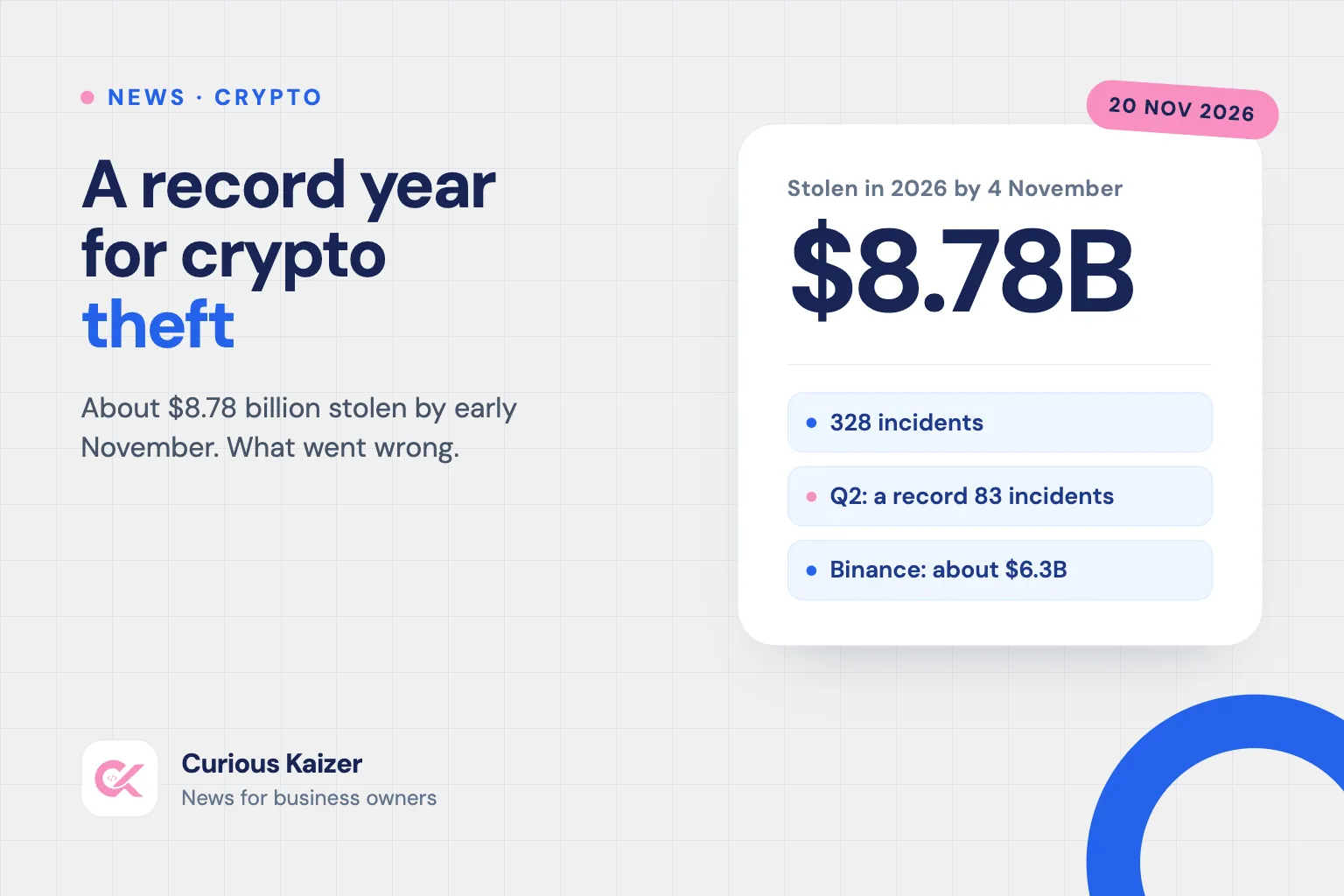
2026 is already the worst year on record for crypto theft. By 4 November, DefiLlama had counted about $8.78 billion stolen across 328 incidents, before counting the full fallout of later attacks. Most of the money did not go through clever cryptography. It went through stolen keys, tricked employees and rushed code.
Key points
- About $8.78 billion was stolen across 328 crypto incidents in 2026 by 4 November, according to DefiLlama.
- The largest single theft was the Binance hot-wallet attack of 29 October, about $6.3 billion, attributed by the FBI to North Korea.
- The second quarter set a record of 83 incidents, including KelpDAO (about $293 million) and Drift (about $280 million).
- In September, Bitget lost about $351.6 million from hot and warm wallets, covered by its $464 million protection fund.
- Common causes: compromised keys and devices, social engineering of staff, and bugs in smart contracts and bridges.
The biggest incidents
| When | Target | Reported loss |
|---|---|---|
| Q2 2026 | KelpDAO | About $293 million |
| Q2 2026 | Drift | About $280 million |
| September 2026 | Bitget (hot and warm wallets) | About $351.6 million, covered by its protection fund |
| 29 October 2026 | Binance (hot wallets) | About $6.3 billion, absorbed by Binance |
How attackers got in
- Keys and devices. Many large thefts start with an attacker gaining control of a device or signing key that can approve transfers.
- People. State-backed groups, especially from North Korea, are known for fake recruiters, malicious job tests and poisoned software packages aimed at engineers.
- Code. Decentralised finance protocols and cross-chain bridges hold large sums in smart contracts, where a single bug can be exploited by anyone.
- Speed. Funds move across chains in minutes. In the Binance case most outflows happened within about 20 minutes, according to TRM Labs.
What defenders did right
The exchanges that survived large thefts had prepared. Bitget had a protection fund larger than its loss. Binance kept most assets in cold storage and had the reserves to cover hot-wallet losses. Some stolen funds were frozen quickly because stablecoin issuers and exchanges co-operated. Preparation, not luck, decided who could keep customers whole.
Lessons for any online business
You do not need to hold crypto for these lessons to apply. Any business with an admin panel, a payment account or customer data faces the same kinds of attack.
- Turn on strong multi-factor authentication for every admin and finance login, preferably with passkeys or hardware keys.
- Give each person only the access they need, and require two approvals for large payments or data exports.
- Be suspicious of unsolicited job offers, file attachments and "test projects" sent to your developers.
- Keep audit logs, so you can see who did what, and review them.
- Write a one-page incident plan: who to call, what to shut off, how to tell customers.
Questions readers ask
How much crypto was stolen in 2026?
About $8.78 billion across 328 incidents by 4 November 2026, according to DefiLlama. The full-year figure will be higher.
What was the biggest crypto hack of 2026?
The Binance hot-wallet theft on 29 October 2026, about $6.3 billion, which the FBI attributed to North Korea's TraderTraitor group.
How do crypto hackers usually get in?
Most large thefts involve compromised keys or devices, social engineering of staff, or bugs in smart contracts and bridges.
Sources and method
We report what official releases, company filings and established news outlets published up to 20 November 2026, and say so where reports differ. Figures can be revised; check the original source before you act on them.
- DefiLlama hacks dashboard, figures as of 4 November 2026.
- Reports on the Binance, Bitget, KelpDAO and Drift incidents from crypto and business media, 2026.
- TRM Labs analysis of the Binance incident, as reported.
This is news and general information for business owners, not investment, tax or legal advice.
Lock down your admin side
We build admin panels and internal tools with passkeys, role-based access, approvals and audit logs.