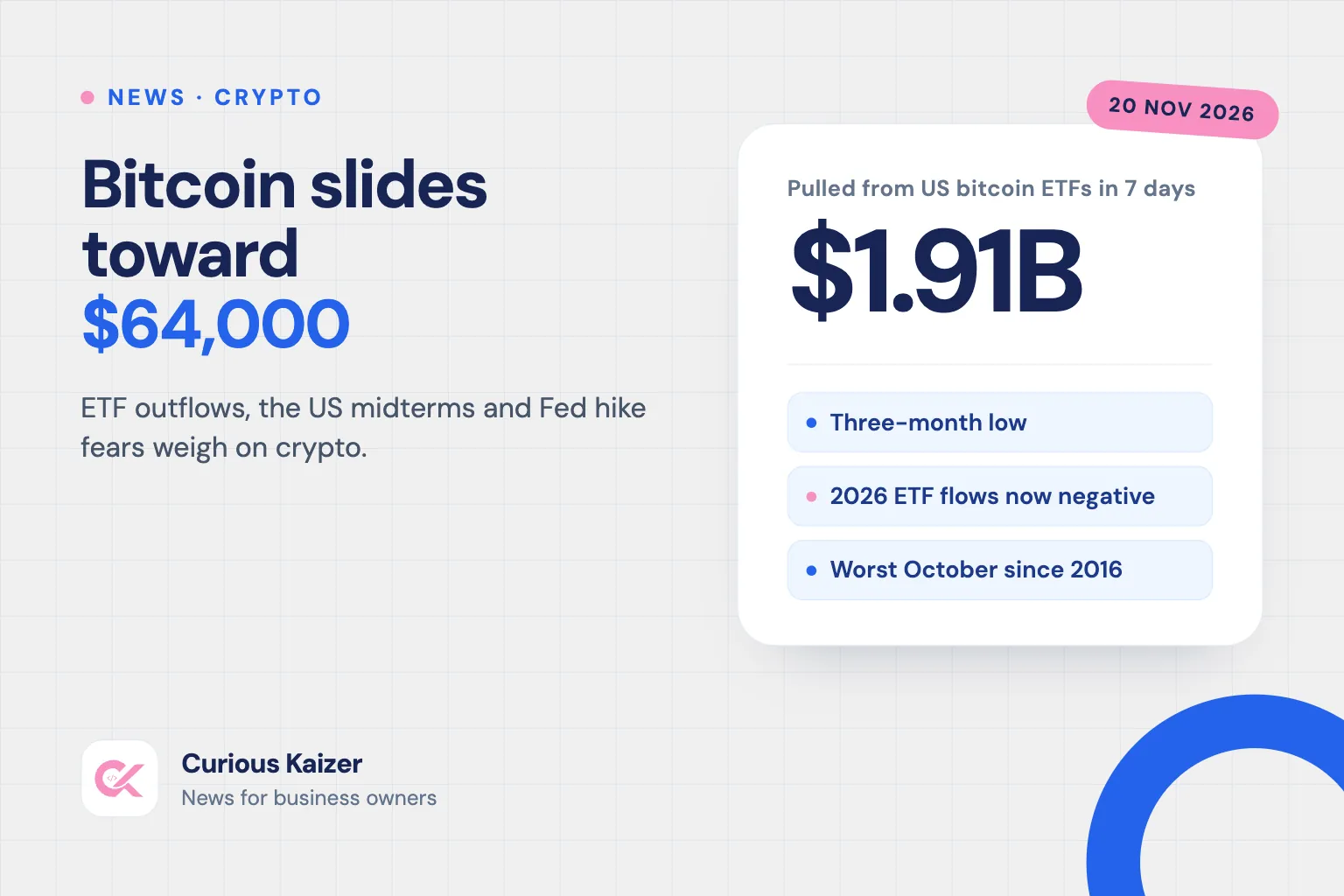
Bitcoin has had a rough autumn. It fell 7.3% in October 2026, its weakest October since 2016, and by mid-November it was trading between roughly $64,000 and $68,000, a three-month low. Money is leaving the US spot bitcoin funds that drove much of the last rally, and on 17 November the price failed to hold $65,000.
Key points
- Bitcoin fell 7.3% in October 2026, its weakest October since 2016.
- Around 14 November it traded near $64,000–68,000, a three-month low, close to its 200-week average of about $67,800.
- US spot bitcoin ETFs had a seven-day outflow streak from 5 November that drained about $1.91 billion, and net flows for 2026 turned negative.
- Drivers cited include the US midterm results, doubts about AI spending, an expected Fed hike and a sell-off in the Nasdaq.
- The 12-month low is $58,570, set on 1 July 2026. Some trading firms, such as Wintermute, warned of a drop below $60,000.
What happened
Bitcoin entered October hoping for its usual strong fourth quarter. Instead it fell 7.3% in the month. In November the selling continued, and by the middle of the month the price had slipped to around $64,000 to $68,000, its lowest in three months. On 17 November it tried and failed to stay above $65,000.
| Marker | Level or figure |
|---|---|
| 12-month low | $58,570 on 1 July 2026 |
| October 2026 change | −7.3%, weakest October since 2016 |
| Mid-November range | About $64,000 to $68,000 |
| 200-week moving average | About $67,800 |
| US spot ETF outflows from 5 November (7 days) | About $1.91 billion |
Why it is falling
- ETF money is leaving. US spot bitcoin ETFs saw about $1.28 billion of outflows in the week to 7 November, the worst since June, and about $1.07 billion in the week to 13 November. Flows for 2026 as a whole have turned negative.
- Politics. Democrats won both houses of Congress in the 3 November midterms, adding uncertainty to crypto legislation that the industry had hoped to pass.
- Rates. The US Federal Reserve raised rates in September and markets expect more. Higher rates make riskier assets less attractive.
- Tech stocks. Doubts about the payoff from heavy AI spending hit the Nasdaq, and bitcoin has traded more like a tech stock than a safe haven this year.
What traders are watching
Analysts are watching the 200-week moving average, a long-term trend line near $67,800 that has often acted as support in past downturns. A sustained break below it, or below $60,000, would be read as a sign the slide has further to go. None of this predicts what happens next; crypto prices can reverse quickly in either direction.
What it means for businesses
If your business holds crypto, accepts it, or builds products for crypto users, a falling market usually means fewer new users and lower trading volumes. It is also when security incidents and scams rise, as stressed traders take risks. A good time to tighten operations, not to cut corners.
Questions readers ask
Why is bitcoin falling in November 2026?
Reports point to outflows from US spot bitcoin ETFs, uncertainty after the US midterm elections, an expected Federal Reserve rate increase and a sell-off in technology stocks.
What is the 200-week moving average?
The average bitcoin price over the last 200 weeks, about $67,800 in mid-November 2026. Traders watch it as a long-term support level.
Should I buy or sell bitcoin now?
We cannot give investment advice. Crypto is highly volatile. Speak to a registered financial adviser before making decisions.
Sources and method
We report what official releases, company filings and established news outlets published up to 20 November 2026, and say so where reports differ. Figures can be revised; check the original source before you act on them.
- Market reports on bitcoin price and ETF flows from CoinDesk, The Block and other crypto media, 7–17 November 2026.
- Reports on Wintermute commentary, November 2026.
- AP and other coverage of the 3 November 2026 US midterm election results.
This is news and general information for business owners, not investment, tax or legal advice.
Building in Web3 or fintech?
We build secure dashboards, onboarding flows and internal tools for finance and crypto businesses, with audits and access controls built in.