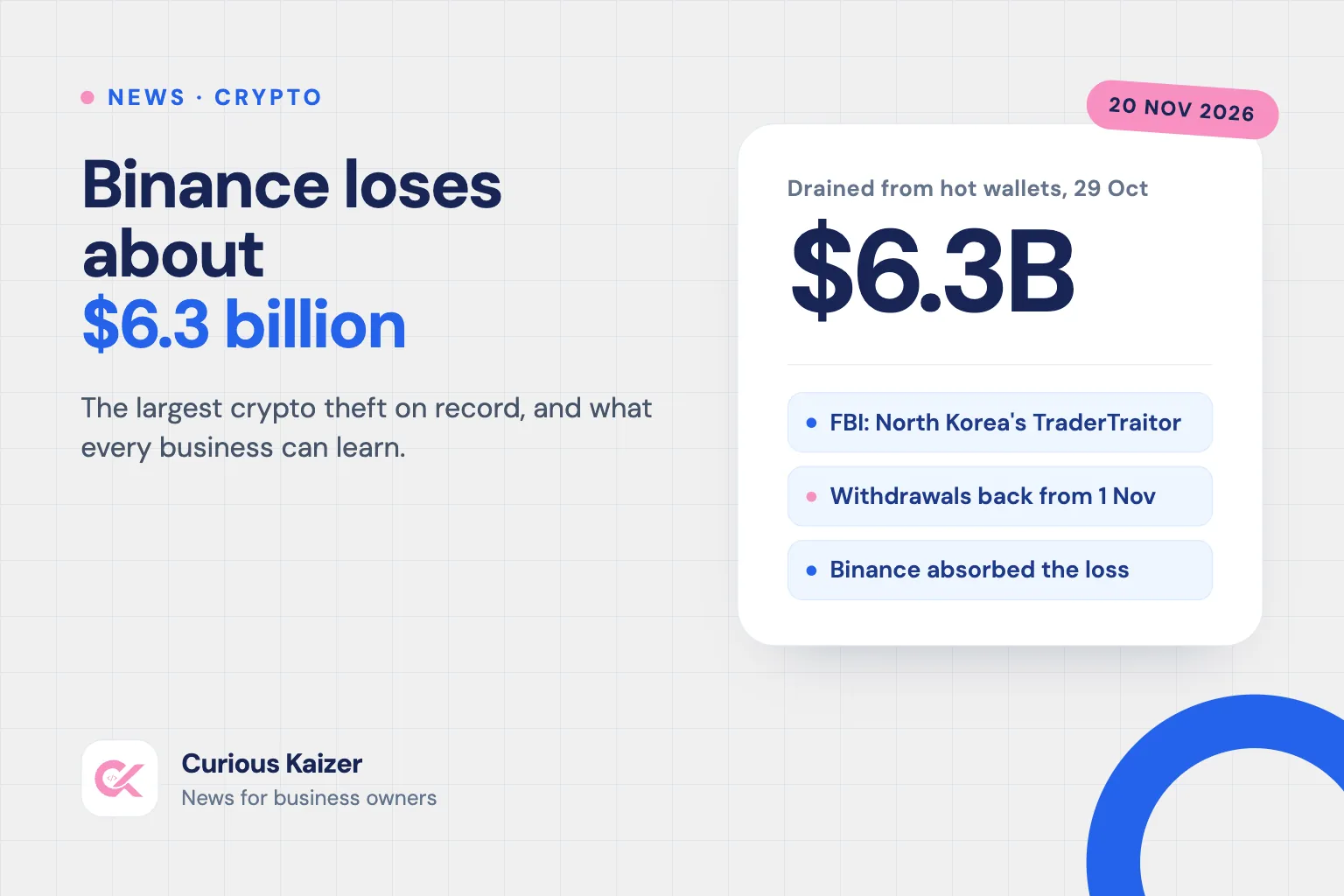
On 29 October 2026, attackers drained about $6.3 billion from hot wallets at Binance, the world's largest crypto exchange, across several blockchains in under four hours. Two days later the FBI attributed the attack to TraderTraitor, a hacking group linked to North Korea. Binance said users would not bear the loss, and withdrawals resumed in phases from 1 November.
Key points
- About $6.3 billion was taken from Binance hot wallets on 29 October 2026, across multiple chains, in under four hours.
- On 31 October the FBI attributed the attack to North Korea's TraderTraitor group.
- Binance said it would absorb the losses and replenished about 90–95% from corporate reserves.
- Deposits stayed open. Withdrawals were restored in phases from 1 November, bitcoin first, then ether and stablecoins.
- Net outflows of about $3.6 billion followed the reopening, then eased.
What happened
A hot wallet is a crypto wallet connected to the internet so an exchange can process withdrawals quickly. Exchanges keep most funds in offline cold storage and only a working balance in hot wallets. On 29 October, attackers gained control of Binance hot wallets and moved funds out across several blockchains. Blockchain analytics firm TRM Labs said most of the outflows happened within about 20 minutes, with the whole attack lasting under four hours.
Binance called it a security incident and paused withdrawals while it investigated. On 31 October the FBI said North Korea's TraderTraitor group was responsible, the same group linked to several large exchange thefts in previous years. Part of the stolen funds was frozen by issuers and exchanges as it moved.
How users were protected
Binance said the losses were its own, not its users'. It replenished about 90–95% of the affected balances from corporate reserves and kept deposits open throughout. Withdrawals came back in stages from 1 November, starting with bitcoin and followed by ether and stablecoins. About $3.6 billion left the exchange in net terms after it reopened, before outflows eased.
Part of a bad year
2026 has been the worst year on record for crypto theft. DefiLlama counted about $8.78 billion stolen across 328 incidents by 4 November. Earlier this year Bitget lost about $351.6 million from hot and warm wallets, covered by its protection fund. We cover the pattern in our post on 2026 crypto hacks.
Lessons for any business
- Keep hot balances small. Whatever system touches money directly, from a crypto wallet to a payments account, should hold only what it needs today.
- Assume people are the target. Groups like TraderTraitor are known for fake job offers and malicious files sent to staff. Training and device controls matter as much as code.
- Separate duties. No single person or key should be able to move large sums. Require approvals from more than one person.
- Have a reserve and a plan. Binance could cover a multi-billion-dollar loss. Most businesses could not survive a smaller one without insurance and an incident plan.
Questions readers ask
How much was stolen from Binance?
About $6.3 billion was drained from Binance hot wallets on 29 October 2026, according to reports.
Who was behind the Binance hack?
The FBI attributed it to TraderTraitor, a hacking group linked to North Korea, on 31 October 2026.
Did Binance users lose money?
Binance said it would absorb the losses and replenished about 90–95% from corporate reserves. Withdrawals were restored in phases from 1 November.
Sources and method
We report what official releases, company filings and established news outlets published up to 20 November 2026, and say so where reports differ. Figures can be revised; check the original source before you act on them.
- Binance statements on the 29 October 2026 security incident.
- FBI attribution to TraderTraitor, 31 October 2026, as reported.
- TRM Labs analysis of the outflows, as reported by Al Jazeera and crypto media.
- DefiLlama hacks dashboard, figures as of 4 November 2026.
This is news and general information for business owners, not investment, tax or legal advice.
Take security seriously
We build internal tools with role-based access, approvals and audit logs, so no single login can move money or data alone.