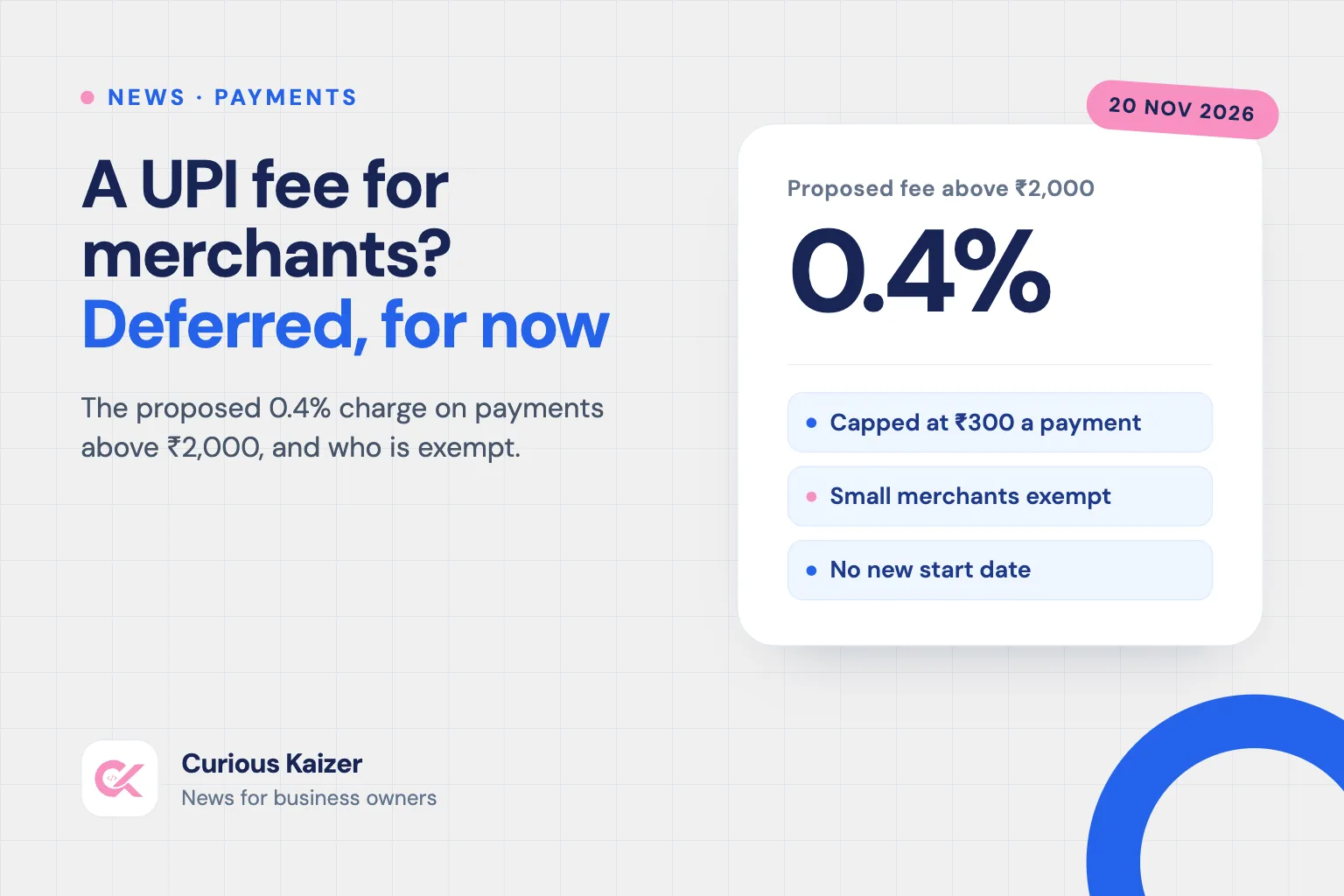
Since 2020, accepting UPI has cost Indian merchants nothing. That was set to change on 15 October 2026, when a merchant discount rate of 0.4% on larger UPI payments was due to start. The start has been pushed back until after the festive season, and no new date has been announced. Here is what was proposed, as reported, and how to get ready either way.
Key points
- The proposal, as reported in September 2026, is a 0.4% fee on UPI payments to merchants above ₹2,000, capped at ₹300 per payment.
- Small merchants receiving up to about ₹1 lakh a month through UPI QR codes would be exempt.
- Person-to-person payments stay free. Some sectors, such as railways, telecom, insurance and fuel, would pay a flat ₹5 per payment above ₹2,000.
- Banks were told merchants must not pass the fee on to customers.
- The 15 October start was deferred until after Diwali. As of mid-November, no new date had been announced.
What is a merchant discount rate?
A merchant discount rate, or MDR, is the fee a business pays its bank or payment provider for accepting a digital payment. Card payments have always carried one. UPI and RuPay debit cards were made MDR-free in 2020, with the government paying banks a subsidy instead. As UPI has grown to billions of payments a month, banks and payment companies have argued that the subsidy no longer covers the cost of running the system.
The proposal, as reported
| Payment type | Proposed fee |
|---|---|
| Person to person (P2P) | Free |
| Merchant payment up to ₹2,000 | Free |
| Merchant payment above ₹2,000 | 0.4%, capped at ₹300 per payment |
| Small merchants, up to about ₹1 lakh a month via UPI QR | Exempt |
| Railways, telecom, insurance, fuel, above ₹2,000 | Flat ₹5 per payment |
Under the reported rules, banks would have to make sure merchants absorb the fee rather than add it to the customer's bill.
Why it was deferred
The fee was meant to start on 15 October 2026, in the middle of the festive season. Reports in early November said it had been put off until after Diwali to avoid disrupting the busiest shopping weeks, and that no new date had been set. Until an official notice is published, UPI payments remain free for merchants.
What it would cost you
A shop that takes ₹10 lakh a month in UPI payments above ₹2,000 would pay about ₹4,000 a month at 0.4%. That is lower than typical card fees, which often run between 1% and 2%, but it is a new cost. Businesses that take large UPI payments, such as furniture, electronics and B2B suppliers, would feel it most, though the ₹300 cap limits the fee on very large payments.
How to prepare
- Know your mix. Pull a report from your payment provider showing how many UPI payments are above ₹2,000 and what they add up to.
- Check your provider's terms. If you use a payment gateway, you may already pay a platform fee on UPI. Ask how a new MDR would be applied on top.
- Do not add a surcharge. Under the reported rules merchants should not pass the fee on, and surcharges also hurt conversion.
- Price for it. If the fee arrives, building 0.4% into your margins on large orders is simpler than changing how you take payments.
Questions readers ask
Is there a fee on UPI payments now?
Not for most merchants. The proposed 0.4% fee on merchant payments above ₹2,000 was deferred, and as of mid-November 2026 no new start date had been announced.
Will customers pay a UPI fee?
Under the reported framework, no. Person-to-person payments stay free, and merchants would not be allowed to pass the fee on to customers.
Are small shops exempt?
Yes, as reported. Small merchants receiving up to about ₹1 lakh a month through UPI QR codes would be exempt.
Sources and method
We report what official releases, company filings and established news outlets published up to 20 November 2026, and say so where reports differ. Figures can be revised; check the original source before you act on them.
- Reports on the UPI MDR framework, September 2026.
- ThePrint and DT Next, reports on the deferral of the UPI merchant fee, early November 2026.
- National Payments Corporation of India, UPI circulars and statistics.
This is news and general information for business owners, not investment, tax or legal advice.
Get paid with less friction
We build checkouts, payment links, invoices and dashboards that work with UPI and the gateways your customers already use.