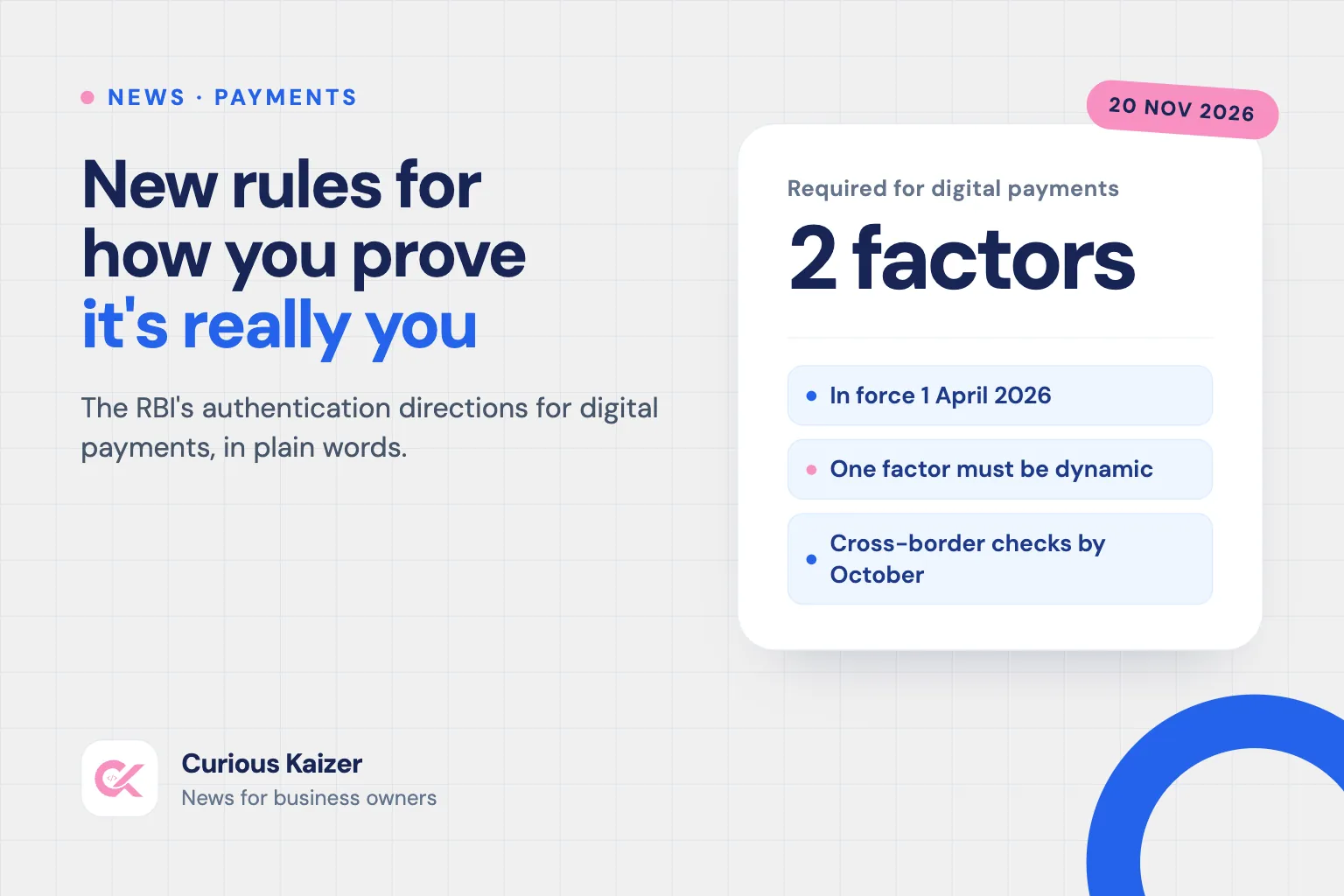
The Reserve Bank of India's directions on authentication for digital payments came into force on 1 April 2026. They require every digital payment to be confirmed with at least two distinct factors, unless it falls under a listed exemption, and they open the door to options beyond the familiar SMS one-time password.
Key points
- The RBI issued the directions on 25 September 2025. They took effect on 1 April 2026.
- They apply to all payment system providers and participants, including banks, card networks and payment apps.
- Every digital payment needs at least two distinct factors, unless exempt under the directions.
- For card-not-present payments, such as online card checkouts, at least one factor must be dynamic, meaning it changes every time.
- SMS OTP is still allowed, but it is no longer meant to be the only option. Card issuers had until 1 October 2026 to add risk-based checks on cross-border online card payments.
What the RBI changed
India has required an extra factor of authentication for card payments for more than a decade, and in practice that factor has almost always been an OTP sent by SMS. SMS OTPs are convenient, but they can be intercepted, phished or stolen through SIM swaps. The new directions keep two-factor authentication but describe it in neutral terms, so banks and payment companies can use other factors too.
A factor is one of three things: something you know, such as a PIN or password; something you have, such as a registered phone or card; or something you are, such as a fingerprint or face. The directions say a payment must be confirmed with at least two different ones.
The main rules
| Rule | What it means |
|---|---|
| Two distinct factors | Every digital payment needs two factors from different categories, unless it is exempt. |
| One dynamic factor for card-not-present | For online card payments, one factor must be unique to that payment, such as an OTP or a cryptographic token. |
| SMS OTP allowed | OTPs still count, but providers can use alternatives, and the RBI expects a move towards them. |
| Exemptions | Listed in an annexure to the directions, for example certain small-value payments. |
| Cross-border card payments | Not covered by the main rule, but issuers had to add risk-based checks for cross-border online card payments by 1 October 2026. |
What changes for customers
Most people will notice little. You may see more banking apps asking for a fingerprint or face scan instead of, or as well as, an OTP. Some banks offer in-app approvals, where you tap to approve a payment on your registered phone. The aim is to make fraud harder without adding steps.
What it means for online sellers
- Use a regulated payment gateway. Your gateway and the customer's bank handle authentication. If you built your own card flow years ago, check it is up to date.
- Design for the extra step. A checkout that loses the customer when they switch to their banking app to approve a payment will lose sales. Keep the order page alive and check payment status automatically.
- Expect fewer chargebacks. Stronger authentication generally means less card fraud, which means fewer disputes for merchants.
- Selling abroad? International cards now face extra risk checks from Indian issuers too, so test your checkout with foreign cards.
Questions readers ask
Is SMS OTP being banned?
No. SMS OTP is still allowed as a factor. The RBI directions let providers use other factors, such as biometrics or app-based approvals, and encourage that shift.
When did the RBI authentication rules start?
The directions were issued on 25 September 2025 and took effect on 1 April 2026.
Do merchants need to do anything?
Mostly no, if you use a regulated payment gateway. Make sure your checkout handles app-based approvals smoothly and test it with both Indian and foreign cards.
Sources and method
We report what official releases, company filings and established news outlets published up to 20 November 2026, and say so where reports differ. Figures can be revised; check the original source before you act on them.
- Reserve Bank of India, Directions on Authentication Mechanisms for Digital Payment Transactions, 25 September 2025.
- Coverage of the directions by Indian business and legal media, September 2025 to April 2026.
This is news and general information for business owners, not investment, tax or legal advice.
Get paid with less friction
We build checkouts, payment links, invoices and dashboards that work with UPI and the gateways your customers already use.