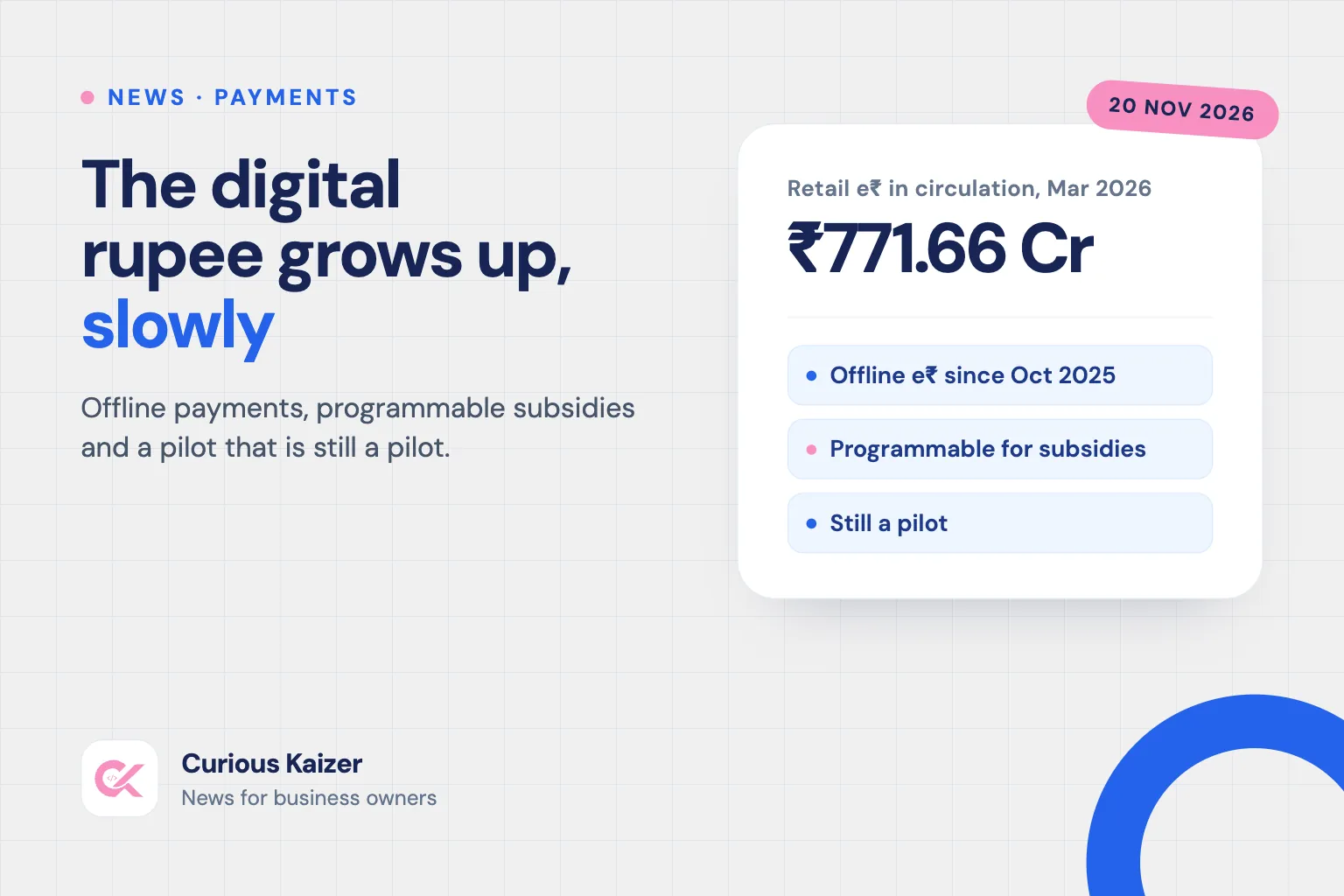
The Reserve Bank of India's retail digital rupee, the e₹, gained two big features in the past year: it can now be used without an internet connection, and it can be programmed so that money is only spent on what it was meant for. Yet the amount in circulation has fallen, and the RBI still calls it a pilot.
Key points
- The retail e₹ is a central bank digital currency: digital cash issued by the RBI, held in a wallet from a participating bank.
- An offline version launched in October 2025, using telecom-assisted and NFC (tap) payments.
- The e₹ can be programmed by expiry date, location, type of merchant or specific merchant, and is being tested for food subsidy payments in Gujarat, Puducherry and Chandigarh.
- Retail e₹ in circulation was ₹771.66 crore on 31 March 2026, down from ₹1,016.46 crore a year earlier.
- Plans for 2026–27 include cross-border pilots, tokenisation and more government benefit schemes.
What the e₹ is
The digital rupee is legal tender issued directly by the RBI, like a banknote, but held in a digital wallet. Unlike UPI, which moves money between bank accounts, the e₹ is the money itself. You load your wallet from your bank account and pay by scanning a QR code or tapping a phone. The wallets are offered by participating banks, and the RBI updated its public FAQ on the e₹ as recently as 1 October 2026.
What is new
- Offline payments. Since October 2025 the e₹ can be used where mobile data is weak or absent, through telecom-assisted payments and near-field communication between devices. That matters in rural areas and crowded places.
- Programmability. Money can be issued with rules attached: spend it before a certain date, only in a certain area, only at certain kinds of shop, or only with a named merchant. Pilots are using this to deliver public distribution system benefits in Gujarat, Puducherry and Chandigarh, so that subsidy money is used for its purpose.
- Next steps. The RBI has signalled cross-border CBDC pilots, tokenisation of assets and use in more direct benefit transfer schemes in 2026–27.
The adoption problem
| Date | Retail e₹ in circulation |
|---|---|
| 31 March 2025 | ₹1,016.46 crore |
| 31 March 2026 | ₹771.66 crore |
The fall is not surprising. For a shopper, UPI already does almost everything the e₹ does, is accepted everywhere and is linked to the bank account they already use. The e₹ is most useful where it does something UPI cannot: working offline, or carrying spending rules for subsidies and corporate expenses.
What it means for businesses
For most merchants, nothing changes today. Interoperable UPI QR codes can accept e₹ payments, and the money settles to your account. Where it may matter later is in programmable payments. Imagine a company issuing travel or meal allowances that can only be spent at approved vendors, or a supplier paid with funds released only on delivery. Those ideas are being tested, not yet mainstream. We will keep watching.
Questions readers ask
Is the digital rupee the same as UPI?
No. UPI moves money between bank accounts. The e₹ is digital cash issued by the RBI and held in a wallet, though you can often pay with it by scanning the same UPI QR codes.
Can the e-rupee work without the internet?
Yes. An offline version launched in October 2025 using telecom-assisted and NFC payments.
How much digital rupee is in circulation?
Retail e₹ in circulation was ₹771.66 crore on 31 March 2026, according to RBI data, down from ₹1,016.46 crore a year earlier.
Sources and method
We report what official releases, company filings and established news outlets published up to 20 November 2026, and say so where reports differ. Figures can be revised; check the original source before you act on them.
- Reserve Bank of India, FAQs on the digital rupee (updated 1 October 2026) and Annual Report data.
- Reports on the offline e₹ launch at the Global Fintech Fest, October 2025.
- Reports on programmable e₹ pilots for the public distribution system.
This is news and general information for business owners, not investment, tax or legal advice.
Get paid with less friction
We build checkouts, payment links, invoices and dashboards that work with UPI and the gateways your customers already use.