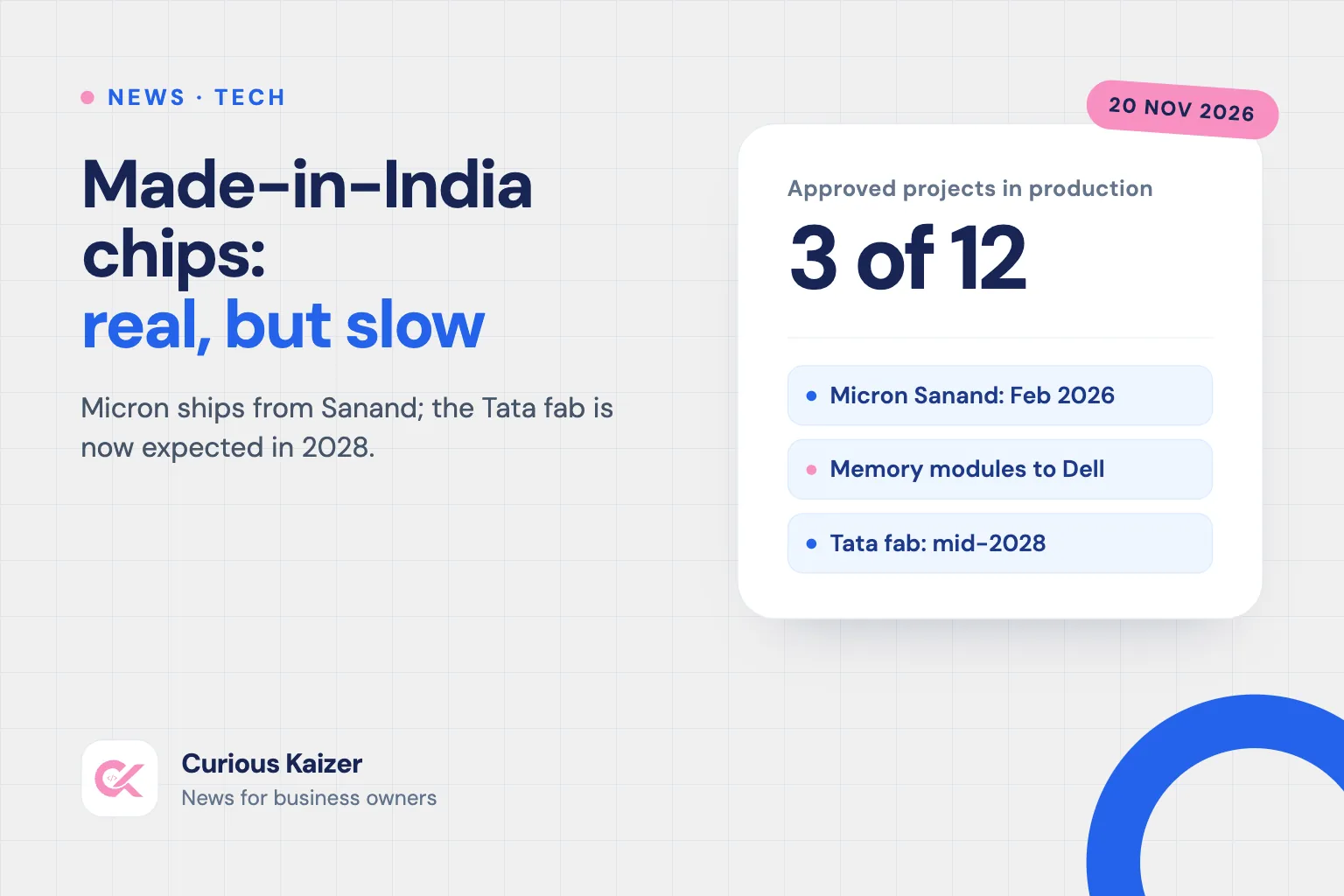
India's semiconductor ambitions produced real chips in 2026. Micron's assembly and test plant at Sanand, Gujarat, was inaugurated by Prime Minister Narendra Modi on 28 February 2026 and began commercial production, shipping the first made-in-India memory modules to Dell. But the country's first big chip fab, Tata Electronics' project at Dholera, is now expected to start commercial production in mid-2028, later than planned.
Key points
- Micron's Sanand assembly, test, marking and packaging (ATMP) plant was inaugurated on 28 February 2026 and is in commercial production.
- The first made-in-India memory modules were shipped to Dell, with HP also reported as a customer.
- Kaynes and CG Semi plants in Sanand are also in commercial production, making 3 of the 12 approved projects.
- The Tata–PSMC fab at Dholera, about $10.7 billion for 28-nanometre chips, is now expected in mid-2028, against an earlier late-2026 target, according to Bloomberg.
- Packaging and testing are arriving first; making the chips themselves takes longer.
Assembly first, fabs later
Making a chip has two broad stages. A fabrication plant, or fab, makes the chips on silicon wafers, which is the hardest and most expensive part. Assembly and test plants then cut, package and test those chips so they can go into products. India's first wave of projects is mostly in the second stage, which is faster to build. Micron's Sanand plant takes memory chips made elsewhere and turns them into finished memory modules.
Where the projects stand
| Project | Type | Status |
|---|---|---|
| Micron, Sanand | Assembly and test (memory) | Commercial production since February 2026; modules shipped to Dell |
| Kaynes, Sanand | Assembly and test | Commercial production |
| CG Semi, Sanand | Assembly and test | Commercial production |
| Tata–PSMC, Dholera | Fab, 28 nm, about $10.7 billion | Commercial production expected mid-2028 |
Why it matters
Chips are in everything from phones and cars to payment terminals and medical devices. The pandemic shortage and today's geopolitical tensions showed the risk of depending on a few countries. Domestic packaging and testing build skills and supply chains, attract suppliers and make it more likely that full fabs succeed later. Delays are common in this industry worldwide; what matters is steady progress.
What it means for businesses
For hardware makers, a local supply of packaged memory and chips could, over time, mean shorter lead times and less currency risk. For everyone else, the effect is gradual: more electronics manufacturing in India, more skilled jobs, and a slightly more resilient supply of the devices businesses run on.
Questions readers ask
Is India making semiconductors now?
India has chip assembly, testing and packaging plants in commercial production, including Micron, Kaynes and CG Semi in Sanand. Its first large fab, at Dholera, is expected in mid-2028.
When did Micron's Sanand plant start?
It was inaugurated by Prime Minister Modi on 28 February 2026 and began commercial production, shipping memory modules to Dell.
When will Tata's Dholera fab start production?
Commercial production is now expected in mid-2028, according to Bloomberg, later than an earlier late-2026 target.
Sources and method
We report what official releases, company filings and established news outlets published up to 20 November 2026, and say so where reports differ. Figures can be revised; check the original source before you act on them.
- Press Information Bureau releases on the Micron Sanand inauguration, 28 February 2026.
- Bloomberg reporting on the Tata–PSMC Dholera fab timeline, 2026.
- India Semiconductor Mission, approved projects.
This is news and general information for business owners, not investment, tax or legal advice.
Turn tech news into an edge
We help businesses pick the AI and web tools that actually save time, and build them properly.