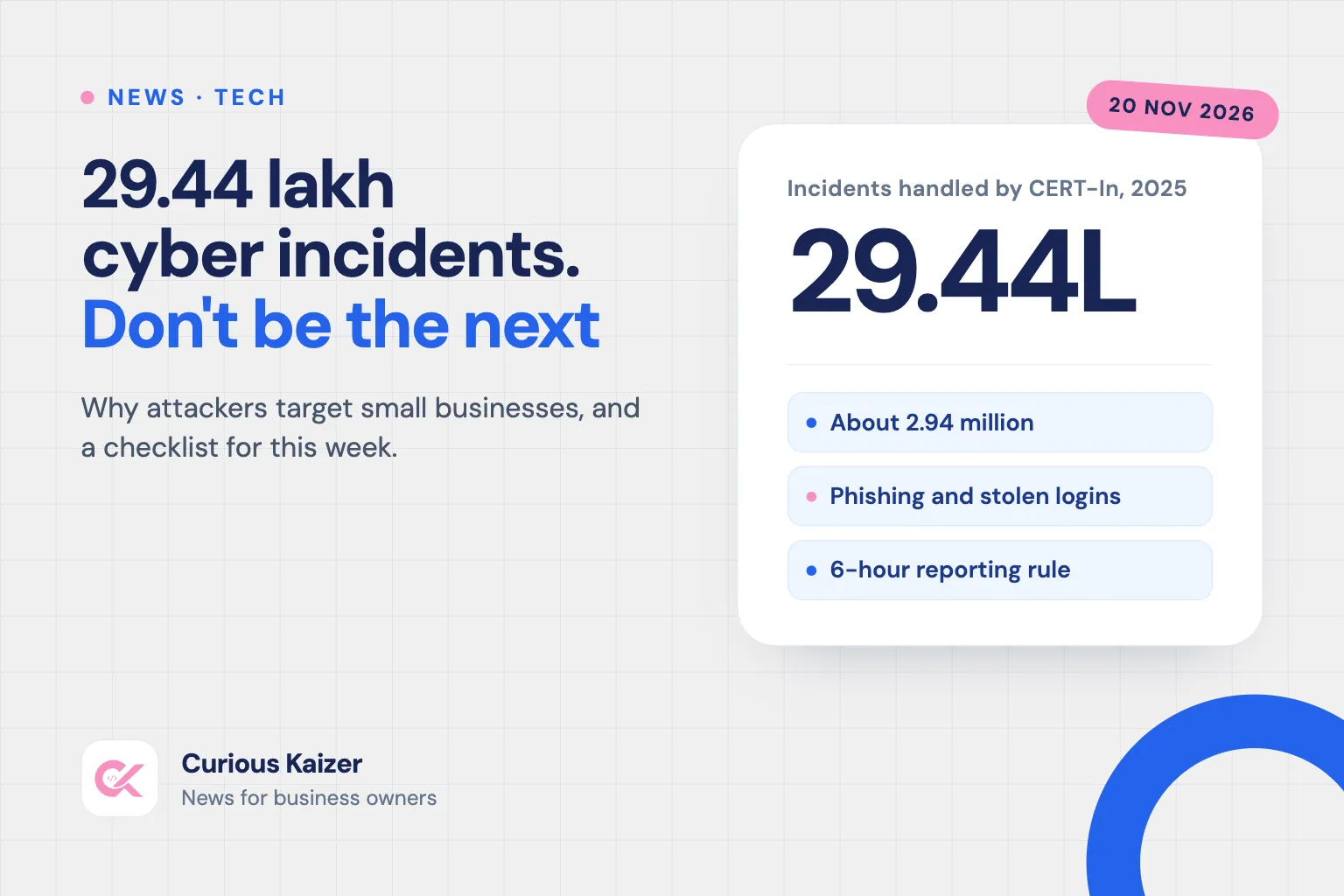
India's national cyber security agency, CERT-In, handled 29.44 lakh, or about 2.94 million, cyber security incidents in 2025. Large companies make the headlines, as when Tata Electronics confirmed an incident in June 2026 that it said did not affect operations. But small businesses are hit far more often, because they are easier targets. The good news is that a handful of basic steps stop most attacks.
Key points
- CERT-In handled 29.44 lakh (about 2.94 million) incidents in 2025.
- Large firms are targets too: Tata Electronics confirmed a cyber incident in June 2026, saying operations were unaffected.
- Most attacks on small businesses start with phishing, stolen passwords or unpatched software.
- CERT-In rules require many organisations to report certain incidents within 6 hours of noticing them.
- Multi-factor authentication, backups and updates prevent most of the damage.
Why small businesses are targets
Attackers go where it is easy. Small businesses often share passwords, skip software updates, have no backups and rarely train staff. Common attacks include fake invoices and payment-change emails, stolen email and social media logins, ransomware that locks files until a payment is made, and hacked websites used to spread malware or spam. The losses can be money, data, reputation or days of downtime.
Your reporting duty
CERT-In's 2022 directions require service providers, intermediaries, data centres, companies and government organisations to report specified types of cyber incidents within six hours of noticing them. Under the DPDP Act, personal data breaches must also be reported to the Data Protection Board and affected people once those duties apply. Know who in your business makes those calls.
A checklist for this week
| # | Action | Why |
|---|---|---|
| 1 | Turn on multi-factor authentication for email, banking, cloud and social accounts | Stops most stolen-password attacks |
| 2 | Use a password manager and unique passwords | One leak does not open everything |
| 3 | Back up important data automatically, with one copy offline | Ransomware cannot hold you hostage |
| 4 | Turn on automatic updates for computers, phones and website software | Closes known holes |
| 5 | Confirm any change in bank details by phone | Stops fake invoice fraud |
| 6 | Give staff only the access they need, and remove it when they leave | Limits damage from any one account |
| 7 | Set up SPF, DKIM and DMARC on your email domain | Makes it harder to impersonate you |
| 8 | Keep your website on managed hosting with HTTPS and a firewall | Protects customers and your search ranking |
| 9 | Train staff to spot phishing, twice a year | People are the first line of defence |
| 10 | Write a one-page incident plan | You know who to call and what to shut off |
Where we help
Many of the sites we take over have outdated plugins, shared admin logins and no backups. Every site we build and host gets HTTPS, automatic updates, backups and email authentication as standard, and admin areas use proper logins with roles. It is not exciting, and that is the point.
Questions readers ask
How many cyber incidents were there in India in 2025?
CERT-In handled 29.44 lakh, or about 2.94 million, cyber security incidents in 2025.
Do I have to report a cyber attack in India?
CERT-In's 2022 directions require many organisations to report specified incidents within six hours of noticing them. Personal data breaches also fall under the DPDP Act as its duties come into force.
What is the most important security step for a small business?
Turning on multi-factor authentication for email, banking and cloud accounts stops a large share of attacks. Automatic backups and updates come next.
Sources and method
We report what official releases, company filings and established news outlets published up to 20 November 2026, and say so where reports differ. Figures can be revised; check the original source before you act on them.
- CERT-In, incident statistics for 2025 and directions of 28 April 2022.
- Reports on the Tata Electronics cyber incident, June 2026.
- Digital Personal Data Protection Act, 2023 and Rules, 2025.
This is news and general information for business owners, not investment, tax or legal advice.
Secure by default
Every site we build and host comes with HTTPS, backups, updates, email authentication and role-based admin access.