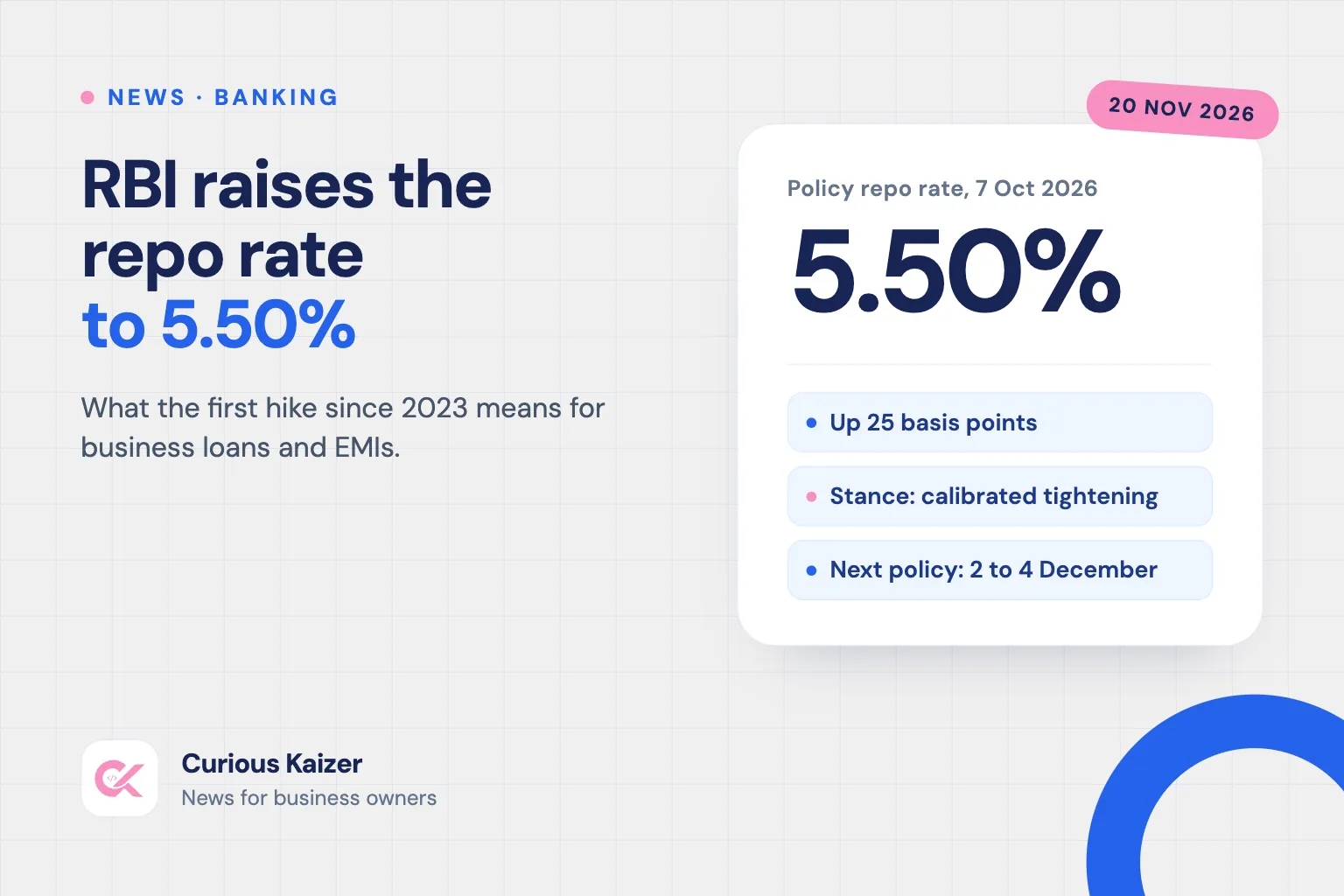
The Reserve Bank of India raised its policy repo rate by 25 basis points to 5.50% on 7 October 2026. It is the first increase since February 2023 and ends a run in which the RBI cut rates by a total of 125 basis points in 2025 and then held at 5.25%. For anyone with a business loan, a home loan or a working-capital line, the cheap-money phase is over for now.
Key points
- The Monetary Policy Committee voted 6–0 to lift the repo rate from 5.25% to 5.50% at its 5–7 October 2026 meeting.
- It changed its stance from neutral to "calibrated tightening", by a 4–2 vote.
- The standing deposit facility rate is now 5.25%, and the marginal standing facility rate and Bank Rate 5.75%.
- Governor Sanjay Malhotra said rate cuts are off the table in the near term. The next meeting is on 2–4 December 2026.
- Repo-linked loans will reprice first. Check your loan's benchmark and reset date now.
What the RBI decided
The six-member Monetary Policy Committee met from 5 to 7 October 2026 under Governor Sanjay Malhotra. All six members voted to raise the policy repo rate, the rate at which the RBI lends to banks overnight, by 25 basis points to 5.50%. With it, the standing deposit facility rate moved to 5.25% and the marginal standing facility rate and Bank Rate to 5.75%.
The committee also dropped its neutral stance for one it calls "calibrated tightening". That vote was 4–2. In plain terms, the RBI is telling markets that its next move is more likely to be another increase than a cut.
| Period | Repo rate | What happened |
|---|---|---|
| February to December 2025 | 6.50% to 5.25% | Cuts totalling 125 basis points |
| February, April and August 2026 | 5.25% | Held, stance neutral |
| 7 October 2026 | 5.50% | Raised 25 basis points; stance "calibrated tightening" |
Why it raised rates
Inflation turned. Headline consumer inflation rose to 4.8% in August 2026, pushed up by food and fuel, and the RBI said it expects inflation to average close to 5.8% over the next three quarters. Fuel is the bigger worry: the war involving Iran that began in late February has kept crude oil prices high and weakened the rupee, which makes every imported barrel dearer.
Malhotra was blunt about what comes next, saying that given current conditions, rate cuts are off the table in the near term and the next move can only be a hike or a pause. Since the meeting, October's retail inflation came in at 6.09%, above the RBI's upper tolerance limit, which is why economists now debate a second hike in December.
What it means for your loans
Most new floating-rate loans to individuals and small businesses in India are linked to an external benchmark, usually the repo rate. Under RBI rules those loans must reset at least once every three months, so a repo increase reaches them quickly. Loans linked to a bank's MCLR move more slowly, because MCLR follows the bank's own cost of funds.
- Term loans and EMIs. Banks usually pass on a repo increase in full to repo-linked loans. Many keep the EMI the same and stretch the tenure instead; ask which your bank does.
- Working capital. Cash credit and overdraft limits priced off the repo will cost more on every rupee you draw. It pays to collect receivables faster than before.
- Deposits. Fixed-deposit rates tend to rise after a hike, which helps businesses holding cash.
Twenty-five basis points on a ₹50 lakh repo-linked loan is about ₹12,500 a year in extra interest before the balance falls. Small on its own, but it compounds with any further hikes.
What to do this quarter
Pull your loan sanction letters and note the benchmark, the spread and the next reset date on each. If you are planning capital spending on borrowed money, run the numbers at 6% as well as 5.50%. And look at the slow parts of your cash cycle: unpaid invoices, enquiries that never get a follow-up, stock that sits too long. Those cost more when money is dearer.
This is where tools earn their keep. A CRM that reminds the team about every quote and overdue invoice, or a simple web app that shows cash, receivables and stock in one place, often pays back faster than a rate cut would.
Questions readers ask
What is the repo rate now?
The policy repo rate is 5.50%, after the RBI raised it by 25 basis points on 7 October 2026.
Will my EMI go up?
If your loan is linked to the repo rate, your bank will pass on the increase at the next reset, which by RBI rules comes at least every three months. Many banks extend the tenure instead of raising the EMI, so ask your bank which it will do.
When is the next RBI policy?
The Monetary Policy Committee meets on 2–4 December 2026. Several economists expect another increase after October inflation rose to 6.09%.
Sources and method
We report what official releases, company filings and established news outlets published up to 20 November 2026, and say so where reports differ. Figures can be revised; check the original source before you act on them.
- Reserve Bank of India, Monetary Policy Statement and MPC resolution, 7 October 2026.
- Press coverage of the October 2026 MPC decision: Moneylife, Drishti IAS daily analysis and OneIndia, 7–9 October 2026.
- RBI MPC resolutions of February and April 2026 (repo rate held at 5.25%).
- Ministry of Statistics and Programme Implementation, CPI release for October 2026, 12 November 2026.
This is news and general information for business owners, not investment, tax or legal advice.
Build for tighter money
When borrowing costs rise, a website that brings its own leads and a CRM that chases every one matter more. Tell us what you need.