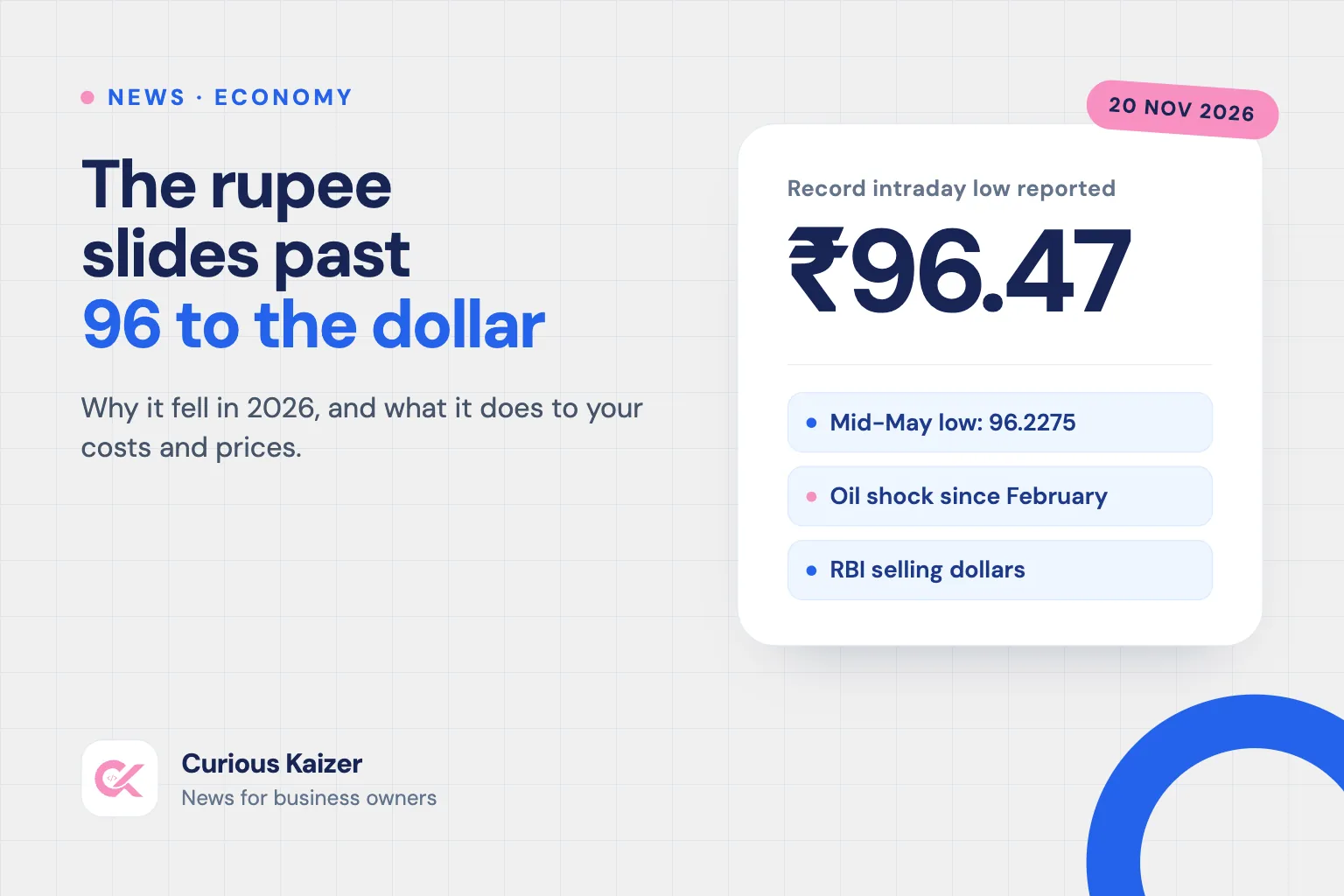
The Indian rupee has set a string of record lows against the US dollar in 2026, falling past 94 in March and past 96 by May. A record intraday low of 96.47 has been reported, and in early October it was still trading near 96.4. For any business that buys in dollars, that is a quiet price increase on everything from crude-linked inputs to software subscriptions.
Key points
- The rupee fell to 94.79 per dollar in late March and 96.2275 in mid-May 2026, both records at the time.
- A record intraday low of 96.47 has been reported, and the rupee was near 96.4 in early October.
- Reports describe it as Asia's weakest major currency this year.
- The main causes are the oil shock from the conflict involving Iran, foreign outflows and importers buying dollars to hedge.
- Importers and anyone paying for dollar-priced software pay more; exporters and service firms billing in dollars earn more rupees.
How far the rupee has fallen
The slide began early in the year, when foreign investors pulled money out and importers rushed to hedge. It sped up after the conflict involving Iran began in late February, which sent crude oil above $100 a barrel within days. India imports most of its oil, so a higher oil bill means more demand for dollars.
| When | Level |
|---|---|
| Late March 2026 | 94.79 |
| Mid-May 2026 | 96.2275 |
| Record intraday low (reported) | 96.47 |
| 6 October 2026 | About 96.4 |
The Reserve Bank of India has sold dollars from its reserves to slow the fall rather than fix a level. Its October rate increase also helps at the margin, because higher Indian rates make rupee assets more attractive.
Who gains and who loses
- Importers of electronics, machinery, chemicals and anything priced in dollars see costs rise even when the supplier's price is unchanged.
- Digital businesses pay more for tools billed in dollars: cloud hosting, design software, AI subscriptions and many SaaS products.
- Advertisers buying on global platforms may see costs move with the exchange rate, depending on billing currency.
- Exporters and IT or design firms billing overseas clients in dollars receive more rupees for the same invoice.
Practical steps
List every cost you pay in dollars and add them up at 96 rather than the rate you budgeted. Ask whether an Indian price exists: several large software companies publish rupee pricing that does not move daily. If you import regularly, talk to your bank about forward contracts, which fix a rate for a future payment; that is a conversation for your bank or adviser, not a blog. If you sell abroad, consider quoting in dollars now that the rupee is weak.
We price our own work in rupees for Indian clients and in dollars for software builds, and we host client sites on platforms with predictable bills. See how on our pricing page.
Questions readers ask
What is the rupee's record low?
Reports put the record intraday low at about 96.47 rupees per dollar in 2026. The exact level and date vary between sources, so check a live quote.
Why is the rupee falling in 2026?
Mainly because oil prices rose sharply after the conflict involving Iran began in February, foreign investors pulled money out, and importers bought dollars to hedge.
Does a weak rupee help anyone?
Yes. Exporters and companies that bill in dollars, such as IT and design service firms, receive more rupees for each dollar they earn.
Sources and method
We report what official releases, company filings and established news outlets published up to 20 November 2026, and say so where reports differ. Figures can be revised; check the original source before you act on them.
- Trading Economics currency notes on the Indian rupee, including 6 October 2026.
- Business Standard, Deccan Herald and Malay Mail reports on rupee record lows, March to May 2026.
- Reports on RBI dollar sales and the October 2026 policy decision.
This is news and general information for business owners, not investment, tax or legal advice.
Costs in dollars, revenue in rupees?
We help businesses move tools in-house, cut subscription bills and build software they own.