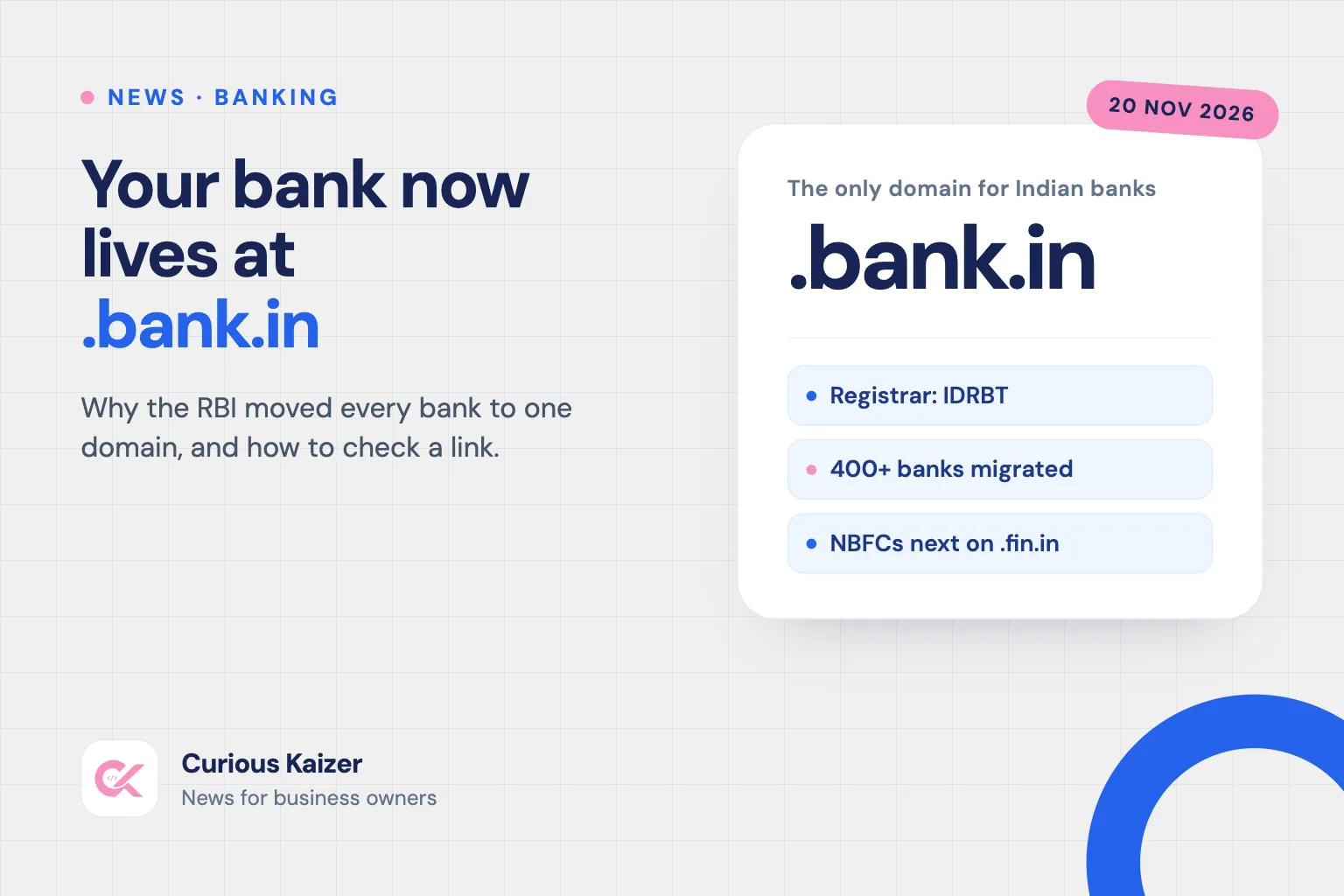
If your bank's website address changed in the last year, that was the Reserve Bank of India's doing. In April 2025 the RBI told every bank in India to move its websites to the .bank.in domain, which only verified banks can register, and set a deadline of 31 October 2025. The aim is simple: make it harder for fraudsters to copy a bank's website.
Key points
- The RBI's circular of 22 April 2025 required banks to move to .bank.in by 31 October 2025.
- Only banks can register .bank.in names. The registrar is IDRBT, the RBI's banking technology institute.
- More than 400 banks have migrated, including all major public and private sector banks, though some missed the first deadline.
- Non-bank finance companies are to get a separate .fin.in domain; we found no confirmed date yet.
- Teach staff who make payments to check the domain, not just the logo.
What changed
Before the move, Indian banks used every kind of address: .com, .co.in, .in and others. That made it easy for fraudsters to register a lookalike such as a bank's name with an extra word or a different ending, copy the login page and send the link by SMS or WhatsApp. Customers had no simple rule to tell a real site from a fake.
The RBI's fix is one domain that only banks can hold. The Institute for Development and Research in Banking Technology checks that an applicant is a licensed bank before issuing a .bank.in name. If an address does not end in .bank.in, it is not your bank's official website, whatever it looks like.
Where the migration stands
The deadline was 31 October 2025. Reports since then say more than 400 banks have moved, including all the major public and private sector banks, although some needed more time than the RBI allowed. Most banks redirect their old addresses to the new one, so old bookmarks still work for now.
The RBI has also said financial companies that are not banks, such as NBFCs, will use a separate .fin.in domain. We have not seen a confirmed timeline for it, so do not assume an NBFC site is fake just because it still uses another ending.
What businesses should do
- Train whoever pays bills. The most expensive fraud for small firms is a fake bank or vendor page that captures login details or changes payment details. The rule "bank sites end in .bank.in" is easy to teach.
- Update saved links. Replace old bank bookmarks in your team's browsers and password manager with the new .bank.in addresses.
- Check payment links in invoices and emails. If a vendor sends new bank details, confirm them by phone on a number you already have.
- Protect your own domain. Set up SPF, DKIM and DMARC on your company email so fraudsters cannot easily send invoices that look like they came from you.
Email authentication records are a ten-minute job that many small businesses skip. We set them up as standard when we build and host a client's website.
Questions readers ask
Is .bank.in mandatory for all Indian banks?
Yes. The RBI's April 2025 circular told all banks to migrate to .bank.in, with a deadline of 31 October 2025.
What is .fin.in?
It is the domain the RBI has said will be used by financial companies that are not banks, such as NBFCs. A launch date had not been confirmed when we checked.
How can I tell if a bank website is real?
Check that the address ends in .bank.in, type the address yourself rather than following links in messages, and never share an OTP or password on a page you reached from an SMS.
Sources and method
We report what official releases, company filings and established news outlets published up to 20 November 2026, and say so where reports differ. Figures can be revised; check the original source before you act on them.
- Reserve Bank of India, circular "Migration to .bank.in domain", 22 April 2025.
- Business Standard and Business Today coverage of the RBI circular, April 2025.
- The Paypers and Digit reports on banks completing the migration.
- Law.asia, on the planned .fin.in domain for NBFCs.
This is news and general information for business owners, not investment, tax or legal advice.
Make your own domain harder to fake
We set up email authentication, secure hosting and clear payment pages for the businesses we work with.