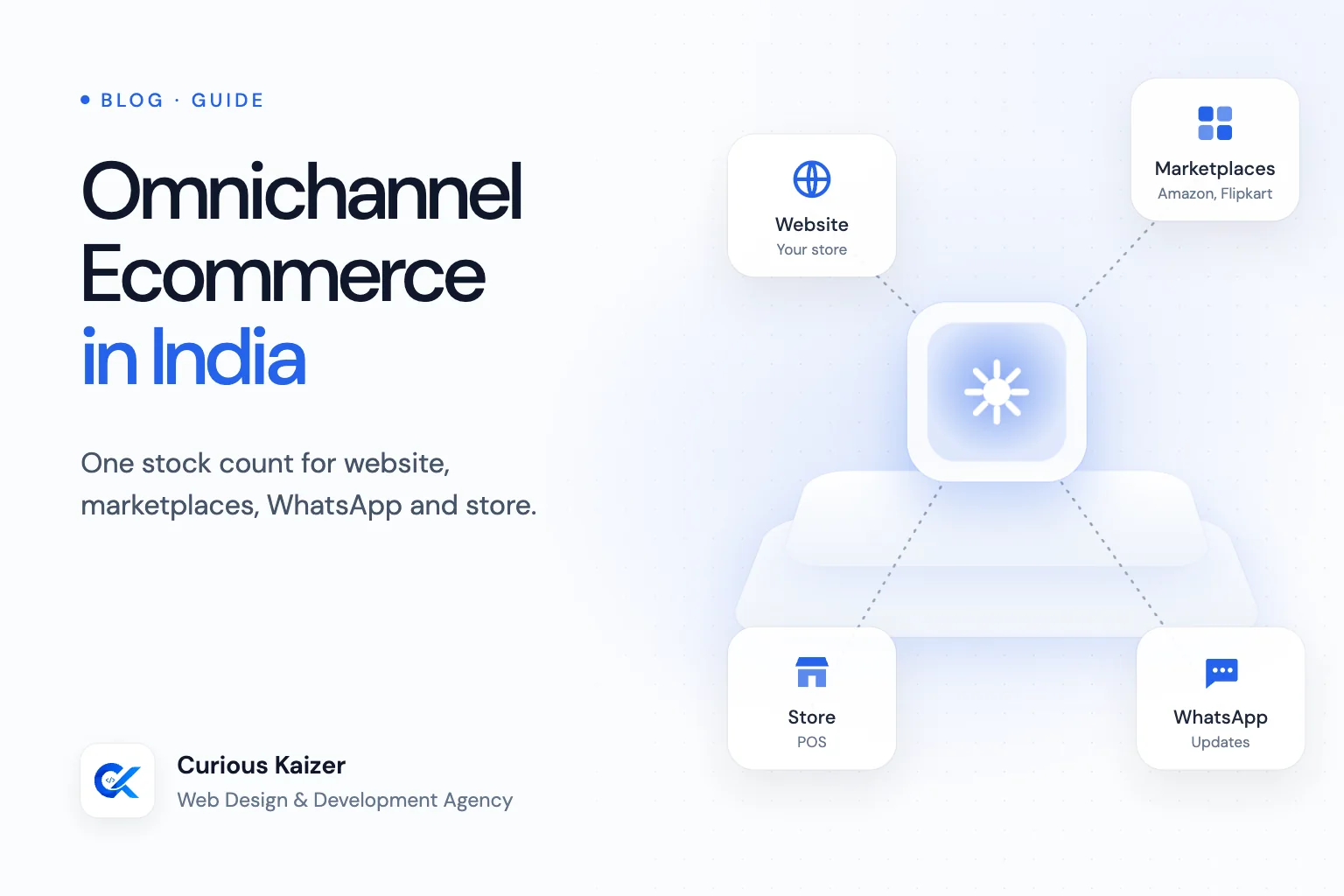
Most Indian brands already sell in more than one place: their own website, a marketplace or two, Instagram, WhatsApp and often a shop. Selling in many places is multichannel. Omnichannel is when those places share one catalog, one stock count, one order flow and one customer record, so a shopper gets the same price, the same promise and the same updates wherever they buy. This guide explains how to build that, in what order, and what it costs to run.
Key takeaways
- Pick one system of record for products, stock and orders, usually your commerce platform or an ERP, and connect every channel to it. Do not keep stock in spreadsheets per channel.
- Overselling is the first problem omnichannel fixes. Sync stock often and hold a small safety buffer on marketplaces.
- WhatsApp is the channel Indian customers answer. Since July 2025 Meta charges per delivered template message, and from 1 October 2026 utility messages inside the customer service window are charged too.
- ONDC is reached through a seller app, not a single dashboard. Several seller apps offer connectors for Shopify and WooCommerce stores.
- Build in phases: website, payments, shipping and WhatsApp first; marketplaces and stock sync next; ONDC, store POS and loyalty after that.
Omnichannel vs multichannel
A multichannel brand has a website, an Amazon listing and an Instagram page, each run on its own. Stock is updated by hand, prices drift apart, and a customer who ordered on the website and messages on WhatsApp is a stranger to whoever replies. An omnichannel brand runs the same channels from one centre. The difference shows up in three places:
- Stock. One count, updated by every sale on every channel, so nothing sells twice.
- Orders. Every order lands in one queue, whatever its source, and flows to packing, shipping and invoicing the same way.
- Customers. One record per customer with their orders, messages and loyalty points, so any team member can answer.
The channels Indian brands sell on
| Channel | What it is good for | How it usually connects |
|---|---|---|
| Your own website | Margin, brand, customer data and repeat orders | It is the centre: Shopify, WooCommerce or a custom store |
| Amazon and Flipkart | Reach and search demand inside the marketplace | The marketplace's seller tools or a listing and stock-sync app; fees on each marketplace's own fee page |
| ONDC | Being found through many buyer apps on an open network | A seller app that is an ONDC network participant |
| Instagram and Facebook | Discovery, product tags and ads | Meta's official apps for Shopify and WooCommerce sync the catalog |
| Product results in Search and Shopping, and ads | Google Merchant Center, through Google's apps for Shopify and WooCommerce | |
| Orders, updates, support and repeat sales | The WhatsApp Business Platform through a provider, linked to your store and CRM | |
| Your physical store | Walk-in sales, pickups and returns | A POS that shares stock with the online store |
You do not need all seven. Start where your customers already are, and add a channel only when the one before it runs without manual fixes.
How the pieces connect
An omnichannel setup has three layers. Channels take orders. A central system keeps the catalog, stock, orders and customers. Operations tools take payment, ship, message and invoice. Every arrow below is an integration that has to be set up, tested and watched.
Channels
- Website
- Amazon, Flipkart
- ONDC seller app
- Instagram, Facebook
- Google Merchant Center
- Store POS
One system of record
- Catalog and prices
- Stock count
- Order queue
- Customer record
Shopify, WooCommerce or an ERP
Operations
- Payments: Razorpay
- Shipping: Shiprocket
- WhatsApp updates
- CRM and loyalty
- GST invoices, accounts
The Total Fitness build follows this shape. One customer account holds supplement orders from the headless Shopify store, digital gym memberships and FitPoints loyalty, with Razorpay for payment and Shiprocket for shipping. WatFix shows the same idea on the lead side: its CRM takes enquiries from Meta Lead Ads forms and Click-to-WhatsApp chats and carries each one through quotation, order, dispatch, delivery and GST invoice.
Stock sync and overselling
Overselling is the most common and most expensive omnichannel failure. A product sells on Amazon and on your website within the same few minutes, there was only one left, and someone gets a cancellation. Marketplaces track cancellations, so repeated ones can hurt your account.
- One source of truth. Stock lives in the central system. Channels read from it; nobody edits stock inside a marketplace by hand.
- Sync frequency. Check how often your connector pushes stock to each channel. Some update on every sale, others on a schedule.
- Safety buffer. Show a marketplace slightly less than you hold on fast-moving items, and release the buffer to your own website, where you control what happens if you run out.
- Bundles and variants. A combo pack must reduce the stock of every item inside it. Test this on each channel.
- Returns. Decide when a returned item goes back into sellable stock, after a quality check, and make that step update the central count.
WhatsApp: updates, sales and costs
WhatsApp works as a channel in two directions. Customers start chats from your website, ads and Instagram, and you send them order confirmations, shipping updates, payment links and offers. The second direction needs the WhatsApp Business Platform, reached through a provider, rather than the free WhatsApp Business app.
How Meta charges, from its pricing page as read on 20 November 2026:
- Since 1 July 2025, pricing is per delivered message, not per conversation, and only for messages from the business to the customer.
- Template messages fall into marketing, utility (such as order and shipping updates) and authentication categories, each with its own rate per country. Marketing costs the most.
- Replies inside the 24-hour customer service window are service messages, with a free allowance of 1,000 per business number per month.
- From 1 October 2026, utility messages sent inside the customer service window are charged, where they were free before.
- Chats that start from a Click-to-WhatsApp ad or a Facebook Page button open a free entry window.
- India accounts must move to INR billing by 31 December 2026, according to Meta.
Rates per message change and are published on Meta's INR rate card, so budget from that sheet, not from a blog post. To keep the bill sensible, send utility updates that customers expect, keep marketing messages for people who opted in, and route replies into a shared inbox or CRM so nobody waits. Our guide on connecting WhatsApp and Meta lead ads to a CRM covers the lead side in detail.
Selling on ONDC
The Open Network for Digital Commerce is not a marketplace with one seller dashboard. Your products appear in buyer apps on the network through a seller-side app that is an ONDC network participant. A 2026 guide from Fretron describes the steps as choosing a seller app, registering with business, GST and bank details, and uploading the catalog.
For brands that already run a website, the useful part is that several seller apps offer connectors for existing stores. Shiprocket's seller app was announced to make Shopify stores discoverable on the network, and Mystore publishes channels for Shopify and WooCommerce. Check each seller app's current fees, categories and support before you choose one, and treat ONDC as another channel reading from your central stock, not a separate catalog to keep by hand.
Linking a physical store
If you have a shop, a showroom or a gym counter, its sales must reduce the same stock count as online orders. A POS that belongs to your commerce platform makes this simplest. Shopify's India pricing page lists a POS Pro add-on at ₹7,000 a month per location. Shared stock also enables what customers ask for most: buy online and pick up in store, and return an online order at the counter.
A store network can also be part of the website without a checkout. The AUCO Automotive website, for example, is a showroom for 51 car accessories with a catalog and a store network, so shoppers can see products online and buy through a dealer.
GST, payouts, COD and returns
Each channel settles money differently, and that is where finance teams lose time.
- Invoices. Your own channels must issue GST invoices with your GSTIN and the right tax split. Marketplaces generate invoices in their own systems; make sure they match your books.
- Marketplace deductions. Marketplaces collect TCS under GST and deduct their fees before paying you. Reconcile payouts against orders, not against bank credits alone.
- Cash on delivery. Track what the courier collected, what it remitted and when. Unremitted COD is money you have earned and not received.
- Returns and RTO. Record why each order came back, whether it was refunded, and whether stock went back on sale.
When volumes grow, these steps belong in software rather than spreadsheets. That is the point where a store needs ERP or operations software alongside the storefront.
A phased roadmap
Trying to launch every channel at once is how omnichannel projects stall. A safer order:
- Phase 1: the core. Your website on a platform you can grow with, a payment gateway, a shipping partner, WhatsApp chat on the site, analytics, and order updates that customers can rely on.
- Phase 2: the first extra channel. One marketplace or Instagram and Facebook selling, connected to central stock, with a safety buffer and a weekly payout reconciliation.
- Phase 3: customers. A CRM that joins website, marketplace and WhatsApp customers, with WhatsApp templates for updates and opted-in offers.
- Phase 4: reach and retention. ONDC through a seller app, a store POS on shared stock, and loyalty or memberships on one customer account.
Move to the next phase only when the current one runs without daily manual fixes. Our project planner helps you write the brief for whichever phase you are in.
What it costs to run
| Cost | How it is charged | Where to check |
|---|---|---|
| Commerce platform | Monthly plan; Shopify Basic is ₹1,499 a month on yearly billing | Shopify India pricing page |
| Platform fee on sales | 2%, 1% or 0.6% on Shopify via a third-party provider, by plan | Shopify India pricing page |
| Payment gateway | Percentage per successful payment, with GST on the fee | Your gateway's rate card |
| Marketplace fees | Commission and fees per order, by category | Each marketplace's seller fee page |
| Shipping | Per shipment, by weight and distance, plus COD and return charges | Your courier's or aggregator's rate card |
| WhatsApp messages | Per delivered template message, by category | Meta's INR rate card |
| Connectors and apps | Usually a monthly subscription each | Each app's listing |
| Store POS | Shopify POS Pro is ₹7,000 a month per location | Shopify India pricing page |
Add your team's time: someone has to watch stock, answer messages and reconcile payouts. A good setup reduces that time; it does not remove it. For the one-time side, see our ecommerce website cost guide and our comparison of the best ecommerce platforms in India.
Omnichannel questions
What is omnichannel ecommerce?
Selling on several channels, such as your website, marketplaces, social media, WhatsApp and a store, from one shared catalog, stock count, order queue and customer record.
What is the difference between omnichannel and multichannel?
Multichannel means being present on several channels. Omnichannel means those channels are connected, so stock, orders and customer history are the same everywhere.
Can a Shopify store sell on Amazon, Flipkart and ONDC?
Yes, through each marketplace's seller tools or a connector app, and through an ONDC seller app that supports Shopify. Keep stock in Shopify and let each connector read from it.
How much does WhatsApp Business cost for an online store?
The WhatsApp Business Platform charges per delivered template message, with different rates for marketing, utility and authentication. From 1 October 2026, utility messages inside the customer service window are charged. Check Meta's INR rate card for current rates.
Do I need an ERP for omnichannel?
Not at the start. A commerce platform can be the system of record for a small brand. An ERP or operations software becomes worth it when stock, dispatch, GST billing and payout reconciliation take hours each week.
Where should a small brand start?
With a fast website, a reliable payment and shipping setup, and WhatsApp updates. Add one marketplace next, connected to central stock, before anything else.
Sources and method
Vendor rules and prices change. We read these pages on the dates shown; check them again before you budget.
- Meta for Developers, pricing on the WhatsApp Business Platform: per-message pricing, categories, free allowances, the 1 October 2026 change and INR billing, read on 20 November 2026.
- Shopify, India pricing page: plan prices, third-party provider fees and POS Pro add-on, read on 20 November 2026.
- Fretron, how to sell on ONDC in India (2026 guide), read on 20 November 2026.
- ONDC blog on the Shiprocket seller app, and Mystore's pages for Shopify and WooCommerce merchants, read on 20 November 2026.
- Curious Kaizer case studies: Total Fitness, WatFix CRM and AUCO Automotive.
Plan your channels before you build them
Tell us where you sell today and where you want to sell next. We will map the system of record, the connectors and the running costs in writing, then build it in phases.