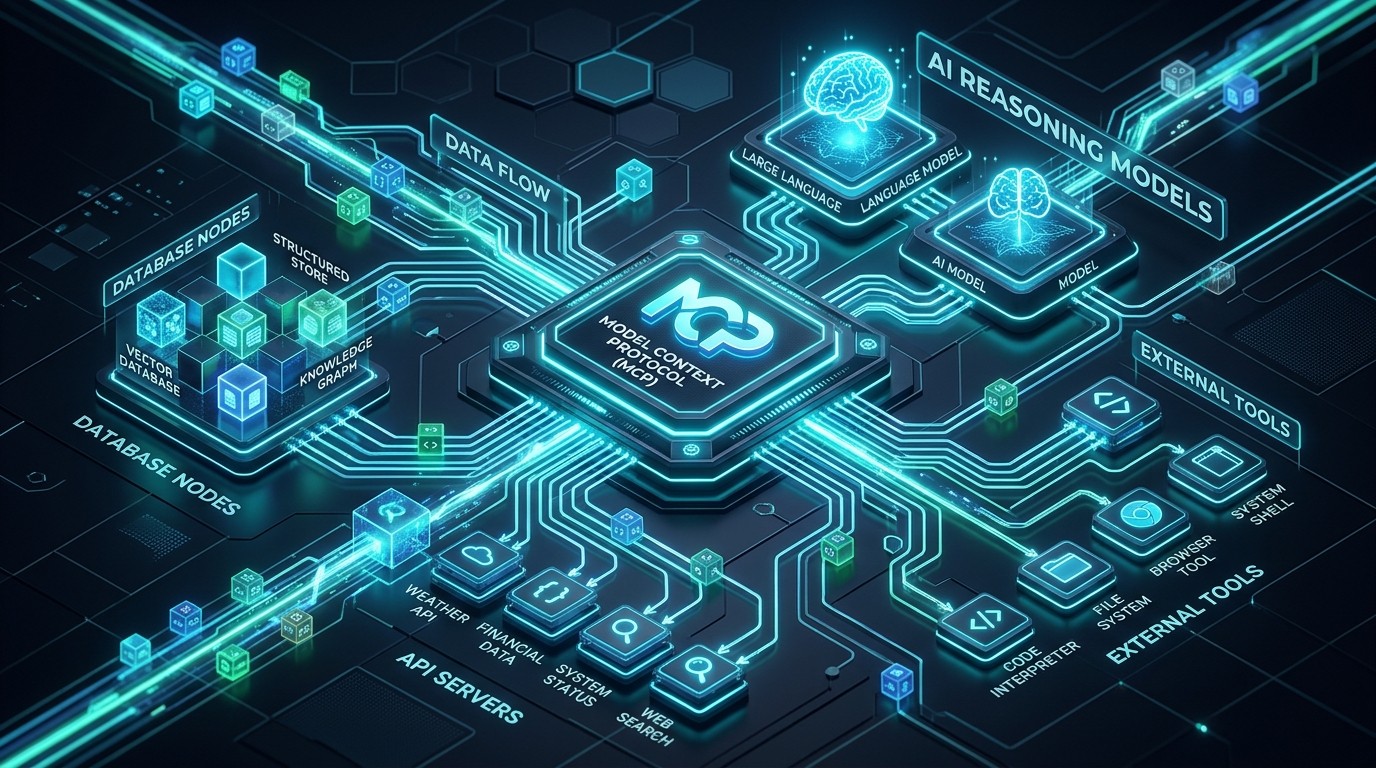
For years, integrating AI agents with real-world business tools was a nightmare of custom JSON schemas, proprietary function-calling wrappers, and brittle API integrations. In 2026, the Model Context Protocol (MCP) has emerged as the universal "USB-C standard" for AI, establishing an open protocol that seamlessly bridges LLMs with internal databases, private APIs, file systems, and enterprise SaaS.
Why MCP is Replacing Ad-Hoc Function Calling
Before MCP, every developer who wanted an LLM (whether Claude, GPT-4o, or Gemini) to interact with Postgres or GitHub had to write tailored function definitions, parse custom response formats, and constantly update schemas whenever the underlying API changed. If you wanted 5 different agents to talk to 10 different systems, you had to maintain 50 bespoke point-to-point connections.
MCP inverts this paradigm by decoupling Tool Providers (MCP Servers) from AI Hosts (MCP Clients). An engineering team creates an MCP Server for their internal PostgreSQL warehouse once, and any MCP-compliant client (Cursor, Claude Desktop, autonomous background swarms, or custom internal web apps) can immediately discover capabilities, execute authenticated queries, and retrieve structured context safely.
The Core MCP Value Proposition
Instead of N × M brittle point-to-point tool integrations, MCP establishes an N + M composable architecture with standardized JSON-RPC 2.0 communication, streaming SSE transports, and zero vendor lock-in.
The Three Pillars of MCP Architecture
The Model Context Protocol operates on three fundamental primitive types exposed by servers to client agents:
- Prompts: Pre-packaged, dynamic prompt templates and workflows that guide the AI through domain-specific tasks.
- Resources: Read-only contextual data streams (such as database schemas, markdown documentation, log files, or code diffs) that the model can inspect as context.
- Tools: Executable functions with typed input schemas that allow the LLM to take real actions in the world (e.g., executing SQL transactions, sending Slack notifications, or deploying microservices).
| Primitive | Direction | Primary Use Case | Enterprise Example |
|---|---|---|---|
| Resources | Server → Client | Passive context retrieval | Live CRM account dossiers, Git branch diffs |
| Tools | Client → Server | State-changing execution | Refund processing, database schema migrations |
| Prompts | Server → Client | Guided prompt templates | Incident post-mortem workflows, code review templates |
Building a Production MCP Server in TypeScript
Let's walk through building a resilient, schema-validated MCP Server using the official TypeScript SDK (@modelcontextprotocol/sdk). This server exposes a secure PostgreSQL read and analytical tool to our AI agents:
// server.ts - Production MCP Server with Zod Validation
import { Server } from "@modelcontextprotocol/sdk/server/index.js";
import { StdioServerTransport } from "@modelcontextprotocol/sdk/server/stdio.js";
import {
  CallToolRequestSchema,
  ListToolsRequestSchema,
  ListResourcesRequestSchema,
  ReadResourceRequestSchema
} from "@modelcontextprotocol/sdk/types.js";
import { z } from "zod";
import pg from "pg";

const pool = new pg.Pool({ connectionString: process.env.DATABASE_URL });

const server = new Server(
  { name: "enterprise-postgres-mcp", version: "1.0.0" },
  { capabilities: { tools: {}, resources: {} } }
);

// 1. List Available Tools
server.setRequestHandler(ListToolsRequestSchema, async () => {
  return {
    tools: [
      {
        name: "execute_safe_query",
        description: "Executes read-only analytical SQL queries with strict row limits",
        inputSchema: {
          type: "object",
          properties: {
            sqlQuery: { type: "string", description: "SELECT query to run" },
            limit: { type: "number", description: "Max rows (capped at 100)" }
          },
          required: ["sqlQuery"]
        }
      }
    ]
  };
});

// 2. Handle Tool Execution with Guardrails
server.setRequestHandler(CallToolRequestSchema, async (request) => {
  if (request.params.name === "execute_safe_query") {
    const { sqlQuery, limit = 50 } = request.params.arguments as { sqlQuery: string; limit?: number };

    // Strict Guardrail: Prevent mutations
    const trimmed = sqlQuery.trim().toLowerCase();
    if (!trimmed.startsWith("select") || trimmed.includes("insert") || trimmed.includes("drop") || trimmed.includes("delete")) {
      throw new Error("Security Violation: Only SELECT queries are permitted on this MCP endpoint.");
    }

    const client = await pool.connect();
    try {
      const sanitizedLimit = Math.min(limit, 100);
      const res = await client.query(`${sqlQuery} LIMIT $1`, [sanitizedLimit]);
      return {
        content: [{ type: "text", text: JSON.stringify(res.rows, null, 2) }]
      };
    } finally {
      client.release();
    }
  }
  throw new Error(`Tool not found: ${request.params.name}`);
});

// Start the stdio transport
const transport = new StdioServerTransport();
await server.connect(transport);
Enterprise Security & Sandboxing Patterns
Connecting autonomous LLMs directly to core infrastructure introduces substantial risk if not guarded by strict boundaries. In production enterprise environments, we implement three non-negotiable security layers:
- Least Privilege Scoping: MCP servers must run with read-only database roles and scoped OAuth 2.0 bearer tokens restricted exclusively to required endpoints.
- Deterministic Schema Validation: All tool inputs must undergo rigorous runtime type checks (e.g., via Zod or Pydantic) before touching backend execution engines.
- Human-in-the-Loop Interceptors: Destructive or financial operations (such as payments, bulk email dispatch, or DNS modifications) require an interactive confirmation token from a human supervisor before the MCP server commits the transaction.
"The true power of MCP is not just standardizing tool calls—it is creating an auditable, cryptographic boundary where security teams can inspect and revoke every autonomous agent interaction in real time."
MCP Transports: Stdio vs Server-Sent Events (SSE)
MCP supports two primary transport protocols depending on the deployment topology:
- Stdio (Standard Input/Output): Best for local developer tools, IDE extensions (Cursor, VSCode), and CLI utilities where the client spawns the MCP server as a child process. Zero networking overhead and instant startup.
- SSE (Server-Sent Events over HTTP): Essential for distributed cloud microservices, multi-tenant agent swarms, and remote serverless deployments. Enables asynchronous bi-directional streaming over standard HTTP/2 and HTTPS.
How Curious Kaizer Deploys MCP for Clients
At Curious Kaizer, we build custom MCP infrastructure for fast-growing startups and enterprises. Whether you are connecting your internal ERP to AI customer service swarms or giving your engineering team agentic database tools with complete audit logs, we architect hardened, sub-50ms MCP pipelines that scale reliably.