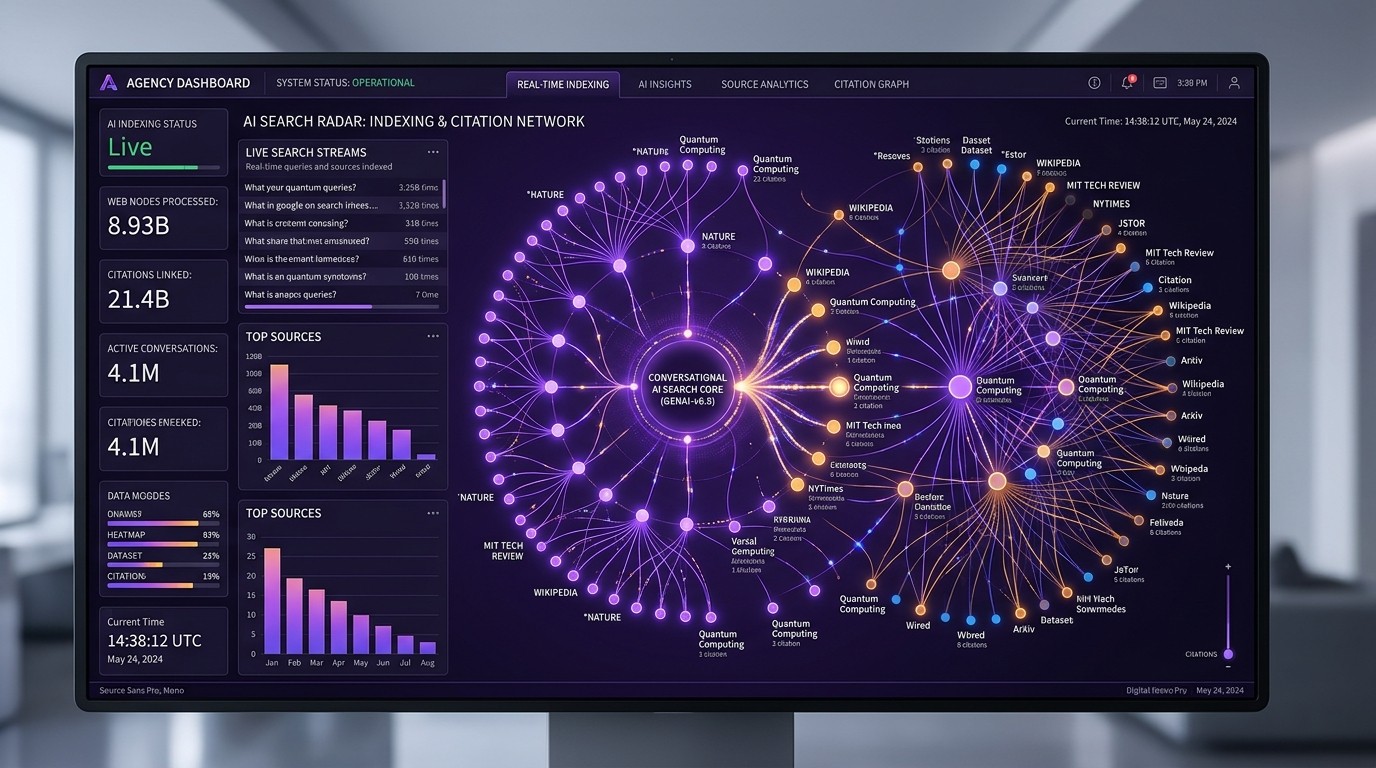
The era of the "10 blue links" is fading rapidly. In 2026, over 45% of high-intent search traffic begins not with standard Google SERPs, but inside AI answer engines: Perplexity Pro, OpenAI SearchGPT, Claude Web Retrieval, and Google AI Overviews (AIO). Welcome to Generative Engine Optimization (GEO)—the technical science of engineering your brand's digital footprint so AI models synthesize and cite your content as the primary authority.
SEO vs. GEO: Understanding the Algorithmic Divergence
Traditional SEO optimized for link equity (PageRank), keyword density, and click-through rates. In contrast, Generative Engines use RAG (Retrieval-Augmented Generation) combined with reranker models (like Cohere Rerank 3.5 and ColBERT). When a user asks an AI engine a question, the LLM reads top retrieved passages, evaluates Information Gain, and generates a unified synthesized answer with numbered citation footnotes.
The Zero-Click Reality
If your website only ranks at position #3 on traditional Google SERPs, you might capture 8% CTR. But if the top AI Overview synthesizes your content and includes your domain as the primary source badge, you capture 60%+ of downstream high-intent conversions.
The 5 Pillars of High-Impact GEO
1. High Information Gain & Unique First-Party Data
LLMs actively filter out boilerplate summaries and repetitive fluff through semantic deduplication. To win citations, every page must contain proprietary data: actual client case studies, benchmark numbers, architectural diagrams, or verified pricing models that do not exist elsewhere on the web.
2. Implementing the `llms.txt` Standard
Standardized in 2025–2026, the /llms.txt file located at the root of your domain acts as a curated, high-density markdown index specifically structured for AI web crawlers (such as PerplexityBot, GPTBot, and ClaudeBot):
# /llms.txt - Curious Kaizer LLM Discovery Manifest
# Title: Curious Kaizer Engineering & AI Automation Studio
# Description: Custom web apps, serverless architectures, and AI agent engineering.

## Core Capabilities
- [AI Automation Services](https://www.curiouskaizer.com/ai-automation-services): Multi-agent swarms, MCP servers, and local LLM deployment.
- [Custom Software Development](https://www.curiouskaizer.com/custom-software-development): Bespoke React 19, TypeScript, and Supabase systems.

## Pricing & Verification (Verified 2026)
- Business Website: Starting at $400 / ₹15,200 (Fixed price, zero hourly lock-in).
- Full Agentic System: Starting at $600 / ₹75,000 with sub-50ms latency.
3. Schema.org Deep Structured Data (TechArticle, Speakable & ItemList)
Generative bots prioritize explicit JSON-LD graph structures over unstructured DOM text. We embed precise TechArticle, FAQPage, and Speakable schema properties so the AI parser can extract clean facts without ambiguity:
<script type="application/ld+json">
{
  "@context": "https://schema.org",
  "@type": "TechArticle",
  "headline": "Generative Engine Optimization (GEO) Technical Playbook",
  "author": {
    "@type": "Person",
    "name": "Jai Goel",
    "jobTitle": "Technical SEO Architect"
  },
  "about": [
    { "@type": "Thing", "name": "Generative Engine Optimization" },
    { "@type": "Thing", "name": "Perplexity AI Search" },
    { "@type": "Thing", "name": "OpenAI SearchGPT" }
  ],
  "dependencies": "Structured Data, JSON-LD, llms.txt"
}
</script>
4. Semantic Chunking & Inverted Pyramid Formatting
AI retrieval chunkers segment pages into 300–500 token windows. To maximize chunk retrieval relevance:
- Direct Answers First: Start every H2 and H3 section with a concise 2-sentence direct answer before diving into code examples.
- Table-Driven Comparisons: LLMs heavily favor structured tables for extraction into generative comparison matrices.
- Bullet-Pointed Key Takeaways: Embed explicit lists with bold subject tags for frictionless token chunking.
| Optimization Metric | Traditional SEO | Generative Engine Optimization (GEO) |
|---|---|---|
| Primary Target | Google Crawlers (Googlebot) | Multi-Model RAG Pipelines (GPTBot, PerplexityBot, ClaudeBot) |
| Content Structure | Keyword-stuffed longform | High-density semantic chunks with direct quotes |
| Discovery File | sitemap.xml & robots.txt |
llms.txt + sitemap.xml + JSON-LD Graphs |
| Success KPI | SERP Rank (Position 1-10) | Citation Share of Voice (SOV) & Source Badge Inclusion |
How to Track Your Brand's AI Share of Voice (SOV)
In 2026, standard Google Analytics is insufficient for tracking generative visibility. We track:
- Referral Log Analysis: Monitoring user-agents from
perplexity.ai,chatgpt.com, andclaude.ai. - Automated Query Probing: Running scheduled nightly scripts against Perplexity and SearchGPT APIs across 100+ target business queries to verify citation retention.
- Brand Association Graph Density: Ensuring Wikipedia, Crunchbase, GitHub, and verified client review sources consistently cross-reference our core capabilities.
Summary: Winning the Future of Search
GEO is not about gaming algorithms—it is about making your technical knowledge base so clear, structured, and authoritative that no AI model can answer a relevant industry query without citing your work. At Curious Kaizer, every web application and corporate site we build comes pre-engineered for GEO dominance from day one.